 (+91) 842-700-1426
  agriparts@jcblmail.com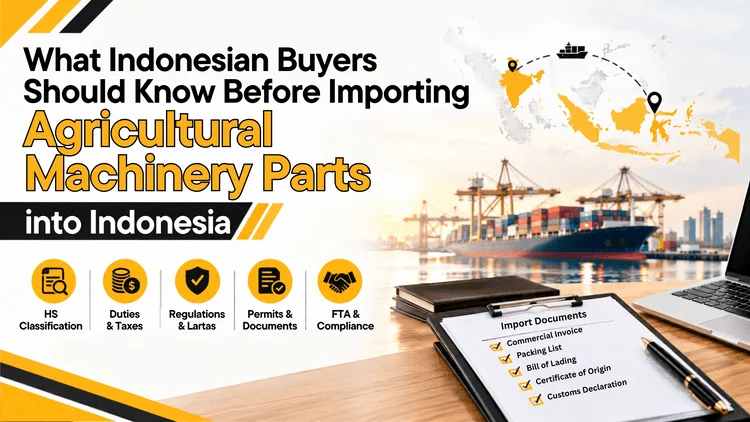
Importing agricultural machinery parts into Indonesia requires more than identifying the product and paying customs duty. The applicable import duty, taxes, tariff treatment, and regulatory requirements depend on the exact HS classification, customs value, country of origin, and whether the product is subject to import restrictions. For businesses importing agricultural machinery spare parts, the key is to confirm the correct BTKI/HS code and applicable import requirements before shipment. Indonesia’s tariff framework was updated by PMK No. 50 of 2026, effective July 28, 2026, while import policy rules were also amended by Permendag No. 18 of 2026. What Are the Import Duties and Regulations? There is no single import-duty rate for all agricultural machinery parts in Indonesia. The applicable rate depends primarily on the product’s correct HS/BTKI classification and the tariff regime that applies to the shipment. Importers should check: The Indonesia National Trade Repository (INTR) and Indonesian Customs resources provide tools for checking tariff, HS, Lartas, and trade-regulation information. What Are the Import Duties on Agricultural Machinery Parts in Indonesia? The first step is to determine the correct HS code under Indonesia’s BTKI. Agricultural machinery parts cannot be assigned a duty rate simply because they are described as “spare parts.” Their classification can depend on the part’s function, construction, material, and the machinery with which it is used. Indonesia uses the Buku Tarif Kepabeanan Indonesia (BTKI) as its tariff-classification framework. BTKI incorporates the international HS system and ASEAN Harmonised Tariff Nomenclature. How import duty is determined The basic calculation depends on: Import Duty = Customs Value × Applicable Import-Duty Rate For imports for use, Indonesian Customs states that the customs value used for calculating import duty is based on CIF (cost, insurance and freight). The applicable tariff can change depending on the tariff regime. For example, a shipment may be subject to the normal MFN rate or qualify for a preferential tariff under an FTA. Indonesia’s PMK No. 50 of 2026 amended the country’s classification and import-duty tariff framework and took effect on July 28, 2026. Therefore, importers should verify the tariff applicable at the time the PIB receives its registration number rather than relying on an old tariff table. What Taxes Apply When Importing Agricultural Machinery Parts? Import duty is only one part of the potential import tax cost. Depending on the shipment and applicable Indonesian tax rules, imports may also be subject to Pajak Dalam Rangka Impor (PDRI), which can include import-related VAT and income-tax collection. Indonesian Customs requires importers to calculate and settle applicable import duty and PDRI based on the information declared in the PIB. This means a buyer should not estimate the landed cost using the customs-duty percentage alone. A practical cost review should therefore consider: The exact tax treatment should be checked against the current tariff classification and Indonesian tax regulations applicable to the shipment. What Import Regulations Apply to Agricultural Machinery Parts? HS classification and BTKI Correct classification is central to both tariff and regulatory compliance. The HS/BTKI code can determine the applicable duty, taxes, Lartas requirements, and other import controls. Indonesian Customs notes that BTKI is used for tariff classification as well as the implementation of import restrictions and licensing requirements. Import restrictions (Lartas) Not every agricultural machinery part is automatically subject to an import restriction. Lartas requirements are product- and HS-specific. Indonesia’s import-policy framework was amended through Permendag No. 18 of 2026, effective June 4, 2026. KMK No. 40/MK/BC/2026 subsequently identifies goods subject to import restrictions under the amended framework and took effect July 4, 2026. Therefore, importers should check the exact HS code in the relevant Indonesian trade and customs systems before shipping. Preferential tariffs under FTAs If the agricultural machinery part originates from a country covered by an applicable Indonesian trade agreement, the shipment may qualify for a preferential import tariff. However, preferential treatment is not automatic. The goods must satisfy the applicable Rules of Origin (ROO), and the importer must provide the required proof of origin, such as a Certificate of Origin or another permitted origin declaration. Documents Required to Import Agricultural Machinery Parts The exact documentation depends on the product, HS code, origin, and applicable restrictions. Common customs documentation includes: Indonesian Customs specifically identifies invoice, packing list, transport documents, goods-identification documents, and documents proving compliance with import requirements among the supporting customs documents. How to Check Compliance Before Shipment For B2B importers, the safest approach is to complete the regulatory check before the goods leave the exporting country. Use this sequence: Product specifications → HS/BTKI classification → Import-duty rate → PDRI → Lartas check → FTA/origin check → Required documents → Shipment The INTR system is particularly useful because it provides information related to HS codes, Lartas, regulations, and rules of origin. Do not rely only on a supplier’s HS code. The Indonesian importer should verify whether the classification accurately describes the actual product being imported. Agricultural Machinery Parts Import Compliance Checklist Before shipping to Indonesia, confirm that: Conclusion Importing agricultural machinery parts into Indonesia requires a product-specific approach. The key compliance points are the correct BTKI/HS classification, applicable import duty and PDRI, Lartas requirements, FTA eligibility, and supporting documentation. Because Indonesian tariff and import-policy rules can change, businesses should verify the applicable requirements against the current official customs and trade databases before each shipment. This is particularly important for parts with complex technical specifications or potentially restricted classifications. FAQs