
 (+91) 842-700-1426
  agriparts@jcblmail.com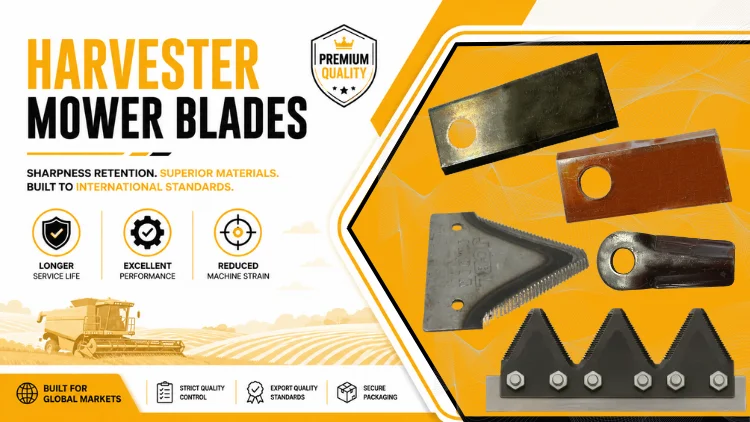
Harvesting efficiency depends not only on the machine itself, but also on the quality of the mower blades. A well-manufactured harvester mower blade delivers clean cuts, reduces machine strain, and lasts longer under demanding field conditions. Its performance is determined by three key factors: the blade material, the ability to retain a sharp cutting edge, and compliance with recognized quality and export standards.
This guide explains how these factors influence blade performance and what buyers should evaluate when sourcing harvester mower blades.
What Makes a High-Quality Harvester Mower Blade?
A high-quality harvester mower blade combines wear-resistant steel, precise heat treatment, accurate manufacturing, and consistent quality control. Together, these factors help the blade maintain its sharpness, resist impact and abrasion, and perform reliably across different harvesting conditions.
Why Sharpness Retention Matters
Sharpness retention is the blade’s ability to maintain an effective cutting edge throughout extended use. Instead of becoming dull after a short operating period, a blade with good edge retention continues delivering clean and efficient cuts.
The benefits include:
- Cleaner crop cutting with minimal plant damage
- Reduced machine vibration and cutting resistance
- Lower fuel or power consumption
- Less frequent blade replacement
- Reduced downtime during harvesting
- Improved overall field productivity
A blade that loses its edge quickly increases operating costs because it requires more frequent sharpening or replacement.
Best Materials Used for Harvester Mower Blades
The steel used in manufacturing directly affects durability, toughness, and cutting performance.
High Carbon Steel
High carbon steel is widely used because it provides an excellent balance of hardness and wear resistance. When properly heat-treated, it maintains a sharp edge while remaining cost-effective for regular agricultural operations.
Advantages
- Good edge retention
- High wear resistance
- Economical for large-scale production
Boron Steel
Boron steel contains small amounts of boron that significantly improve hardenability. This allows manufacturers to achieve higher strength without sacrificing toughness.
Compared with conventional carbon steel, boron steel generally offers:
- Better impact resistance
- Longer service life
- Improved resistance to abrasive wear
- Higher durability in demanding field conditions
Alloy Steel
Alloy steel incorporates elements such as chromium, manganese, or molybdenum to enhance mechanical properties.
It is commonly selected for heavy-duty harvesting applications where blades experience higher mechanical stress and repeated impacts.
How Heat Treatment Improves Blade Performance
Even premium steel cannot perform well without proper heat treatment.
Manufacturers typically use controlled hardening and tempering processes to achieve the right balance between hardness and toughness.
A correctly heat-treated blade offers:
- Better edge retention
- Increased wear resistance
- Reduced risk of cracking
- Improved impact strength
- Longer operational life
Excessive hardness can make a blade brittle, while insufficient hardness accelerates wear. The objective is to achieve a balanced microstructure that delivers reliable performance in combine harvester applications.
Quality Parameters Buyers Should Evaluate
Before ordering harvester mower blades in bulk, buyers should verify several quality characteristics instead of focusing only on price.
| Quality Parameter | Why It Matters |
| Steel grade | Determines durability and strength |
| Hardness consistency | Ensures uniform wear across the blade |
| Dimensional accuracy | Guarantees proper machine fitment |
| Edge geometry | Improves cutting efficiency |
| Hole positioning | Prevents installation issues |
| Surface finish | Helps reduce corrosion risk |
| Manufacturing consistency | Delivers reliable batch-to-batch quality |
Consistent manufacturing tolerances contribute to smoother machine operation and predictable blade performance.
Export Standards for Harvester Mower Blades
International buyers often assess suppliers based on manufacturing systems, testing procedures, and product consistency rather than price alone.
ISO-Compliant Quality Management
Many exporters operate under ISO 9001 quality management systems to ensure standardized production processes, documentation, and continuous quality improvement.
Material Verification
Reputable manufacturers verify the chemical composition of incoming steel to ensure it matches specified material grades before production begins.
Hardness Testing
Hardness testing confirms that heat treatment has achieved the desired mechanical properties. Consistent hardness across production batches helps ensure uniform performance.
Dimensional Inspection
Each blade should be inspected for:
- Thickness
- Length
- Width
- Hole diameter
- Hole spacing
- Straightness
Accurate dimensions help maintain compatibility with harvesting equipment.
Corrosion Protection
Export blades are commonly protected using anti-rust coatings, oil films, or moisture-resistant packaging to prevent corrosion during storage and international shipping.
Traceability
Leading manufacturers maintain batch identification records that allow products to be traced back to their production lot, material source, and inspection results. This improves quality assurance for international buyers.
How Harvester Mower Blades Are Tested
Quality testing helps ensure blades meet both performance and export requirements.
Common inspection procedures include:
- Chemical composition analysis
- Hardness testing
- Dimensional measurement
- Visual inspection for surface defects
- Edge consistency inspection
- Flatness and straightness verification
- Packaging inspection before shipment
These tests reduce the likelihood of manufacturing defects reaching customers.
How to Choose the Right Harvester Mower Blade
Selecting the correct blade requires matching the product to both the machine and the working environment.
Consider the following factors:
- Machine model and OEM specifications
- Blade dimensions and mounting pattern
- Crop type
- Field conditions
- Expected operating hours
- Required wear resistance
- Material grade
- Manufacturer’s quality control processes
Using incompatible blades may reduce cutting efficiency and accelerate machine wear.
Common Reasons for Premature Blade Wear
Even high-quality blades can wear quickly if operating conditions are unfavorable.
Common causes include:
- Contact with stones or hard obstacles
- Incorrect blade installation
- Operating at excessive speeds
- Poor-quality blade material
- Improper heat treatment
- Working in highly abrasive soil conditions
Routine inspection and timely replacement help maintain harvesting efficiency and protect the machine.
Conclusion
The performance of a harvester mower blade depends on more than its appearance. Steel quality, heat treatment, manufacturing precision, and quality inspection all contribute to sharpness retention and long-term durability. Choosing a reliable exporter or manufacturer that follows recognized quality standards is equally important. For buyers, evaluating these technical factors, along with adherence to recognized export quality practices, helps ensure reliable performance, lower maintenance costs, and consistent harvesting efficiency across a wide range of agricultural applications.
FAQs
High carbon steel and boron steel are among the most commonly used materials. Boron steel generally provides better wear resistance and toughness, while high carbon steel offers an excellent balance of performance and cost.
A blade that stays sharp for longer delivers cleaner cuts, reduces machine load, lowers replacement frequency, and improves harvesting productivity.
Yes. Proper heat treatment improves hardness, toughness, and wear resistance, allowing the blade to maintain its cutting edge for a longer period.
Manufacturers should verify material quality, hardness, dimensional accuracy, surface finish, corrosion protection, packaging, and batch traceability before dispatch.