
 (+91) 842-700-1426
  agriparts@jcblmail.com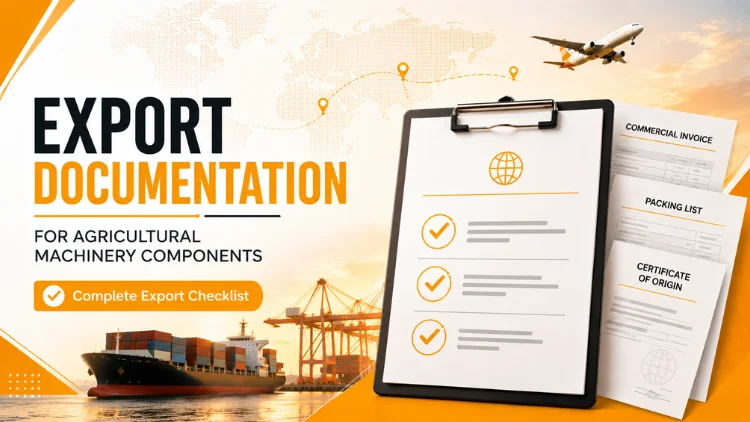
Exporting agricultural machinery components involves more than preparing products for shipment. Exporters must provide accurate commercial, customs, shipping, and compliance documents to ensure smooth international trade. Missing or incorrect paperwork can lead to customs delays, shipment holds, penalties, and additional costs.
This guide covers the essential export documentation required for agricultural machinery components and explains the purpose of each document.
What Documents Are Required to Export Agricultural Machinery Components?
The most common export documents required for agricultural machinery components include:
- Commercial Invoice
- Packing List
- Bill of Lading or Air Waybill
- Export Declaration
- Certificate of Origin
- Purchase Order or Sales Contract
- Insurance Certificate
- Inspection Certificate (if required)
- Product Compliance Certificates
- Export License (if applicable)
- Customs Clearance Documents
The exact documentation requirements may vary depending on the destination country, shipping method, product category, and applicable trade regulations.
Export Documentation Checklist for Agricultural Machinery Components
| Document | Purpose | Requirement |
| Commercial Invoice | Provides transaction and product details | Mandatory |
| Packing List | Lists shipment contents and packaging information | Mandatory |
| Bill of Lading/Air Waybill | Serves as proof of shipment | Mandatory |
| Export Declaration | Required for customs processing | Mandatory |
| Certificate of Origin | Confirms manufacturing country | Often Required |
| Compliance Certificates | Demonstrate regulatory compliance | Conditional |
| Inspection Certificate | Verifies product quality and specifications | Conditional |
| Insurance Certificate | Covers cargo risks during transit | Conditional |
| Export License | Required for restricted products | Conditional |
Key Export Documents Explained
1. Commercial Invoice
The commercial invoice is the primary document used by customs authorities to assess duties, taxes, and shipment value. It should include:
- Exporter and importer details
- Product description and quantity
- HS code
- Shipment value
- Country of origin
- Incoterms
Any mismatch between the invoice and other export documents can delay customs clearance.
2. Packing List
A packing list provides a detailed breakdown of the shipment and helps customs officials, freight forwarders, and buyers verify cargo information. It typically includes:
- Number of packages
- Net and gross weight
- Package dimensions
- Packaging type
- Item-wise quantity
The information should match the commercial invoice and shipping documents.
3. Bill of Lading or Air Waybill
A Bill of Lading (B/L) is used for sea freight, while an Air Waybill (AWB) is used for air shipments. These documents serve as proof that the carrier has received the goods for transportation.
Key details generally include:
- Shipper and consignee information
- Port or airport details
- Cargo description
- Shipment reference number
4. Export Declaration
An export declaration is submitted to customs authorities before goods leave the exporting country. It helps verify shipment information and ensures compliance with export regulations.
The declaration typically contains:
- Exporter details
- Product classification
- Shipment value
- Destination country
- Customs information
5. Certificate of Origin
A Certificate of Origin confirms the country where the agricultural machinery components were manufactured. Importing countries may require it for customs processing and duty assessment.
It is commonly used to:
- Verify product origin
- Support trade agreement claims
- Determine applicable tariff rates
6. Compliance Certificates
Certain countries may require documents showing that agricultural machinery components meet applicable quality, safety, or technical standards.
Examples include:
- Product test reports
- Manufacturer declarations
- Material certifications
- Industry-specific compliance documents
Requirements vary by destination market and product category.
7. Inspection Certificate
Some buyers or importing countries require a pre-shipment inspection certificate to verify that products meet agreed specifications before export.
The certificate may confirm:
- Product quality
- Quantity accuracy
- Technical specifications
- Compliance with purchase requirements
8. Insurance Certificate
An insurance certificate provides evidence that the shipment is covered against specified transit risks. It helps protect exporters and buyers from potential losses during transportation.
The document generally includes:
- Policy number
- Coverage value
- Insured goods
- Coverage period
9. Export License
Most agricultural machinery components can be exported without a license. However, products subject to export controls or trade restrictions may require government authorization.
Exporters should verify applicable regulations before shipping goods internationally.
Why Is HS Code Classification Important for Agricultural Machinery Components?
HS code classification is important because customs authorities use it to determine import duties, taxes, trade restrictions, and regulatory requirements. Incorrect HS codes can lead to customs delays, shipment rejections, compliance issues, and financial penalties.
Using the correct HS code helps ensure faster customs clearance and accurate trade documentation.
Country-Specific Documentation Requirements
United States
Exporters may need:
- Commercial Invoice
- Packing List
- Bill of Lading or Air Waybill
- Certificate of Origin (where applicable)
- Product compliance documentation
Importers may also request additional technical documentation depending on product specifications.
European Countries
Exporters should ensure:
- Accurate product classification
- Compliance documentation where required
- Technical product information
- Certificate of Origin when applicable
Certain machinery-related components may require additional regulatory documentation depending on their intended use.
Middle East and African Markets
Many importers and customs authorities commonly request:
- Commercial Invoice
- Packing List
- Certificate of Origin
- Inspection Certificate
- Shipping Documents
Specific requirements vary by country and local customs regulations.
Common Documentation Mistakes That Delay Agricultural Machinery Component Exports
Avoid these common errors:
- Incorrect HS code classification
- Mismatched invoice and packing list details
- Missing Certificate of Origin
- Incomplete customs declarations
- Inaccurate product descriptions
- Missing compliance documentation
- Incorrect shipment values
- Documentation inconsistencies across forms
Even minor documentation errors can result in customs inspections and shipment delays.
Best Practices for Export Documentation Management
To streamline agricultural machinery component exports:
- Verify destination-country requirements before shipment
- Use standardized document templates
- Maintain accurate product records
- Cross-check all shipment information before filing
- Store digital copies of export documents
- Conduct pre-shipment document reviews
- Stay updated on changing trade regulations
Proper documentation management helps reduce compliance risks and improves shipment efficiency.
Conclusion
Accurate export documentation is essential for the smooth international shipment of agricultural machinery components. Ensuring that customs, shipping, and compliance documents are complete and error-free can help minimize delays and support efficient global trade.
As a trusted supplier and exporter of agricultural machinery components, JCBL Agri is committed to delivering quality products and supporting export requirements for customers across international markets.
FAQs
The main export documents include a Commercial Invoice, Packing List, Bill of Lading or Air Waybill, Export Declaration, and Certificate of Origin. Depending on the destination country, exporters may also need compliance certificates, inspection certificates, insurance documents, or export licenses.
A Certificate of Origin is often required for customs clearance, tariff assessment, and trade agreement benefits. Requirements vary by destination country and importer specifications.
HS codes help customs authorities classify products, determine duties and taxes, and apply import regulations. Using the correct HS code helps prevent customs delays and compliance issues.
Some countries require compliance certificates to verify that agricultural machinery components meet applicable quality, safety, or technical standards. Requirements depend on the product and destination market.
Exporters can avoid delays by using accurate product descriptions, correct HS codes, complete export documents, and consistent information across all shipping and customs paperwork.