
 (+91) 842-700-1426
  agriparts@jcblmail.com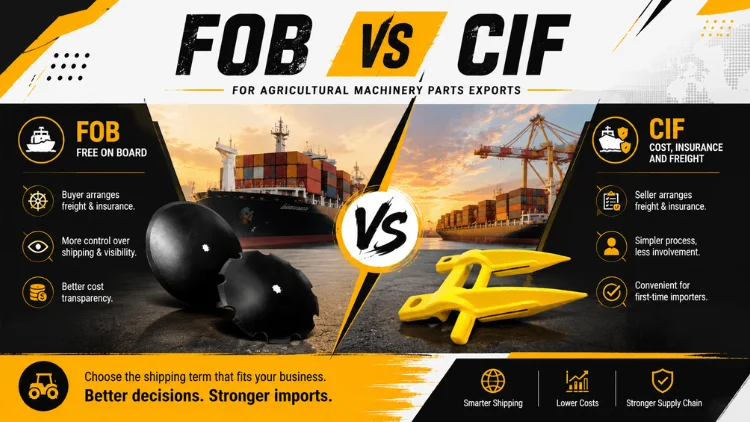
When importing agricultural machinery parts from India or other manufacturing countries, one of the most important decisions is choosing the right shipping term. The two most commonly used Incoterms for sea freight shipments are FOB (Free On Board) and CIF (Cost, Insurance and Freight).
The shipping term you select affects freight costs, insurance responsibilities, logistics control, shipment visibility, and overall landed costs. For agricultural machinery parts importers, understanding the difference between FOB and CIF is essential for building an efficient and cost-effective supply chain.
This guide explains FOB and CIF in simple terms, compares them in detail, and helps buyers determine which option best suits their import requirements.
What Is FOB in Agricultural Machinery Parts Exports?
FOB (Free On Board) is an international shipping term where the agricultural machinery parts exporter is responsible for delivering the goods to the designated port of shipment and loading them onto the vessel.
Once the cargo is loaded onto the ship, ownership risks transfer from the exporter to the importer. From that point onward, the buyer assumes responsibility for freight, insurance, and transportation to the final destination.
Exporter Responsibilities Under FOB
Under FOB terms, the exporter handles:
- Manufacturing and packaging of agricultural machinery parts
- Inland transportation to the port
- Export customs clearance
- Export documentation
- Port handling charges at origin
- Loading goods onto the vessel
Importer Responsibilities Under FOB
The importer is responsible for:
- Ocean freight booking
- Marine cargo insurance
- Destination port charges
- Import customs clearance
- Import duties and taxes
- Inland transportation after arrival
Benefits of FOB for Agricultural Machinery Parts Importers
- Greater Control Over Shipping: Importers can select their preferred freight forwarders, shipping lines, and logistics partners.
- Better Freight Cost Transparency: Buyers know exactly how much they are paying for transportation and insurance, helping them manage landed costs more accurately.
- Easier Supplier Consolidation: Many buyers source tractor utility parts, engine components, hydraulic systems, and transmission parts from multiple manufacturers. FOB makes it easier to consolidate shipments from different suppliers.
- Improved Supply Chain Visibility: Importers receive direct updates from their logistics providers, allowing better tracking and planning.
Limitations of FOB
- Requires logistics experience
- Importers must arrange freight and insurance
- More coordination is needed compared to CIF
What Is CIF in Agricultural Machinery Parts Exports?
CIF (Cost, Insurance and Freight) is a shipping term where the exporter arranges and pays for ocean freight and marine insurance up to the destination port.
The buyer receives a quotation that includes the product cost, freight charges, and insurance costs.
However, many importers misunderstand one important detail. Even under CIF terms, risk transfers to the buyer once the goods are loaded onto the vessel at the export port.
Exporter Responsibilities Under CIF
The exporter handles:
- Product manufacturing
- Packaging
- Export customs clearance
- Ocean freight booking
- Marine insurance arrangement
- Shipping documentation
Importer Responsibilities Under CIF
The importer remains responsible for:
- Import customs clearance
- Import duties and taxes
- Destination handling charges
- Inland transportation after arrival
Benefits of CIF for Agricultural Machinery Parts Importers
- Simplified Shipping Process: The exporter manages freight and insurance arrangements, reducing logistics involvement for the buyer.
- Convenient for First-Time Importers: Businesses new to importing agricultural equipment parts often find CIF easier to manage.
- Reduced Administrative Work: The buyer does not need to coordinate with multiple logistics providers.
- Single Point of Contact: Product sourcing and shipping arrangements are managed through one supplier.
Limitations of CIF
- Less visibility into freight costs
- Limited control over shipping carriers
- Potential freight markups
- Reduced logistics flexibility
FOB vs CIF for Agricultural Machinery Parts Exports: Detailed Comparison
While both shipping terms are widely used in agricultural machinery parts exports, they differ significantly in terms of logistics control, cost management, and buyer involvement.
- Freight Responsibility: Under FOB, the importer arranges and pays for ocean freight. Under CIF, the exporter arranges and pays for ocean freight to the destination port.
- Insurance Coverage: Under FOB, the importer purchases marine cargo insurance. Under CIF, the exporter arranges insurance coverage for the shipment.
Importers should always review the insurance coverage included in CIF quotations to ensure it meets their requirements. - Cost Control: FOB offers greater cost transparency because buyers negotiate directly with freight providers. CIF combines freight costs into the supplier’s quotation, making it more difficult to evaluate transportation expenses separately.
- Risk Transfer: One of the most misunderstood aspects of international trade is risk transfer. Under both FOB and CIF, risk transfers from the exporter to the importer once the goods are loaded onto the vessel at the port of shipment. The difference is not the transfer of risk but who arranges freight and insurance.
- Carrier Selection: FOB allows buyers to select their preferred shipping lines and freight forwarders. Under CIF, carrier selection is typically handled by the exporter.
- Shipment Visibility: FOB generally provides better shipment visibility because importers communicate directly with logistics providers. Under CIF, communication often passes through the exporter.
- Flexibility for Multiple Suppliers: Agricultural machinery parts importers often source components from several manufacturers. FOB offers greater flexibility for consolidating shipments from multiple suppliers into a single container, helping reduce transportation costs.
- Long-Term Cost Efficiency: For businesses importing regularly, FOB often delivers better long-term value through freight optimization and logistics control. For occasional buyers, CIF may provide convenience and operational simplicity.
FOB vs CIF: Quick Comparison Table
| Factor | FOB | CIF |
| Freight Booking | Buyer | Seller |
| Insurance Arrangement | Buyer | Seller |
| Freight Cost Visibility | High | Moderate |
| Shipping Control | High | Lower |
| Carrier Selection | Buyer | Seller |
| Shipment Visibility | High | Moderate |
| Risk Transfer | Loaded on Vessel | Loaded on Vessel |
| Best For | Experienced Importers | New Importers |
FOB gives importers greater control over freight costs, shipping partners, and logistics planning, while CIF offers a simpler purchasing process by allowing the exporter to arrange freight and insurance.
Which Shipping Term Is Better for Agricultural Machinery Parts Imports?
The right choice depends on the buyer’s logistics capabilities, shipment volume, and sourcing strategy.
Choose FOB If:
- You import agricultural machinery parts regularly
- You have established freight partners
- You want maximum cost transparency
- You source from multiple suppliers
- You want greater control over delivery schedules
Choose CIF If:
- You are importing for the first time
- You have limited logistics expertise
- You want a simpler buying process
- You prefer the supplier to manage freight arrangements
- You import smaller shipment volumes
For most established agricultural machinery parts importers, FOB is often the preferred choice because it provides greater flexibility and better control over transportation costs.
Why FOB Is Often Preferred for Agricultural Machinery Parts Exports
Agricultural machinery parts are often heavy, high-value industrial products that require careful transportation planning. Many global buyers prefer FOB because it allows them to:
- Optimize Freight Costs: Importers can compare shipping rates from multiple providers and select the most cost-effective solution.
- Consolidate Multiple Orders: FOB enables buyers to combine products from different agricultural machinery parts manufacturers into a single shipment.
- Improve Supply Chain Planning: Direct communication with freight partners improves shipment tracking and delivery coordination.
- Gain Better Logistics Control: Large importers often have preferred shipping networks and established freight agreements that reduce overall transportation costs.
How Agricultural Machinery Parts Exporters Help Buyers Choose Between FOB and CIF
Experienced agricultural machinery parts exporters understand that different buyers have different logistics requirements.
Reliable exporters typically assist buyers by:
- Providing both FOB and CIF quotations
- Explaining shipping cost differences clearly
- Supporting export documentation
- Coordinating shipment schedules
- Assisting with customs requirements
- Recommending suitable shipping options based on shipment size and destination
For international buyers sourcing agricultural machinery parts from India, comparing both FOB and CIF quotations can help identify the most efficient purchasing strategy.
Conclusion
FOB and CIF are the two most widely used shipping terms in agricultural machinery parts exports, but each serves a different purpose.
FOB offers greater control, freight transparency, and logistics flexibility, making it a preferred choice for experienced importers and high-volume buyers. CIF simplifies the shipping process by allowing the exporter to arrange freight and insurance, making it ideal for businesses with limited logistics experience.
Before choosing between FOB and CIF, importers should evaluate their freight capabilities, shipment volume, supply chain requirements, and total landed cost objectives. Selecting the right shipping term can improve cost efficiency, reduce logistics challenges, and support a more reliable agricultural machinery parts supply chain.
FAQs
Under FOB, the buyer arranges freight and insurance. Under CIF, the exporter arranges and pays for freight and insurance to the destination port.
Yes. CIF requires the exporter to arrange marine insurance for the shipment.
Under both FOB and CIF, risk transfers to the buyer once the goods are loaded onto the vessel at the port of shipment.
FOB is generally preferred by experienced importers, while CIF is often suitable for first-time buyers.
FOB may provide better long-term cost optimization because importers can negotiate freight rates directly, but the total cost depends on shipment size and logistics arrangements.