
 (+91) 842-700-1426
  agriparts@jcblmail.com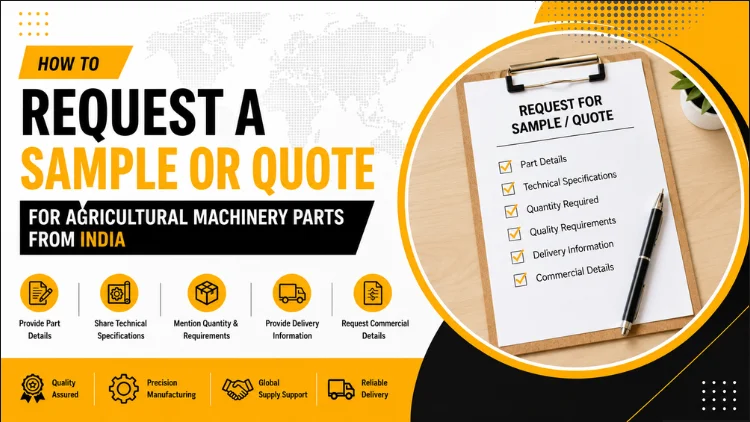
If you’re sourcing agricultural machinery parts from India, requesting a product sample or quotation is one of the most important steps before placing a purchase order. A well-prepared request helps manufacturers understand your requirements, provide accurate pricing, and recommend suitable production options.
Whether you’re looking for OEM agricultural parts, replacement farm machinery components, or custom-engineered solutions, providing complete technical information can help streamline the quotation process and reduce delays.
In this blog, you’ll learn how to request a sample or quote from an Indian agricultural machinery parts manufacturer, what information to include, and the key questions to ask before confirming your order.
Why Should You Request a Sample Before Ordering Agricultural Machinery Parts?
Requesting a sample allows buyers to verify product quality, dimensions, material, finish, compatibility, and manufacturing accuracy before placing a bulk order. It helps reduce sourcing risks and ensures the agricultural machinery parts meet the required specifications.
A product sample allows you to evaluate the following:
- Material quality and grade
- Dimensions and tolerances
- Surface finish and coating
- Component fitment and compatibility
- Overall workmanship
- Packaging quality (if applicable)
For customized agricultural machinery parts, samples also help confirm that the final product matches the approved drawings and technical requirements.
What Information Should You Include When Requesting a Quote?
Providing complete and accurate information enables manufacturers to prepare a precise quotation and recommend suitable production methods.
| Information Required | Why It Matters |
| Product name | Identifies the required agricultural machinery part |
| Part number (if available) | Prevents ordering errors |
| Technical drawing or CAD file | Defines dimensions and specifications |
| Material grade | Ensures the correct material is used |
| Quantity required | Determines pricing and production planning |
| Surface finish or coating | Meets application requirements |
| Delivery destination | Helps estimate shipping costs |
| Required certifications or standards | Supports compliance needs |
| Preferred delivery timeline | Assists production scheduling |
If you’re requesting custom agricultural machinery parts from India, including engineering drawings or reference samples can significantly improve quotation accuracy.
How to Request a Sample or Quote for Agricultural Machinery Parts from India
Following a structured approach helps manufacturers understand your requirements and respond efficiently.
1. Identify the Agricultural Machinery Part
Begin by specifying exactly what you need.
Include details such as:
- Product name
- Part number (if available)
- Equipment or machine model
- Intended application
The more specific the information, the easier it is for the manufacturer to identify the correct part.
2. Share Technical Specifications
Technical specifications help manufacturers evaluate production feasibility and prepare an accurate quotation.
Provide:
- Dimensions
- Material specifications
- Engineering drawings
- CAD files
- Product photographs
- Existing sample (if available)
For replacement agricultural machinery parts, reference images can also help verify compatibility.
3. Mention Your Quantity Requirements
Clearly specify whether you’re requesting:
- A prototype
- A product sample
- A small production batch
- A bulk order
Quantity directly influences production planning, pricing, and lead times.
4. Specify Quality Requirements
If your application requires specific manufacturing or material characteristics, include them in your request.
Examples include:
- Material grade
- Heat treatment requirements
- Surface finish
- Hardness requirements
- Dimensional tolerances
- Inspection or testing requirements
Providing these details early helps avoid revisions later in the quotation process.
5. Provide Delivery Information
Include your delivery destination so the manufacturer can estimate shipping costs and timelines.
Mention:
- Country
- City or postal code
- Preferred port (if applicable)
- Preferred shipping method
Complete delivery information allows suppliers to prepare more accurate commercial quotations.
6. Request Commercial Details
Ask the manufacturer to include the following information in the quotation:
- Unit price
- Minimum Order Quantity (MOQ)
- Sample availability
- Sample cost (if applicable)
- Tooling charges (for customized parts, if applicable)
- Production lead time
- Payment terms
- Packaging details
Reviewing these details helps you compare suppliers more effectively.
7. Review the Quotation Carefully
Before confirming your order, verify that the quotation includes:
- Correct product specifications
- Material details
- Quantity
- Pricing
- Lead time
- Shipping terms
- Payment conditions
If anything is unclear, request clarification before proceeding.
Documents That Can Help Speed Up the Quotation Process
Including supporting documents can help manufacturers understand your requirements more quickly.
Useful documents include:
- Technical drawings
- CAD files
- PDF specifications
- Product photographs
- Existing sample images
- Material specifications
- Bill of Materials (if applicable)
- Existing part numbers
Providing complete documentation can reduce back-and-forth communication and improve quotation accuracy.
Questions to Ask Before Approving the Quote
Before placing your order, consider asking:
- Is the material grade confirmed?
- Will the product be manufactured according to the provided drawings?
- What is the estimated production lead time?
- Can product samples be approved before mass production?
- What quality inspections are performed before dispatch?
- What packaging methods are available?
- Which shipping options are offered?
- Is customization available for future orders?
These questions help ensure both parties have a clear understanding of the project requirements.
Why Source Agricultural Machinery Parts from India?
India has become a preferred sourcing destination for agricultural machinery parts due to its established manufacturing capabilities and export experience.
Many Indian manufacturers offer:
- OEM and custom manufacturing support
- Precision machining and fabrication capabilities
- Production for small and large order volumes
- Competitive manufacturing costs
- Engineering support for customized components
- Experience supplying international markets
- Multiple shipping options for global buyers
Businesses sourcing agricultural equipment parts from India often look for reliable suppliers that can meet technical specifications while supporting consistent production and timely delivery.
Conclusion
Requesting a sample or quotation for agricultural machinery parts from India is an important step in the sourcing process. By providing complete technical specifications, quantity requirements, delivery details, and quality expectations, buyers can receive more accurate quotations and evaluate whether the parts meet their application needs. A well-prepared request also helps manufacturers respond efficiently, making the procurement process smoother for both parties.
FAQs
Yes. Many agricultural machinery parts manufacturers in India offer product samples before bulk production. Samples allow buyers to evaluate material quality, dimensions, compatibility, and workmanship before confirming larger orders.
An accurate quotation typically requires the product name, part number, technical drawings, material specifications, required quantity, delivery destination, and any quality or certification requirements.
The quotation timeline depends on product complexity and the information provided. Complete technical specifications generally enable manufacturers to prepare quotations more efficiently.
Yes. Many manufacturers in India support OEM and custom manufacturing based on customer drawings, CAD files, specifications, or physical samples.
Minimum order quantities vary depending on the manufacturer, product type, and production process. Buyers should confirm sample availability and MOQ during the quotation stage.
Pricing may depend on material grade, manufacturing process, product complexity, quantity ordered, tooling requirements, surface finish, packaging, and shipping destination.