
 (+91) 842-700-1426
  agriparts@jcblmail.com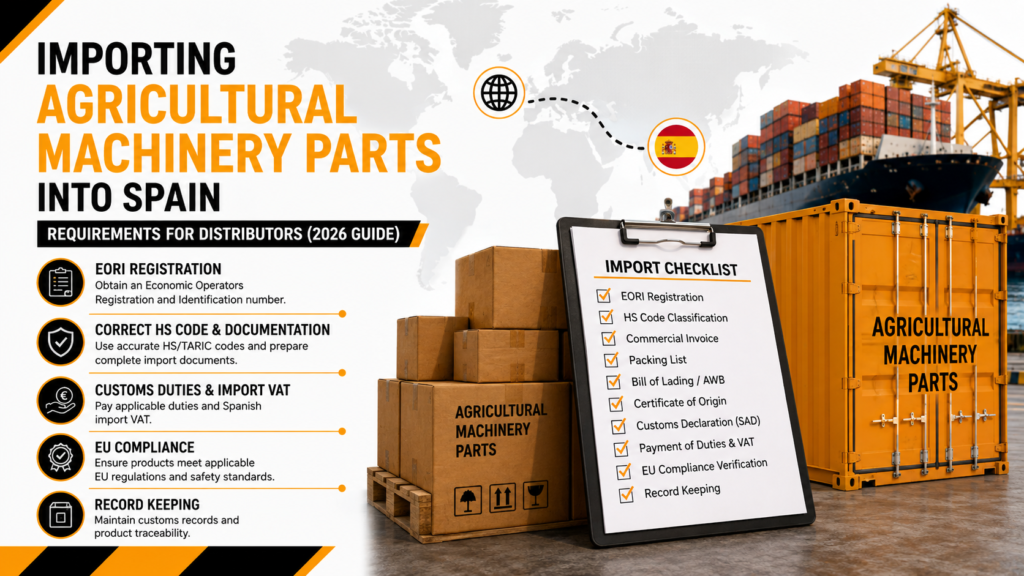
Spain is one of Europe’s leading agricultural economies, creating consistent demand for replacement parts for tractors, harvesters, irrigation systems, tillage equipment, and other agricultural machinery. For distributors sourcing parts from outside the European Union, successful importing involves more than selecting a reliable supplier; it requires compliance with EU customs regulations, Spanish import procedures, and applicable product safety requirements.
This blog explains the key requirements distributors should understand before importing agricultural machinery parts into Spain.
What Are the Requirements for Importing Agricultural Machinery Parts into Spain?
Distributors importing agricultural machinery parts into Spain should:
- Obtain an Economic Operators Registration and Identification (EORI) number.
- Classify products under the correct HS/TARIC code.
- Submit customs declarations with complete import documentation.
- Pay applicable customs duties and Spanish import VAT.
- Verify compliance with applicable EU product regulations.
- Maintain technical documentation and product traceability where required.
- Keep accurate customs and import records.
Meeting these requirements helps minimize customs delays and supports regulatory compliance when placing products on the Spanish market.
Why Spain Is an Important Market for Agricultural Machinery Parts
Spain has one of the largest agricultural sectors in the European Union, with extensive cultivation of cereals, olives, vineyards, fruits, and vegetables. This creates ongoing demand for replacement parts that help maintain agricultural equipment throughout its operational lifecycle.
For international manufacturers and exporters, Spain offers opportunities to supply distributors serving:
- Agricultural equipment dealers
- Farm machinery repair businesses
- OEM replacement markets
- Independent aftermarket suppliers
- Agricultural service providers
As imported goods can generally circulate throughout the EU after customs clearance, Spain also serves as a strategic entry point for businesses supplying broader European markets.
Key Legal Requirements for Spanish Distributors
Obtain an EORI Number
Businesses importing agricultural machinery parts from outside the EU must obtain an Economic Operators Registration and Identification (EORI) number before completing customs procedures.
The EORI serves as the importer’s identification number for customs authorities across the European Union and is required for submitting import declarations.
Understand Importer Responsibilities
A distributor importing products from a non-EU country often becomes the importer of record, which carries additional responsibilities beyond product distribution.
Depending on the product, importers may need to verify that:
- Manufacturer information is available.
- Required conformity assessments have been completed.
- Technical documentation can be provided when requested.
- Products comply with applicable EU legislation before being placed on the market.
Customs Requirements for Importing Agricultural Machinery Parts into Spain
Correct Product Classification
Every imported agricultural machinery part must be classified using the appropriate HS/TARIC code.
Accurate classification determines:
- Applicable customs duties
- Import requirements
- Trade measures
- Eligibility under EU trade agreements
Incorrect product classification may result in customs delays, reassessment of duties, or administrative penalties.
Common agricultural machinery parts requiring classification include:
- Tractor components
- Hydraulic pumps
- PTO parts
- Bearings
- Engine components
- Filters
- Transmission parts
- Cultivation equipment components
Customs Declaration
Imports entering Spain require a customs declaration supported by accurate shipment information.
Typical customs data include the following:
- Product description
- HS/TARIC code
- Country of origin
- Customs value
- Quantity and weight
- Transport details
- Importer information
- Commercial invoice details
Spain uses the Single Administrative Document (SAD) for customs declarations on imports from non-EU countries.
Documents Required for Customs Clearance
Preparing complete documentation helps avoid unnecessary customs delays.
Distributors should typically have:
- Commercial invoice
- Packing list
- Bill of lading, Air Waybill, or CMR (depending on transport mode)
- Customs declaration (SAD)
- EORI number
- Certificate of origin (where applicable)
- Insurance documents (if applicable)
- Technical documentation for regulated products
Additional documentation may be required depending on the specific agricultural machinery part being imported.
Customs Duties and Import VAT
Customs Duties
Import duties are not fixed for all agricultural machinery parts. The applicable duty depends on factors such as:
- HS/TARIC classification
- Country of origin
- Applicable EU preferential trade agreements
Using the correct tariff classification before shipment helps distributors estimate landed costs more accurately.
Import VAT
Agricultural machinery parts imported into Spain are generally subject to Spanish import VAT during customs clearance.
VAT-registered businesses may typically recover import VAT according to applicable Spanish tax regulations, making accurate documentation essential for tax reporting.
EU Compliance Requirements for Agricultural Machinery Parts
Not every agricultural machinery part is subject to the same regulatory requirements.
Compliance obligations depend on factors such as whether the imported product is:
- A standard replacement spare part
- A safety-related component
- An electrical or electronic component
- A product covered by specific EU harmonisation legislation
Where applicable, distributors should verify that products include the required documentation before placing them on the market.
Technical Documentation
For regulated products, importers should ensure that appropriate documentation is available, including:
- Product identification details
- Manufacturer information
- Technical documentation
- EU Declaration of Conformity where required
- Safety information and instructions, if applicable
It is important to note that not all agricultural machinery parts require CE marking. Whether CE marking applies depends on the specific product and the relevant EU legislation.
Product Traceability and Record-Keeping
Maintaining accurate records supports regulatory compliance and helps manage product recalls or market surveillance requests.
Distributors should maintain records relating to:
- Suppliers
- Imported shipments
- Product identification
- Customs declarations
- Technical documentation where applicable
- Distribution records
A structured record-keeping system also improves supply chain transparency and audit readiness.
Common Compliance Mistakes to Avoid
Many import issues can be avoided with proper planning.
Common mistakes include:
- Using an incorrect HS/TARIC code.
- Importing goods without an EORI number.
- Providing incomplete customs documentation.
- Declaring inaccurate customs values.
- Assuming every agricultural machinery part has identical compliance requirements.
- Failing to retain technical documentation where required.
- Overlooking applicable EU product legislation before placing products on the Spanish market.
Choosing a Reliable International Supplier
Compliance begins with selecting a supplier experienced in international exports.
When evaluating suppliers, distributors should look for partners that can provide:
- Consistent product specifications
- OEM-quality replacement parts
- Complete export documentation
- Product traceability support
- International shipping experience
- Reliable packaging for overseas transportation
Working with suppliers familiar with EU import requirements can help reduce documentation errors and improve customs clearance efficiency.
Conclusion
Importing agricultural machinery parts into Spain requires more than arranging international shipping. Distributors must ensure compliance with EU customs procedures, obtain an EORI number, accurately classify products, prepare complete documentation, and verify applicable product compliance requirements before placing goods on the Spanish market.
Establishing robust import processes and partnering with experienced suppliers can help distributors streamline customs clearance, reduce compliance risks, and maintain a reliable supply chain for Spain’s growing agricultural equipment aftermarket.
Disclaimer: This article is for general informational purposes only and does not constitute legal, customs, or tax advice. Import requirements may vary depending on the specific agricultural machinery parts, country of origin, and applicable EU and Spanish regulations. Distributors should consult customs authorities or qualified trade professionals before importing.
FAQs
Yes. Businesses importing goods from outside the European Union into Spain generally require an EORI number to complete customs procedures.
Typical documents include a commercial invoice, packing list, transport document, customs declaration, EORI number, and, where applicable, a certificate of origin and technical documentation.
Not all spare parts require CE marking. Whether CE marking applies depends on the specific product and the relevant EU legislation governing that product category.
In many cases, VAT-registered businesses may recover import VAT in accordance with Spanish tax regulations, subject to applicable requirements.
Distributors can minimize delays by obtaining an EORI number, using the correct HS/TARIC classification, preparing complete documentation, verifying product compliance requirements, and maintaining accurate shipment records.