
 (+91) 842-700-1426
  agriparts@jcblmail.com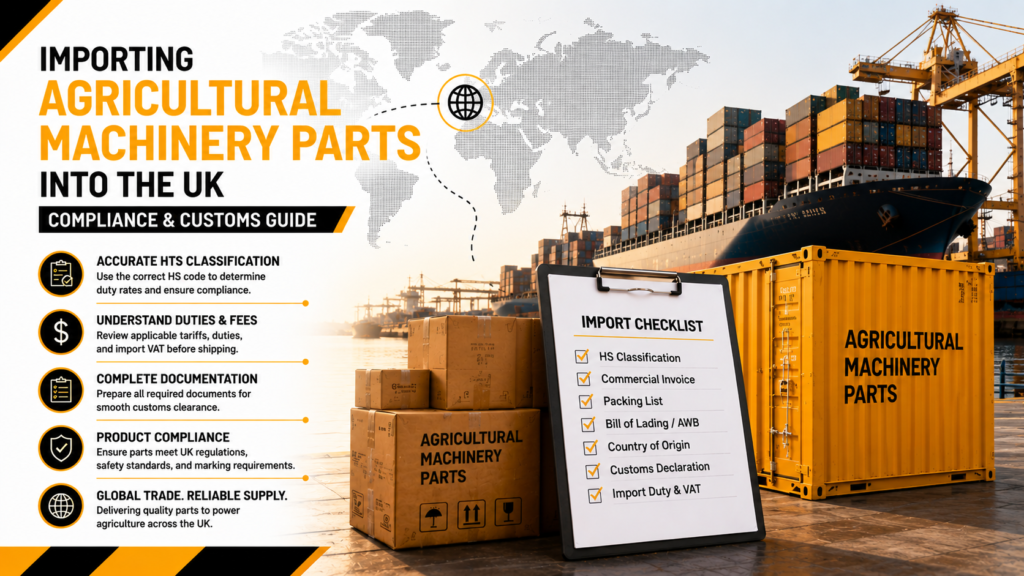
Importing agricultural machinery parts into the UK involves more than sourcing quality components. Businesses must comply with UK customs procedures, classify products correctly, prepare the required documentation, and understand applicable duties, VAT, and product compliance requirements. Whether you’re an importer, distributor, OEM buyer, or agricultural equipment supplier, following the correct import process can help avoid customs delays and unexpected costs.
This blog explains the key compliance and customs requirements for importing agricultural machinery parts into the UK.
How do you import agricultural machinery parts into the UK?
To import agricultural machinery parts into the UK, businesses typically need a GB EORI number, the correct commodity code, commercial shipping documents, and a customs declaration submitted through the Customs Declaration Service (CDS). Applicable customs duty and import VAT must be paid, and imported products must meet relevant UK compliance requirements before customs clearance.
Agricultural Machinery Parts Commonly Imported into the UK
The UK imports a wide range of replacement parts and components for agricultural equipment, including:
- Tractor spare parts
- Harvester components
- Hydraulic cylinders and pumps
- Bearings and bushings
- PTO shafts
- Gearboxes and transmission parts
- Engine components
- Filters
- Electrical components
- Agricultural implement parts
The exact customs requirements may vary depending on the product’s classification and intended use.
Key Import Requirements
Before importing agricultural machinery parts into Great Britain, businesses should ensure they have the following:
GB EORI Number
A UK Economic Operators Registration and Identification (EORI) number is generally required for businesses importing goods into Great Britain. Customs authorities use the EORI number to identify importers throughout the customs process.
Correct Commodity Code
Every imported product must be classified using the appropriate commodity (HS) code. This classification determines:
- Customs duty
- Import VAT treatment
- Licensing requirements (where applicable)
- Customs procedures
- Statistical reporting
Using an incorrect commodity code may result in customs delays, incorrect duty calculations, or rejected declarations.
Customs Declaration
Import declarations are submitted through the UK’s Customs Declaration Service (CDS), either directly by the importer or through a customs broker or freight forwarder.
Required Import Documentation
Preparing complete and accurate documentation helps streamline customs clearance.
| Document | Purpose |
| Commercial Invoice | Declares the value and description of goods |
| Packing List | Details shipment contents and packaging |
| Bill of Lading or Air Waybill | Confirms transportation of goods |
| Customs Declaration | Required for customs clearance |
| Certificate of Origin (where applicable) | Supports claims for preferential tariff treatment under eligible trade agreements |
| Insurance Certificate (if applicable) | Provides evidence of cargo insurance |
Depending on the product and shipment, customs authorities may request additional supporting documents.
Commodity Codes: Why They Matter
Commodity codes are one of the most important aspects of importing agricultural machinery parts into the UK.
These codes determine how customs authorities classify imported products and directly affect:
- Customs duty rates
- Import VAT calculations
- Trade restrictions
- Licensing requirements
- Customs documentation
Agricultural machinery parts do not share a single commodity code. Components such as hydraulic systems, engine parts, filters, or transmission assemblies are classified separately. Importers should always verify the correct commodity code before shipment using the UK Trade Tariff.
Customs Duty and Import VAT
Customs Duty
There is no universal customs duty rate for agricultural machinery parts.
The applicable duty depends on several factors, including:
- Commodity code
- Country of origin
- Customs value
- Applicable UK trade agreements
Some products may qualify for reduced or preferential tariff treatment if they meet the relevant rules of origin under an eligible UK trade agreement.
Import VAT
Import VAT is generally calculated using the customs value of the goods together with any applicable customs duty and eligible import costs.
VAT treatment may differ depending on the imported product and the importer’s tax status. Businesses should confirm the latest VAT requirements before importing.
Product Compliance Requirements
Import compliance extends beyond customs clearance. Certain agricultural machinery parts may also be subject to UK product regulations.
Depending on the component being imported, businesses may need to consider:
- Product safety requirements
- Technical documentation
- UKCA or accepted CE conformity marking (where applicable)
- Material or chemical restrictions
- Manufacturer instructions and declarations
Not every agricultural spare part requires the same compliance measures. Importers should evaluate the specific regulatory requirements applicable to each product category before shipment.
UK Customs Clearance Process
A typical import process follows these steps:
- Source agricultural machinery parts from a qualified supplier.
- Confirm the correct commodity code.
- Prepare the commercial invoice, packing list, and transport documents.
- Arrange shipping to the UK.
- Submit the customs declaration through CDS.
- Customs assesses applicable duties and VAT.
- Goods are released following successful customs clearance.
- Shipment is delivered to the importer.
Accurate documentation and product classification help minimize delays during this process.
Common Customs Challenges
Many import delays result from preventable documentation or classification issues.
Some of the most common challenges include:
- Incorrect commodity codes
- Missing or incomplete commercial invoices
- Errors in customs declarations
- Incorrect customs valuation
- Missing country of origin documentation
- Failure to meet applicable product compliance requirements
Reviewing shipping documents before dispatch can significantly reduce clearance issues.
Best Practices for Importers
Businesses importing agricultural machinery parts into the UK can improve compliance by following these best practices:
- Verify commodity codes before every shipment.
- Confirm whether products qualify for preferential tariff treatment.
- Prepare complete commercial documentation before dispatch.
- Understand the agreed Incoterms and responsibility for customs charges.
- Work with experienced customs brokers or freight forwarders for complex shipments.
- Maintain organized records of customs declarations and import documentation for future audits.
These practices help improve supply chain efficiency while reducing the risk of customs delays.
Conclusion
Importing agricultural machinery parts into the UK requires careful attention to customs compliance, product classification, documentation, and regulatory obligations. By obtaining the appropriate GB EORI number, using the correct commodity codes, preparing accurate shipping documents, and understanding customs duty, VAT, and product compliance requirements, businesses can improve customs efficiency and reduce the risk of costly delays.
Working with experienced suppliers and maintaining accurate import records further supports smooth cross-border trade and helps importers build a reliable supply chain for agricultural machinery parts.
FAQs
Yes. Most businesses importing goods into Great Britain require a GB EORI number before submitting customs declarations.
Not necessarily. Customs duty depends on the product’s commodity code, country of origin, customs value, and whether any applicable UK trade agreement provides preferential tariff treatment.
Businesses typically need a commercial invoice, packing list, transport document, customs declaration, and, where applicable, a certificate of origin or additional supporting documentation.
Some products may require UKCA marking or other compliance measures depending on their classification and applicable UK regulations. Requirements vary by product.
Yes. Many businesses appoint customs brokers or freight forwarders to prepare customs declarations and manage import formalities on their behalf.