Importance of Material Hardness in Heavy-Duty Farm Equipment Components

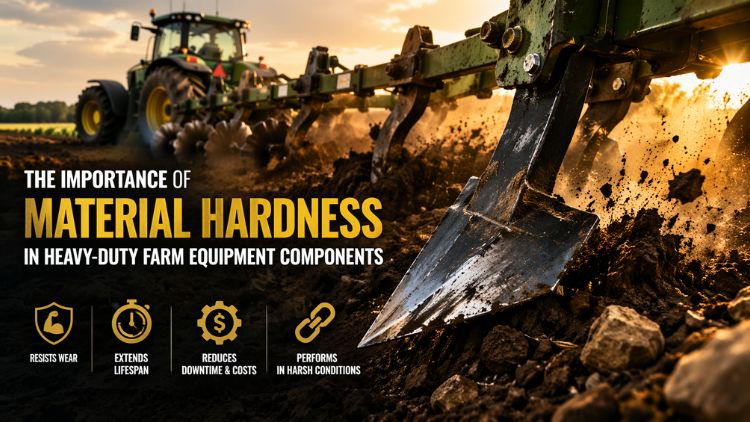
In modern agriculture, downtime isn’t just inconvenient; it’s expensive. During a critical 7–10 day planting window, equipment failure can cost thousands of dollars per hour in lost yield potential. When a plowshare wears out, or a cultivator tine shatters mid-operation, the root cause, like incorrect material hardness, is often overlooked. Today’s high-horsepower tractors and advanced machinery place significantly greater stress on components than older equipment ever did. This makes material hardness more critical now than ever before. From resisting soil scouring to maintaining edge retention under constant shearing forces, material hardness determines whether your equipment survives the field or fails in it. What is Material Hardness? Material hardness is the ability of a material to resist wear, deformation, and surface damage under mechanical stress such as friction, impact, and pressure. It is commonly measured using standardized scales: Material hardness is the measure of a material’s resistance to wear, deformation, and surface damage, typically expressed in HRC or HB scales. Why Material Hardness is Critical in Heavy-Duty Farm Equipment 1. Resistance to Abrasive Soil Conditions Agricultural fields often contain sand, stones, and debris that constantly grind against equipment surfaces. Components with higher hardness: 2. Ability to Withstand Heavy Loads and Impact Farm machinery like tractors and tillage tools experience repeated impact and high stress. Proper hardness ensures: 3. Extended Component Lifespan Harder materials wear slower, which leads to: 4. Reduced Downtime and Maintenance Costs Frequent breakdowns can halt operations during critical farming periods. Optimal hardness: 5. Consistent Performance in Harsh Environments Equipment must perform reliably across: Proper hardness ensures consistent efficiency regardless of the environment. Real-World Impact: Where Hardness Makes a Difference Material hardness directly affects the performance of key farm equipment components: Insight: Even a small increase in hardness can significantly reduce wear rates in high-contact components. Consequences of Incorrect Material Hardness Choosing the wrong hardness level can lead to serious operational issues: If the material is Too Soft: If Material is Too Hard: Key Takeaway: Incorrect hardness doesn’t just reduce performance-it can cause complete equipment failure. The Balance Between Hardness and Toughness While hardness improves wear resistance, toughness ensures the material can absorb impact without breaking. Example: Best practice: Use a balanced combination of hardness and toughness based on application conditions. Material Selection: Why Alloy Choice Matters Not all steels are equal. Industry-preferred materials include: Boron Steel Manganese Steel Why They Are Gold Standard How Manufacturers Achieve Optimal Hardness To ensure components perform reliably, manufacturers use controlled processes such as the following Heat Treatment Techniques Surface Hardening Methods These processes allow manufacturers to: How to Choose the Right Hardness for Farm Equipment Components Selecting the correct hardness depends on real-world usage conditions: Key Factors to Consider: Selection Checklist Why Hardness Directly Impacts Cost Efficiency In real-world farming operations, material hardness has a measurable economic impact: Investing in correctly hardened components upfront significantly reduces long-term operational expenses. Conclusion Material hardness is not just a technical specification; it is a critical factor that determines the durability, efficiency, and cost-effectiveness of heavy-duty farm equipment. From resisting abrasive soil conditions to maintaining structural integrity under heavy loads, the right hardness ensures that components perform reliably over time. However, achieving the correct balance between hardness and toughness is essential to avoid premature wear or sudden failure. Selecting the right material hardness is a strategic decision that directly impacts equipment lifespan, maintenance costs, and overall farming productivity. FAQs

Heat Treatment Process in Agricultural Blades & Implement Parts

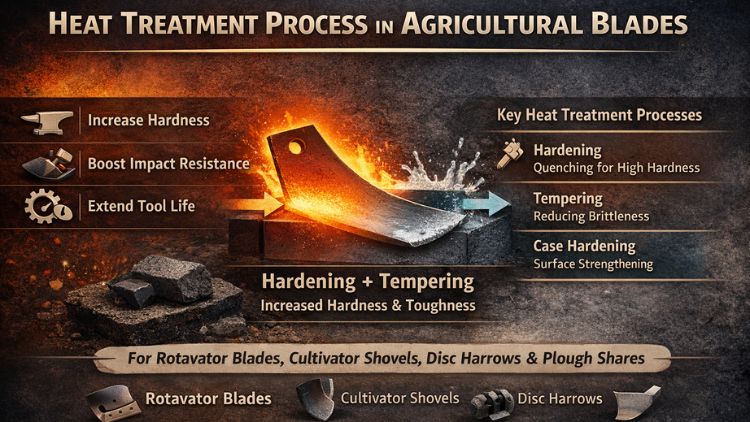
Heat treatment in agricultural blades is a controlled process of heating and cooling steel to improve hardness, wear resistance, and toughness. It ensures longer blade life, better edge retention, and reliable performance in abrasive soil conditions. Key Takeaways Why Heat Treatment is Important for Agricultural Blades Heat treatment is important because it improves wear resistance, impact strength, and service life of agricultural blades operating in abrasive soil conditions. In abrasive field conditions, poorly heat-treated blades can lose up to 30–40% of their service life, making controlled heat treatment essential for consistent performance. Metallurgical Science Behind Heat Treatment At the core of heat treatment is phase transformation in steel: The goal is not maximum hardness, but optimized microstructure for real-world agricultural loads. What Are the Main Types of Heat Treatment Processes Used? 1. Hardening (Quenching) 2. Tempering 3. Case Hardening (Carburizing / Nitriding) 4. Normalizing Quick Comparison of Heat Treatment Methods Process Primary Purpose Key Benefit Typical Use in Agri Parts Hardening Increase hardness High wear resistance Blade edges Tempering Reduce brittleness Improved toughness Post-hardening treatment Case Hardening Surface strengthening Hard surface + tough core High-impact components Normalizing Grain refinement Uniform structure Pre-treatment stage Industrial Heat Treatment Process (Step-by-Step) Here is a step-by-step process of heat treatment: Step 1: Raw Material Inspection The process starts by verifying the steel’s chemical composition to ensure it meets the required specifications for heat treatment performance.Process Highlights: Step 2: Controlled Heating Components are heated to the required austenitizing temperature using controlled furnace systems to prepare the material for transformation.Process Highlights: Step 3: Soaking The material is held at the target temperature to ensure uniform heat distribution throughout the entire component.Process Highlights: Step 4: Quenching The heated components are rapidly cooled to form a hardened structure, directly influencing final hardness and strength. Process Highlights:  Step 5: Tempering After quenching, the steel is reheated to reduce brittleness and improve toughness for real-world applications.Process Highlights: Step 6: Post-Treatment Testing Final inspection ensures the components meet required mechanical and dimensional standards before use.Process Highlights: What Are the Benefits of Heat Treatment in Agricultural Parts? Heat treatment improves agricultural parts by increasing wear resistance, strength, fatigue life, and edge stability, while reducing overall operating and replacement costs. Where Are Heat-Treated Components Used in Agricultural Equipment? Heat-treated components are used in soil-engaging agricultural tools where high wear resistance, impact strength, and durability are required. Heat-treated components are critical in: These parts require precision-engineered hardness profiles to perform effectively across varying soil conditions. What Are the Key Industry Standards and Quality Parameters? Key heat treatment standards focus on hardness, case depth, and microstructure consistency, supported by strict quality control practices to ensure reliable performance. Key Parameters: Quality Practices: Globally accepted frameworks such as those from the International Organization for Standardization guide process consistency and quality assurance. What Are the Common Challenges in Heat Treatment? Heat treatment must be precisely controlled, as even minor variations in temperature, cooling rate, or timing can lead to performance issues and reduced component life. Maintaining process precision, automation, and metallurgical expertise is essential to ensure consistent and reliable results. Conclusion Heat treatment is a core engineering process that defines the performance, durability, and reliability of agricultural blades and implements. Optimizing the internal structure of steel, it enables components to withstand extreme field conditions while maintaining consistent efficiency and performance over time. For B2B buyers, sourcing from a manufacturer with strong metallurgical control and well-defined heat treatment processes is critical. It ensures superior product performance, reduces overall lifecycle costs through longer service life, and delivers long-term operational reliability across demanding agricultural applications. FAQs

Quality Testing Standards for Agricultural Machinery Components: Complete Compliance & Testing Guide

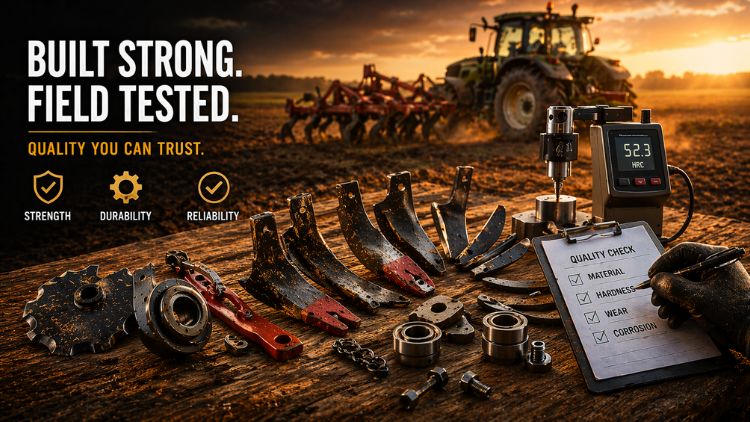
Agricultural machinery components operate under extreme conditions, including constant soil abrasion, heavy loads, vibration, moisture exposure, and long working hours. Unlike controlled industrial environments, farm conditions are unpredictable, making component reliability essential for consistent performance. Even a single component failure, such as a worn-out rotavator blade, a cracked cultivator tine, or a corroded fastener, can disrupt operations, increase downtime, and lead to significant productivity and financial losses. Quality testing standards for agricultural machinery components ensure that parts are tested for strength, durability, and performance, helping manufacturers deliver reliable components that perform consistently in real-world field conditions. What Are Quality Testing Standards for Agricultural Machinery Components? Quality testing standards are defined frameworks such as ISO, BIS, and ASTM that specify how agricultural machinery components should be tested for mechanical strength, material composition, environmental resistance, and performance reliability using standardized procedures and measurable parameters. Why are quality testing standards important in agricultural machinery? Quality testing standards are important because they ensure components can withstand mechanical stress, soil abrasion, and environmental exposure, reducing failure risk and improving reliability, safety, and long-term performance in field conditions. In agricultural applications, failure is often not gradual; it is sudden and operationally disruptive. Quality testing helps manufacturers and buyers ensure the following: From a B2B perspective, testing is not just quality control; it is a risk management tool for both manufacturers and buyers. Key Quality Testing Standards for Agricultural Machinery Components Understanding how standards apply at a practical level is essential for building credibility. ISO Standards (System & Safety Level) ISO standards ensure that quality is built into the process, not just checked at the end. BIS Standards (Indian Regulatory Framework) Essential for domestic market access and institutional buyers. ASTM Standards (Testing Methodology Level) ASTM does not define what to achieve; it defines how to test it. Examples: These standards ensure repeatability and comparability of test results across manufacturers. OECD & CE Certifications (Performance & Export Readiness) Standards Mapping Table Standard Level What It Controls Example Application ISO System Quality processes Manufacturing control BIS Regulatory Minimum compliance Indian market ASTM Testing Test methods Material validation OECD/CE Performance Field validation Export What are the main types of testing for agricultural machinery components? The main types of testing include mechanical testing, abrasion testing, chemical testing, environmental testing, and performance testing, each designed to evaluate strength, wear resistance, material integrity, and real-world functionality. 1. Mechanical Testing (Core Structural Reliability) Mechanical testing evaluates how a component behaves under physical stress, helping manufacturers ensure that parts can withstand load, pressure, and repeated operational forces without failure. Key parameters typically evaluated include: For example, a cultivator tine experiences continuous bending during field operations. Fatigue testing ensures it can endure thousands of stress cycles without cracking or deforming prematurely. 2. Abrasion & Wear Testing (Critical for Soil-Engaging Parts) Abrasion and wear testing measure how quickly a material degrades when exposed to friction, which is especially critical for components that directly interact with soil and abrasive particles. Key measurements include the following: For instance, rotavator blades are tested using standardized abrasion methods to simulate soil contact, helping estimate their wear rate and operational lifespan in real farming environments. 3. Chemical & Metallurgical Testing Chemical and metallurgical testing ensures that the material composition and internal structure meet required specifications, which directly affect strength, durability, and resistance to environmental damage. Key parameters evaluated include the following: These tests are critical because even minor variations in material composition can lead to premature failure, reduced wear resistance, or inconsistent performance across batches. 4. Environmental Testing (Field Condition Simulation) Environmental testing simulates real-world agricultural conditions to evaluate how components perform under exposure to moisture, temperature changes, dust, and other environmental factors over time. Key parameters assessed include the following: This testing is especially important for externally exposed components, where environmental degradation can significantly reduce service life and reliability. 5. Performance Testing (Functional Validation) Performance testing verifies whether a component performs as intended under actual working conditions, ensuring it delivers consistent results when subjected to operational loads and stress. Key parameters evaluated include the following: This type of testing connects laboratory validation with real-world application, ensuring that components meet both design expectations and practical performance requirements. Quality Testing Overview Test Type Key Parameter Why It Matters Mechanical Strength & fatigue Prevents breakage Abrasion Wear resistance Extends life of blades Chemical Material composition Ensures consistency Environmental Corrosion resistance Prevents degradation Performance Load handling Ensures functionality Material-Based Testing Requirements for Key Components Material-based testing ensures that each agricultural machinery component is evaluated according to its material properties and real-world application. Different materials, such as steel, rubber, and coated surfaces, require specific testing methods to ensure durability, strength, and resistance to field conditions. Steel Components (Blades, Tines, Discs, Shafts) Steel components are widely used in agricultural machinery because they handle heavy loads, repeated stress, and continuous soil contact. Their performance depends not only on material grade but also on proper heat treatment and processing. To ensure reliability, testing focuses on achieving the right balance between hardness and toughness, as overly hard components may crack while softer ones wear out quickly. Key parameters tested: Incorrect heat treatment is a common failure point, leading to brittle fractures or excessive wear, especially in high-load or high-friction applications. In many real-world cases, improper hardness levels in blades and tines lead to faster wear or sudden breakage. Components that are too hard may crack under impact, while softer ones wear out quickly in abrasive soil conditions. Soil-Engaging Components (High Wear Zone) Soil-engaging components operate in direct contact with soil, making them highly susceptible to abrasion, impact, and continuous friction. Their durability directly affects field efficiency and maintenance frequency. These include rotavator blades, plough shares, and disc harrow discs, which require enhanced wear resistance to maintain performance over time. Key parameters tested: Since these components face constant wear, improved testing can significantly extend service life and reduce replacement costs. Rubber & Polymer Components Rubber and polymer components are used in seals, bushes, and flexible connections where elasticity and environmental… Continue reading Quality Testing Standards for Agricultural Machinery Components: Complete Compliance & Testing Guide

Complete Guide to Agricultural Machinery Replacement Parts

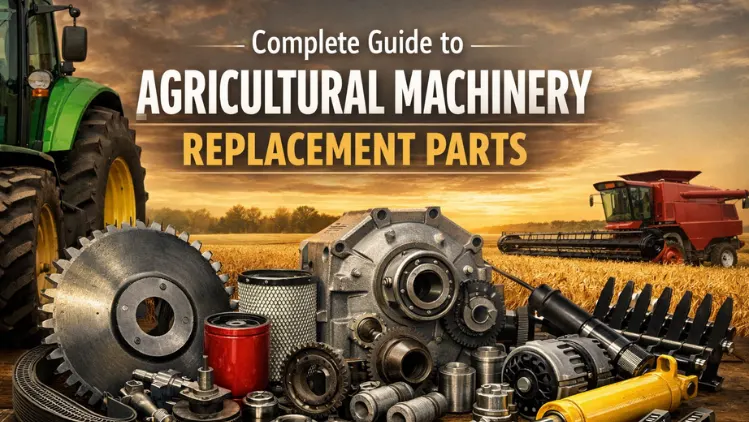
Modern farming depends heavily on agricultural machinery to ensure timely operations, higher productivity, and reduced manual effort. From harvesting crops to preparing fields and managing implements, machines are expected to perform efficiently under demanding conditions. However, continuous use naturally leads to wear and tear, making agricultural machinery replacement parts a critical aspect of farm maintenance. Using the right replacement parts not only improves machine performance but also helps farmers avoid costly breakdowns during peak agricultural seasons. This guide explains the major categories of agricultural replacement parts, their practical role in farming operations, and how choosing quality components contributes to long-term reliability. What Are Agricultural Machinery Replacement Parts? Agricultural machinery parts are components used to restore worn or damaged machines to proper working condition. Constant exposure to dust, soil resistance, vibration, moisture, and heavy operational loads gradually reduces part efficiency. High-quality replacement parts help: In contrast, poor-quality or incompatible parts may lead to frequent failures, uneven performance, and higher repair expenses. Combine Harvester Replacement Parts and Their Role Combine harvesters are complex machines designed to cut, thresh, and clean crops in a single operation. Any failure in key components can directly affect harvesting speed and crop quality. A complete range of Combine Harvester Parts is designed to support smooth operation throughout the harvesting cycle. Important Combine Harvester Components Fingers and Knife GuardsFingers and knife guards support cutting blades and ensure clean, straight crop cutting. When these components wear out, blades vibrate excessively, leading to uneven cutting and higher blade damage. Timely replacement with reliable fingers and knife guards improves cutting accuracy and reduces maintenance issues. Harvester BladesHarvester blades are responsible for the actual cutting of crops. Sharp blades reduce crop loss, maintain harvesting speed, and minimize strain on the machine. Using compatible and durable harvester blades ensures consistent performance during long harvesting hours. Harvester RASP BarsRASP bars play a crucial role in threshing by separating grain from crop material. Worn RASP bars result in poor threshing efficiency and grain damage. High-quality harvester RASP bars help maintain grain quality while improving output. Harvester Plastic PartsPlastic components are widely used to reduce machine weight and resist corrosion. These parts improve durability, especially in moist or chemically treated fields. Reliable harvester plastic parts contribute to better machine balance and long-term reliability. Torsion Springs and Auger TynesTorsion springs maintain mechanical balance, while auger tynes ensure smooth movement of crop material. Properly fitted torsion springs and auger tynes reduce blockages and improve operational efficiency. Farm Implements Replacement Parts for Field Operations Farm implements such as ploughs, harrows, mulchers, and tillers face extreme soil pressure and abrasive conditions. Their performance largely depends on the quality of their replacement parts. A wide selection of Farm Implements Replacement Parts helps maintain efficiency across different farming activities. Common Farm Implement Components Hammer BladesHammer blades are used in mulchers and shredders for residue management. Durable hammer blades withstand repeated impact and ensure longer service life. Disc Harrow BladesDisc harrow blades are essential for soil preparation and residue mixing. Well-manufactured disc harrow blades ensure uniform soil penetration and reduce tractor load. Tillage Blades (MB Plough, Duck Foot, and Tiller Blades)Tillage blades loosen and turn soil for crop preparation. Properly shaped and hardened tillage blades improve soil finish while reducing fuel consumption. Disc Harrow AxlesAxles support the disc assembly and carry heavy operational loads. Strong disc harrow axles prevent misalignment and premature bearing failure. Bale SpearsBale spears are used for lifting and transporting hay and straw bales. Reliable bale spears ensure safe handling and stable load movement. Implements and General PinsPins secure implements to tractors and equipment. High-quality implements and general pins reduce vibration and improve operational safety. Three Point Linkage Kit Parts and Tractor Stability The three-point linkage system connects implements to tractors and plays a decisive role in lifting control, depth adjustment, load transfer, and overall tractor stability. In real field conditions, even minor wear in linkage components can lead to side sway, uneven working depth, excessive vibration, or sudden implement movement—all of which increase safety risks and reduce operational efficiency. Reliable Three Point Linkage Kit Parts include top links, levelling assemblies, stabilizers, draw bars, pins, and bushes. Correct selection ensures proper load distribution and smooth implements control. A detailed, component-wise explanation of this system is covered in our guide Three Point Linkage Kit Parts Explained: How They Ensure Tractor Stability, where we break down the role of top links, levelling assemblies, stabilizers, draw bars, pins, bushes, and other linkage components from a practical, safety-focused perspective. Tractor Accessories and Utility Parts In addition to major mechanical components, small utility parts play a critical role in daily tractor operation, preventive maintenance, and operator safety. Experienced tractor owners understand that many serious breakdowns begin with the failure of minor supporting components that are often ignored during routine servicing. Essential tractor accessories and utility parts include gauges for monitoring performance, weather caps for exhaust protection, grease nipples for lubrication, and silencer clamps for secure exhaust fitting. Regular inspection of these components helps maintain efficiency and safety. A detailed understanding of these components is covered in our guide on Tractor Accessories & Utility Parts: Essential Components for Daily Maintenance and Safe Operation, where we explain how gauges help monitor engine health, weather caps protect exhaust systems, grease nipples ensure proper lubrication, and silencer clamps maintain exhaust stability. How to Choose the Right Agricultural Replacement Parts When selecting replacement parts, always consider: Proper installation and routine inspection further extend part life and improve machine reliability. Conclusion Agricultural machinery parts are critical to maintaining productivity, safety, and efficiency on the field. From combine harvester components to farm implements and tractor linkage systems, choosing high-quality parts reduces downtime and ensures smooth farming operations throughout the season. Investing in the right replacement parts is not an expense—it is a long-term investment in reliable and efficient agriculture. Frequently Asked Questions (FAQs)