
 (+91) 842-700-1426
  agriparts@jcblmail.com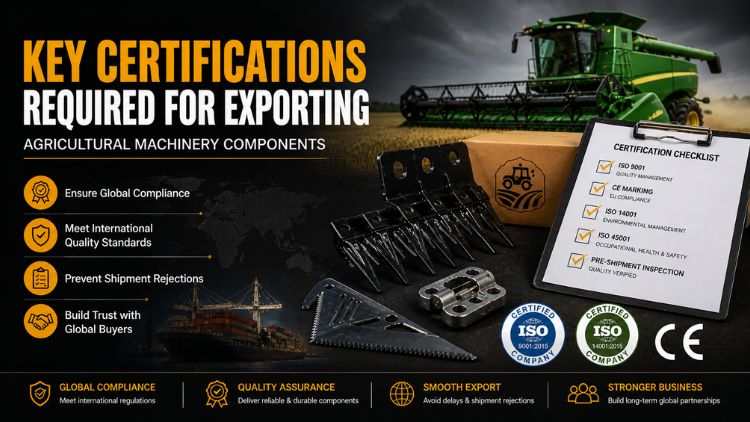
Exporting agricultural machinery components requires strict compliance with international quality, safety, and regulatory standards. Certifications such as ISO 9001, CE Marking, and ISO 14001 are essential for ensuring product acceptance in global markets, preventing shipment rejections, and meeting the sourcing requirements of OEMs and international distributors. These certifications validate that components meet international regulatory standards, ensuring smooth customs clearance, reduced compliance risk, and acceptance by global OEMs and distributors.
Key Takeaway
- Exporting agricultural machinery components requires key certifications like ISO 9001, CE Marking, and ISO 14001 for global compliance.
- CE marking is mandatory for European Union exports and ensures machinery safety and regulatory approval.
- ISO certifications are essential for supplier approval by global OEMs and international buyers.
- Pre-shipment inspection and product testing certifications help prevent shipment rejection and ensure quality standards.
- Certification requirements vary by country, making a market-specific export compliance strategy crucial.
- Strong certification and documentation practices help exporters build trust, reduce risks, and secure long-term B2B contracts.
Why Certifications Are Critical in Global Agricultural Machinery Trade
In international B2B trade, certifications are not optional; they are commercial gatekeepers. Agricultural machinery components, such as combine harvester fingers, knife guards, cutter bar components, and forged parts, operate under high mechanical stress and must meet strict safety and durability standards. Importing countries enforce these standards to protect end-users and ensure machine reliability.
From a business standpoint, certifications serve three key functions:
1. Regulatory Compliance
Every country enforces its own technical regulations. Without proper certification, shipments can be:
- Delayed at customs
- Rejected or returne
2. Supplier Qualification in B2B Ecosystems
Large OEMs, distributors, and aftermarket buyers typically require:
- ISO-certified suppliers
- Documented quality systems
- Traceable production processes
In many cases, certification is a prerequisite even before price negotiations begin.
3. Risk Mitigation & Brand Trust
Certified exporters are perceived as:
- Low-risk partners
- Operationally reliable
- Capable of long-term supply consistency
In practical export scenarios, shipments are often delayed or rejected due to incomplete certification documentation, especially in regulated markets like the European Union and Middle East. Experienced exporters ensure all compliance documents, including test reports and declarations, are verified before shipment dispatch to avoid costly disruptions.
Core Certifications Required for Exporting Agricultural Machinery Components
1. ISO 9001 – Quality Management System (QMS)
ISO 9001 is the foundation of export credibility in manufacturing.
It ensures that your organization follows a structured approach to:
- Process control and standardization
- Quality consistency across batches
- Root cause analysis and corrective actions
- Documentation and traceability
For agricultural components, this is especially important because:
- Parts must fit precisely within machinery assemblies
- Inconsistent quality can lead to machine failure in the field
Buyers often audit ISO 9001 documentation to evaluate supplier reliability before onboarding. According to global procurement standards, a majority of OEM buyers prefer or mandate ISO 9001-certified suppliers to ensure consistent quality and traceability.
2. CE Marking: Mandatory for European Union Exports
CE Marking is a legal requirement for machinery and related components entering the EU. CE marking compliance is governed by the EU Machinery Directive 2006/42/EC, which mandates safety requirements for machinery and critical components entering the European market.
It indicates compliance with key EU directives such as:
- Machinery Directive
- Low Voltage Directive (if applicable)
- Electromagnetic Compatibility (EMC) Directive
For agricultural machinery components:
- CE applies when components impact machine safety
- Documentation must include technical files, risk assessments, and conformity declarations
Without CE marking, your shipment can be blocked at EU borders, regardless of product quality.
3. ISO 14001: Environmental Management System (EMS)
ISO 14001 demonstrates that your manufacturing processes are environmentally responsible.
This includes:
- Waste management systems
- Energy efficiency practices
- Controlled emissions and resource usage
Why it matters in exports:
- European and global buyers are under pressure to meet ESG goals
- OEMs increasingly prefer suppliers aligned with sustainability standards
Environmental compliance is now a supplier selection criterion, not just a value-add.
4. ISO 45001 – Occupational Health & Safety
ISO 45001 ensures safe and compliant working conditions in manufacturing facilities.
It focuses on:
- Worker safety protocols
- Risk identification and hazard control
- Incident prevention systems
From a buyer’s perspective:
- Reduces supply chain disruption risks
- Reflects ethical manufacturing practices
Demonstrates operational maturity and responsible business practices.
5. Pre-Shipment Inspection (PSI) / Export Inspection Certificate
Pre-shipment inspection is often required by importers or governments, particularly in:
- Africa
- Middle East
- Some Asian markets
Inspection agencies verify:
- Product specifications
- Quantity and packaging
- Compliance with agreed standards
Practical Benefit: Minimizes disputes and ensures smoother customs clearance.
6. Country-Specific Certifications and Compliance
Export requirements vary significantly by region:
United States
- ANSI (American National Standards Institute) compliance
- Product liability and safety expectations
Middle East (e.g., Saudi Arabia)
- SASO certification
- Gulf Conformity (GCC) standards
Canada
- CSA certification (for certain machinery applications)
Emerging Markets (Africa, Southeast Asia)
- Mandatory inspection certificates
- Local conformity approvals
Exporter Tip: Certification strategy should always be market-driven, not generic.
7. Material & Mechanical Testing Certifications
For agricultural machinery components, especially forged and wear-resistant parts, technical validation is critical.
Common certifications include:
- Mill Test Certificates (MTC): Verifying raw material composition
- Hardness Testing Reports: Ensuring wear resistance
- Tensile Strength Reports: Measuring load-bearing capacity
- Microstructure Analysis: Ensuring metallurgical integrity
These are often required by:
- OEM buyers
- Engineering procurement teams
- Quality auditors
In addition to certifications, exporters must prepare supporting documentation to ensure smooth customs clearance and buyer approval.
Key documents include the following:
- Commercial Invoice
- Packing List
- Certificate of Origin
- Bill of Lading / Airway Bill
- Test Reports (MTC, hardness, tensile strength)
- Declaration of Conformity (for CE-marked products)
Missing or incorrect documentation can lead to shipment delays, penalties, or rejection at destination ports.
Certification Requirements by Major Export Markets
| Region | Key Requirements |
| Europe | CE Marking, ISO 9001, ISO 14001 |
| USA | ANSI compliance, ISO standards |
| Middle East | SASO, PSI, ISO certifications |
| Africa | Pre-shipment inspection, ISO |
| Asia Pacific | Mixed regulatory + ISO requirements |
This variation highlights why exporters must adopt a multi-certification strategy.
How Exporters Obtain These Certifications
Achieving certification is a structured process:
Step 1: Market Identification
Define where you want to export, certifications depend on destination markets
Step 2: Compliance Gap Analysis
Evaluate current systems against required standards
Step 3: Process Implementation
Upgrade:
- Quality systems
- Documentation
- Production controls
Step 4: Certification Body Engagement
Apply through accredited agencies (national or international)
Step 5: Audit & Verification
Third-party auditors assess compliance
Step 6: Certification & Maintenance
Maintain compliance through:
- Annual audits
- Process improvements
- Documentation updates
Common Certification Challenges
1. High Cost of Certification
Multiple certifications can be expensive for exporters, especially SMEs. Prioritize certifications based on target markets, customer requirements, and expected return on investment.
2. Documentation Complexity
Certification requires extensive technical documentation, records, and traceability. Implement digital documentation systems to streamline processes, reduce errors, and ensure compliance during audits.
3. Frequent Regulatory Changes
Export regulations and certification standards change frequently across markets. Stay updated through export councils, industry bodies, and regulatory authorities to maintain ongoing compliance.
4. Audit Failures
Many SMEs fail certification audits due to weak processes. Conduct internal pre-audits, strengthen quality systems, and hire experienced compliance consultants for better success rates.
Best Practices Followed by Successful Exporters
- Maintain end-to-end product traceability
- Invest in in-house quality testing labs
- Build long-term relationships with certification bodies
- Align manufacturing with global OEM expectations
- Continuously train teams on compliance standards
Export Certification Checklist for Agricultural Components
Before exporting, ensure you have:
- Required ISO certifications (ISO 9001, ISO 14001, etc.)
- CE marking (for EU exports)
- Product testing reports (MTC, hardness, tensile)
- Pre-shipment inspection clearance
- Country-specific compliance approvals
- Complete export documentation
This checklist helps exporters avoid last-minute compliance issues and shipment delays.
Conclusion
For exporters of agricultural machinery components, certifications go beyond regulatory obligations and act as strategic enablers of sustainable global business growth. Manufacturers supplying components such as combine harvester fingers, knife guards, and cutter bar parts must align their certification strategy with target export markets to remain competitive in global supply chains. Companies that invest in strong quality systems, robust compliance infrastructure, and certification readiness are better positioned to enter high-value international markets, secure long-term B2B contracts, and build a globally trusted and competitive brand presence.
FAQs
ISO 9001, CE Marking (for Europe), and ISO 14001 are among the most critical certifications for global exports.
CE marking is mandatory for components that fall under EU machinery safety directives and impact equipment safety.
Typically, 3 to 6 months, depending on the organization’s readiness and process maturity.
No, certifications should be selected based on target export markets and buyer requirements.
In some markets, yes, but in regulated regions like the EU, uncertified products can be rejected or banned.