Heat Treatment Process in Agricultural Blades & Implement Parts

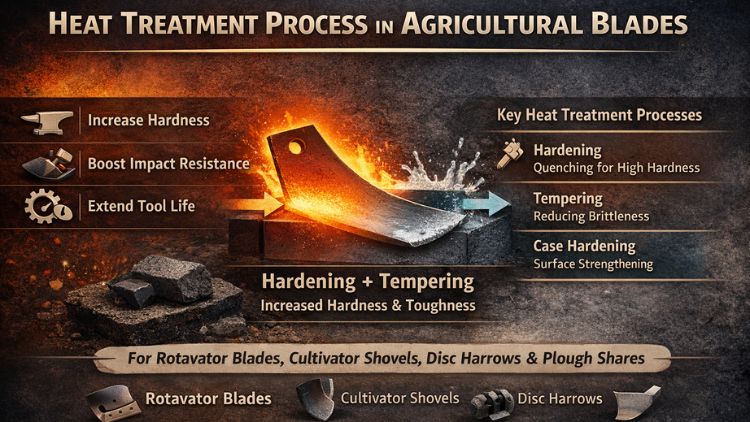
Heat treatment in agricultural blades is a controlled process of heating and cooling steel to improve hardness, wear resistance, and toughness. It ensures longer blade life, better edge retention, and reliable performance in abrasive soil conditions. Key Takeaways Why Heat Treatment is Important for Agricultural Blades Heat treatment is important because it improves wear resistance, impact strength, and service life of agricultural blades operating in abrasive soil conditions. In abrasive field conditions, poorly heat-treated blades can lose up to 30–40% of their service life, making controlled heat treatment essential for consistent performance. Metallurgical Science Behind Heat Treatment At the core of heat treatment is phase transformation in steel: The goal is not maximum hardness, but optimized microstructure for real-world agricultural loads. What Are the Main Types of Heat Treatment Processes Used? 1. Hardening (Quenching) 2. Tempering 3. Case Hardening (Carburizing / Nitriding) 4. Normalizing Quick Comparison of Heat Treatment Methods Process Primary Purpose Key Benefit Typical Use in Agri Parts Hardening Increase hardness High wear resistance Blade edges Tempering Reduce brittleness Improved toughness Post-hardening treatment Case Hardening Surface strengthening Hard surface + tough core High-impact components Normalizing Grain refinement Uniform structure Pre-treatment stage Industrial Heat Treatment Process (Step-by-Step) Here is a step-by-step process of heat treatment: Step 1: Raw Material Inspection The process starts by verifying the steel’s chemical composition to ensure it meets the required specifications for heat treatment performance.Process Highlights: Step 2: Controlled Heating Components are heated to the required austenitizing temperature using controlled furnace systems to prepare the material for transformation.Process Highlights: Step 3: Soaking The material is held at the target temperature to ensure uniform heat distribution throughout the entire component.Process Highlights: Step 4: Quenching The heated components are rapidly cooled to form a hardened structure, directly influencing final hardness and strength. Process Highlights:  Step 5: Tempering After quenching, the steel is reheated to reduce brittleness and improve toughness for real-world applications.Process Highlights: Step 6: Post-Treatment Testing Final inspection ensures the components meet required mechanical and dimensional standards before use.Process Highlights: What Are the Benefits of Heat Treatment in Agricultural Parts? Heat treatment improves agricultural parts by increasing wear resistance, strength, fatigue life, and edge stability, while reducing overall operating and replacement costs. Where Are Heat-Treated Components Used in Agricultural Equipment? Heat-treated components are used in soil-engaging agricultural tools where high wear resistance, impact strength, and durability are required. Heat-treated components are critical in: These parts require precision-engineered hardness profiles to perform effectively across varying soil conditions. What Are the Key Industry Standards and Quality Parameters? Key heat treatment standards focus on hardness, case depth, and microstructure consistency, supported by strict quality control practices to ensure reliable performance. Key Parameters: Quality Practices: Globally accepted frameworks such as those from the International Organization for Standardization guide process consistency and quality assurance. What Are the Common Challenges in Heat Treatment? Heat treatment must be precisely controlled, as even minor variations in temperature, cooling rate, or timing can lead to performance issues and reduced component life. Maintaining process precision, automation, and metallurgical expertise is essential to ensure consistent and reliable results. Conclusion Heat treatment is a core engineering process that defines the performance, durability, and reliability of agricultural blades and implements. Optimizing the internal structure of steel, it enables components to withstand extreme field conditions while maintaining consistent efficiency and performance over time. For B2B buyers, sourcing from a manufacturer with strong metallurgical control and well-defined heat treatment processes is critical. It ensures superior product performance, reduces overall lifecycle costs through longer service life, and delivers long-term operational reliability across demanding agricultural applications. FAQs

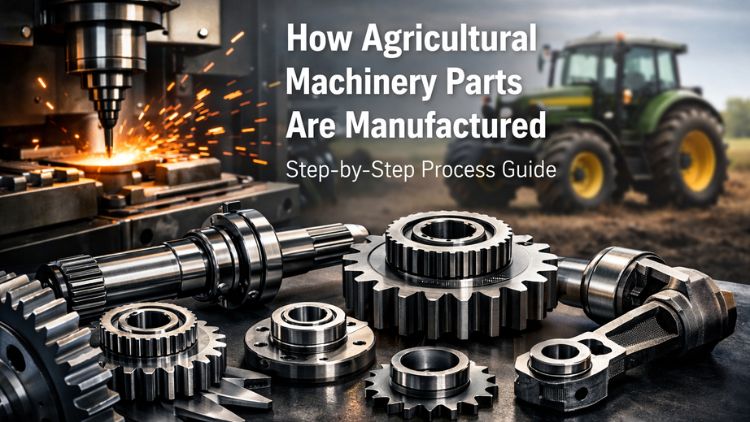
How Agricultural Machinery Parts Are Manufactured (Step-by-Step Process Guide)

Agricultural machinery parts are manufactured through a multi-stage industrial process that includes design engineering, material selection, casting or forging, precision machining, heat treatment, surface finishing, and rigorous quality testing. Each stage is critical to ensure the components can withstand heavy loads, abrasive soil conditions, and prolonged exposure to moisture and chemicals. From tractor transmission gears to harvester blades, the manufacturing process directly determines the durability, efficiency, and operational lifespan of agricultural equipment. Key Takeaways Agricultural Machinery Parts Manufacturing Process (7 Key Steps) Raw Materials Used in Agricultural Machinery Parts The performance of agricultural machinery parts begins with selecting the right raw materials. These materials must withstand high stress, abrasion, moisture, and temperature variations to ensure durability and consistent performance in demanding farming conditions. 1. Steel (Carbon & Alloy Steel) Steel is the primary material used due to its high tensile strength and fatigue resistance. Alloy steels, in particular, are preferred for gears and shafts because they maintain hardness and structural stability under cyclic loads and high torque conditions. 2. Cast Iron Cast iron is widely used for heavy-duty components due to its excellent wear resistance and vibration-damping properties. It performs well in engine housings and structural parts where rigidity and stability are essential. 3. Aluminum Alloys Aluminum alloys offer a combination of lightweight construction and corrosion resistance, making them suitable for components where reducing machine weight improves fuel efficiency and handling. 4. Plastics & Composites Engineering plastics and composites are used in non-load-bearing components due to their resistance to chemicals, moisture, and corrosion. These materials are especially useful in parts exposed to fertilizers and varying environmental conditions. Why Material Selection Matters Material choice directly affects component lifespan, performance, and maintenance frequency. Incorrect selection can lead to premature wear, deformation, or failure, particularly in high-load and abrasive agricultural applications. Step-by-Step Manufacturing Process of Agricultural Machinery Parts Each stage in the manufacturing process is designed to enhance strength, precision, and durability while ensuring consistent performance in real-world agricultural environments. 1. Design and Engineering The process begins with CAD-based design and engineering, where components are modeled and analyzed for stress, load distribution, and fatigue resistance. This ensures the part is optimized for real operating conditions before production. 2. Material Selection and Procurement Materials are selected based on mechanical requirements, environmental exposure, and cost efficiency, with sourcing from certified suppliers to maintain consistency and traceability. 3. Casting or Forging Casting is used to produce complex geometries by pouring molten metal into molds, while forging shapes metal under high pressure to improve grain structure and mechanical strength. Forged components generally offer superior fatigue resistance and are preferred for high-stress applications. 4. Machining and CNC Processing Machining processes such as turning, milling, and drilling refine the part to precise dimensions. CNC machining ensures tight tolerances (often within microns), enabling accurate fit, reduced vibration, and efficient mechanical performance. 5. Heat Treatment Heat treatment processes such as hardening, tempering, and annealing modify the internal structure of metals to enhance hardness, toughness, and wear resistance. Properly treated components can achieve hardness levels suitable for high-friction agricultural operations. 6. Surface Finishing and Coating Surface treatments such as powder coating, galvanizing, and plating protect components from corrosion, oxidation, and chemical exposure. This is essential for maintaining performance in soil, moisture, and fertilizer-rich environments. 7. Assembly (If Required) Final components undergo rigorous inspection, including dimensional checks, load testing, and surface analysis. This ensures compliance with manufacturing standards and guarantees reliable performance in field conditions. 8. Quality Control and Testing The final stage involves rigorous quality control and testing to ensure each part meets industry standards. This includes dimensional inspections, load and stress testing, surface quality checks, and performance validation. Thorough testing guarantees that the components will perform reliably under real agricultural working conditions. Casting vs Forging: Which is Better for Agricultural Parts? Casting and forging serve different purposes in agricultural machinery manufacturing, and the choice depends on application requirements. In most heavy-duty agricultural applications, forging is preferred where strength and fatigue resistance are critical. Quality Standards and Certifications Agricultural machinery parts manufacturers follow strict quality standards to ensure consistency, safety, and long-term performance. Common Certifications: ISO 9001 is widely used to standardize quality management systems, while additional industry-specific standards ensure compliance with performance and durability benchmarks. Material certifications further verify chemical composition and mechanical properties. Why it matters: Adherence to recognized standards reduces defect rates, ensures consistency across batches, and builds trust with buyers, distributors, and OEM partners. Challenges in Manufacturing Agricultural Machinery Parts Manufacturing agricultural machinery parts involves several challenges due to demanding operating environments and the need for consistent performance and durability. How to Choose a Reliable Agricultural Machinery Parts Manufacturer Selecting the right manufacturer is crucial for ensuring product quality and long-term performance. A trusted manufacturer ensures consistent quality, lower failure rates, and better ROI. Conclusion Agricultural machinery parts are manufactured through a precise, multi-stage process involving material selection, casting or forging, machining, heat treatment, finishing, and rigorous quality control. Each step plays a critical role in ensuring durability, performance, and resistance to harsh farming environments. Understanding this process helps businesses and buyers make informed decisions when sourcing high-quality agricultural components. FAQs

Agricultural Machinery Parts Manufacturer in India: What Importers Should Know

Key Takeaways The global agricultural machinery market is evolving rapidly, driven by mechanization, sustainability, and stricter regulatory standards. For importers, sourcing the right parts is no longer just about price, it’s about compliance, reliability, and long-term scalability. India has positioned itself as a global manufacturing hub for agricultural machinery parts. With strong engineering capabilities, export experience, and new trade advantages in 2026, India offers both cost and compliance benefits to global buyers. This guide helps importers, distributors, and OEM buyers understand what truly matters when sourcing from India in today’s regulatory and trade environment. Why Choose an Agricultural Machinery Parts Manufacturer in India? India offers a unique combination of affordability, quality, and scalability that makes it highly attractive for global buyers. Key Advantages: Types of Agricultural Machinery Parts Exported from India Indian manufacturers supply a broad spectrum of components used in modern farming equipment. Common Categories: 2026 Regulatory Update: TREM V Compliance (Critical for Importers) As of October 1, 2026, India’s TREM V emission norms require tractor parts, especially for engines above 75 HP and below 25 HP, to meet stricter, EU-aligned standards. For importers, this means ensuring all sourced engine, fuel, and exhaust components carry advanced Type Approval certification to avoid compliance issues or rejection in destination markets. What This Means: Why It Matters: Importers must ensure that sourced parts, especially engines and exhaust systems, are TREM V compliant, or they may face regulatory issues in their destination markets. Key Factors Importers Should Check Before Choosing a Manufacturer This is the most critical step for ensuring a successful import experience. 1. Certifications & Quality Standards Look for manufacturers with: 2. Manufacturing Capabilities Evaluate: 3. Export Experience Choose suppliers who: 4. Material Quality & Testing Ensure: 5. Pricing Transparency Check for: 6. Communication & Responsiveness Reliable suppliers: Import Regulations & Documentation You Must Know (2026 Update) Key Documents Required: New Addition (2026): FEMA Regulations 2026: What Importers Must Know Effective October 1, 2026, the updated FEMA regulations improve ease of doing business. Key Benefits: Value Insight: This makes India a more flexible sourcing partner for small and mid-sized importers, especially for trial orders and smaller MOQs. TREM IV vs TREM V: Quick Comparison for Importers Feature TREM IV TREM V (2026) Emission Standards Moderate Stricter (EU-aligned) Engine Efficiency Standard Improved Environmental Impact Higher emissions Lower emissions Compliance Requirement Basic certification Advanced Type Approval Export Compatibility Limited Global-ready Common Challenges Faced by Importers (And How to Avoid Them) Even experienced importers face issues. Being prepared reduces risk significantly. Incorrect Product Specifications: Confirm details with pre-production samples and approvals. How to Identify a Reliable Agricultural Machinery Parts Manufacturer in India Choosing the right partner is more important than choosing the lowest price. Practical Steps: Why Long-Term Partnerships Matter in Agricultural Imports Building a long-term relationship with a manufacturer offers multiple benefits: In global trade, reliability often matters more than cost savings. Conclusion India has positioned itself as a reliable and competitive hub for agricultural machinery parts manufacturing. For importers, the opportunity is significant—but success depends on careful supplier selection, quality checks, and a clear understanding of import processes. By focusing on certifications, communication, and long-term partnerships, importers can build a stable and profitable supply chain from India. FAQs

Implements & General Pins: Shear Strength, Material & Export Standards Guide

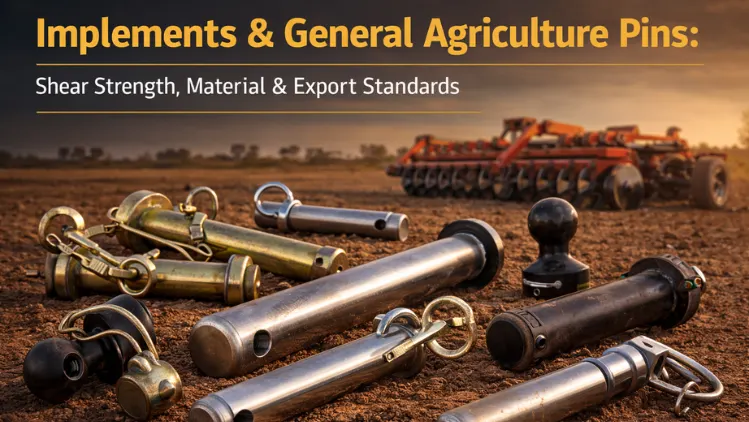
Agricultural machinery operates in demanding environments where reliability, safety, and durability are essential. One of the most critical components ensuring stable tractor-implement connections is the implement pin. These fastening components secure linkages between tractors and equipment such as plows, seeders, cultivators, and trailers. Because these pins function as load-bearing connectors, they are constantly exposed to heavy shear forces, vibration, impact loads, and environmental conditions. The strength and performance of these pins depend on material grade, heat treatment, dimensional accuracy, and corrosion protection. For global OEM buyers, distributors, and equipment manufacturers, sourcing high-quality pins from a reliable implement pins manufacturer ensures operational safety and compliance with international standards. This guide explains the types of agricultural implement pins, material grades, heat treatment processes, load capacity standards, and export considerations that define high-quality fastening components. Key Takeaways What are Agricultural Implement Pins? Agricultural implement pins are high-strength steel fasteners used to connect tractors to agricultural implements such as plows, seeders, and trailers. These pins are engineered to withstand heavy shear loads, vibration, and outdoor exposure while maintaining secure mechanical connections within tractor linkage systems and hydraulic assemblies. Types of Implements & General Pins Different agricultural applications require different pin designs to accommodate varying loads, pivot movement, and mechanical connections. Pin Type Primary Application Load Characteristics Common Material PTO Pins Lock PTO shaft assemblies Rotational + vibration load Alloy steel Hitch Pins Tractor three-point linkage Heavy shear load Carbon steel Clevis Pins Pivot joints and linkages Shear with rotation Alloy steel Cylinder & Square Head Pins Hydraulic cylinder mounting High pressure load Hardened steel Hair / Split / Grip Pins Secondary locking Retention / safety Spring steel For a complete product range, explore implements and general pins. 1. PTO Pins PTO pins secure power take-off shaft assemblies and prevent detachment during rotation. Because PTO systems operate under continuous torque and vibration, these pins require high tensile strength and precise locking mechanisms. 2. Hitch Pins Hitch pins connect agricultural implements such as plows, seeders, and trailers to tractors. These pins are designed to endure heavy shear forces while maintaining secure implement attachment. 3. Clevis Pins Clevis pins are commonly used in pivot joints where movement between connected components is required. They allow rotational motion while distributing load across the joint. 4. Cylinder & Square Head Pins Hydraulic cylinder pins support high-pressure mechanical operations in agricultural machinery. Their design ensures stable connections in hydraulic and load-bearing assemblies. 5. Hair, Split, and Grip Pins These smaller locking pins act as secondary safety components, preventing larger pins from loosening or sliding out during machinery operation. For a detailed product overview, explore implements and general pins used in agricultural machinery systems. Material Grades Used in Agricultural Pins The performance of agricultural pins depends heavily on steel composition and mechanical strength. Material Grade Typical Tensile Strength Hardness Range Application High Tensile Carbon Steel 600–800 MPa 20–28 HRC Standard hitch pins Alloy Steel (e.g., 4140) 850–1000 MPa 28–36 HRC Heavy-duty equipment Case-Hardened Steel Hard surface + tough core Surface 55–60 HRC Wear-resistant applications Carbon steel is commonly used in general agricultural pins because of its balance between strength and cost. Alloy steels offer higher fatigue resistance and improved shear performance, making them ideal for heavy equipment connections. Case hardened pins combine surface hardness with internal toughness, improving wear resistance while preventing brittle fracture. Heat Treatment & Surface Hardening Heat treatment enhances mechanical strength, fatigue resistance, and wear performance. Maintaining a tough internal core with hardness typically between 28–36 HRC ensures the pin resists deformation without becoming brittle. Shear Strength & Load Capacity Standards Shear strength determines how much force a pin can withstand before failing. The basic engineering formula for shear stress is: Shear Stress = Applied Force ÷ Cross-Sectional Area Single Shear vs Double Shear Double shear effectively doubles the load capacity compared to single shear, making it ideal for heavy machinery linkages. Agricultural equipment manufacturers often follow guidelines from organizations such as ASAE (American Society of Agricultural Engineers) to ensure safe load capacities in tractor-implement connections. Surface Finish & Corrosion Protection Agricultural pins operate in environments exposed to moisture, soil, fertilizers, and chemicals, making corrosion protection essential. Dimensional Accuracy & Machining Precision Precision manufacturing ensures proper fitment in tractor linkages and mechanical assemblies. Working with an experienced agricultural implement parts manufacturer in India ensures high machining precision and consistent product quality. How to Select the Right Implement Pin Choosing the correct pin improves machinery safety and operational efficiency. Bulk Procurement & Export Packaging Large-scale agricultural equipment buyers require reliable supply chains and consistent quality. Why Choose a Certified Implement Pins Manufacturer Working with a certified supplier ensures consistent product performance and compliance with global standards. Reliable manufacturers provide: Partnering with a trusted implement pins manufacturer ensures durable fastening components that meet agricultural machinery performance requirements. Conclusion Although small in size, implement pins play a vital role in agricultural machinery operation. They support heavy loads, maintain stable tractor-implement connections, and enable safe mechanical movement within equipment systems. Selecting the right pins requires careful consideration of material strength, heat treatment, corrosion protection, and dimensional accuracy. By working with experienced manufacturers and adhering to international standards, agricultural equipment buyers can ensure reliable performance in demanding field environments. High-quality implements and general pins, such as those provided by JCBL Agri, ultimately contribute to safer machinery operation, longer equipment life, and improved agricultural productivity. FAQs

Three Point Linkage Kit Parts Explained: How They Ensure Tractor Stability

Tractor stability is not defined by engine power or tractor weight alone. In real farming conditions, stability depends on how efficiently the tractor transfers power to the implement, how evenly the load is distributed, and how well unwanted movement is controlled. At the centre of this entire mechanism is the three-point linkage system. Most instability-related issues—such as excessive side sway, uneven working depth, jerky lifting, or sudden implement drop—can be traced back to worn, mismatched, or poorly maintained linkage components. This guide explains three point linkage kit parts in detail, focusing on how each component contributes to tractor stability, operator safety, and consistent field performance. Understanding the Three Point Linkage System The three-point linkage system connects implements to the tractor using three mounting points: two lower links and one top link. This triangular geometry is not accidental—it is designed to distribute load evenly between the tractor’s rear axle and chassis while allowing controlled vertical and horizontal movement. When the linkage system is working correctly, it allows the tractor to: A complete set of Three Point Linkage Kit Parts functions as a single system. Even if one part develops excessive play or weakness, the entire system’s stability is compromised. Why Tractor Stability Depends on Linkage Quality In day-to-day operations, instability rarely appears suddenly. It develops gradually and is often ignored until it becomes dangerous or costly. Common early symptoms include the implement drifting sideways, inconsistent depth, excessive vibration, or frequent need for operator correction. These issues occur because worn linkage parts fail to hold the implement in a fixed geometric relationship with the tractor. As a result: Replacing linkage parts proactively prevents secondary damage to hydraulics, tyres, and transmission systems, while also reducing operator fatigue. Top Link Assemblies: Controlling Implement Angle and Load Transfer The top link is responsible for controlling the fore-and-aft angle of the implement. This angle directly affects how the implement penetrates the soil and how draft force is transferred back to the tractor. High-quality Top Link Assemblies allow precise adjustment and maintain rigidity under load. When top links are worn or mismatched: From an experienced operator’s perspective, even a small amount of play in the top link can significantly affect stability, especially during heavy tillage or uneven terrain. Levelling Assemblies: Ensuring Uniform Working Depth Levelling assemblies ensure that both lower links remain at equal height, keeping the implement level relative to the ground. This is critical for operations where uniform depth directly affects output quality, such as tillage or seeding. Durable Levelling Assemblies maintain alignment under continuous load and vibration. Worn levelling assemblies often lead to: Proper levelling improves field consistency, reduces corrective steering, and minimizes unnecessary stress on the tractor. Stabilizer Assemblies: Controlling Side Sway and Improving Safety Side sway is one of the most underestimated safety risks in tractor operations. When stabilizers are loose or worn, the implement can swing laterally, especially during turns or transport. Well-designed Stabilizer Assemblies limit this unwanted movement without restricting necessary vertical motion. Effective stabilizers: Ignoring stabilizer wear often results in accelerated pin and bush damage, eventually leading to unsafe operating conditions. Draw Bars: Managing Draft Loads and Towing Stability Draw bars are used when implements or trailers require pulling force rather than lifting. In such cases, the point at which force is applied becomes extremely important for tractor balance. Correctly engineered Draw Bars ensure that towing forces are applied at a safe height and angle. Improper draw bar selection or positioning can cause: Using the correct draw bar is a key safety requirement, not just a convenience. Levelling Arms: Fine Adjustment for Implement Balance Levelling arms work in combination with levelling assemblies to provide precise height adjustment on either side of the implement. While levelling assemblies manage gross alignment, levelling arms allow operators to fine-tune balance based on field conditions. High-strength Levelling Arms are especially important during operations where even slight depth variation can affect output quality, such as seeding or shallow tillage. Worn or bent levelling arms often result in: U-Bolts: Structural Clamping and Load Retention U-bolts are used to clamp linkage components securely to tractor frames or brackets. Though they do not move during operation, their role is critical in maintaining structural integrity under load. Properly rated U-Bolts ensure that linkage components remain firmly positioned even under vibration and shock loads. Loose or low-grade U-bolts can lead to: Top Link Ends and Weld-On Ends: Restoring Worn Linkage Assemblies Top link ends and weld-on ends are commonly used when the main linkage rod is still structurally sound but the threaded or joint ends have worn out. From a professional maintenance standpoint, replacing ends instead of the entire assembly: Stabilizer Ends: Maintaining Controlled Lateral Movement Stabilizer ends connect stabilizer assemblies to the linkage arms and absorb side loads during operation. Durable Stabilizer Ends ensure that stabilizers function correctly without excessive play. Worn stabilizer ends are a common cause of: Balls: Enabling Smooth Articulation Under Load Linkage balls are used at joint points to allow controlled rotation and articulation while transferring heavy loads. Precision-machined Linkage Balls: Excessively worn balls often cause jerky lifting and uneven implement response. Pins: Small Components That Determine System Integrity Pins are often the first components to fail because they experience continuous shear, vibration, and load reversal. Despite their size, they are among the most critical linkage parts. A complete range of Three Point Linkage Pins is used to secure different connections. Professional operators replace pins as soon as wear-induced play appears, preventing damage to expensive linkage arms and brackets. Bushes: Preserving Alignment and Reducing Wear Bushes act as sacrificial wear components between moving parts. Their role is to absorb friction and maintain alignment. When bushes wear out: Timely bush replacement restores tight tolerances and significantly extends the life of the entire linkage system. How to Choose the Right Three Point Linkage Kit Parts Experienced professionals follow a structured approach: This approach reduces repeat failures and ensures long-term stability. Conclusion Three point linkage kit parts are the foundation of tractor stability, safety, and efficient implement… Continue reading Three Point Linkage Kit Parts Explained: How They Ensure Tractor Stability

Complete Guide to Agricultural Machinery Replacement Parts

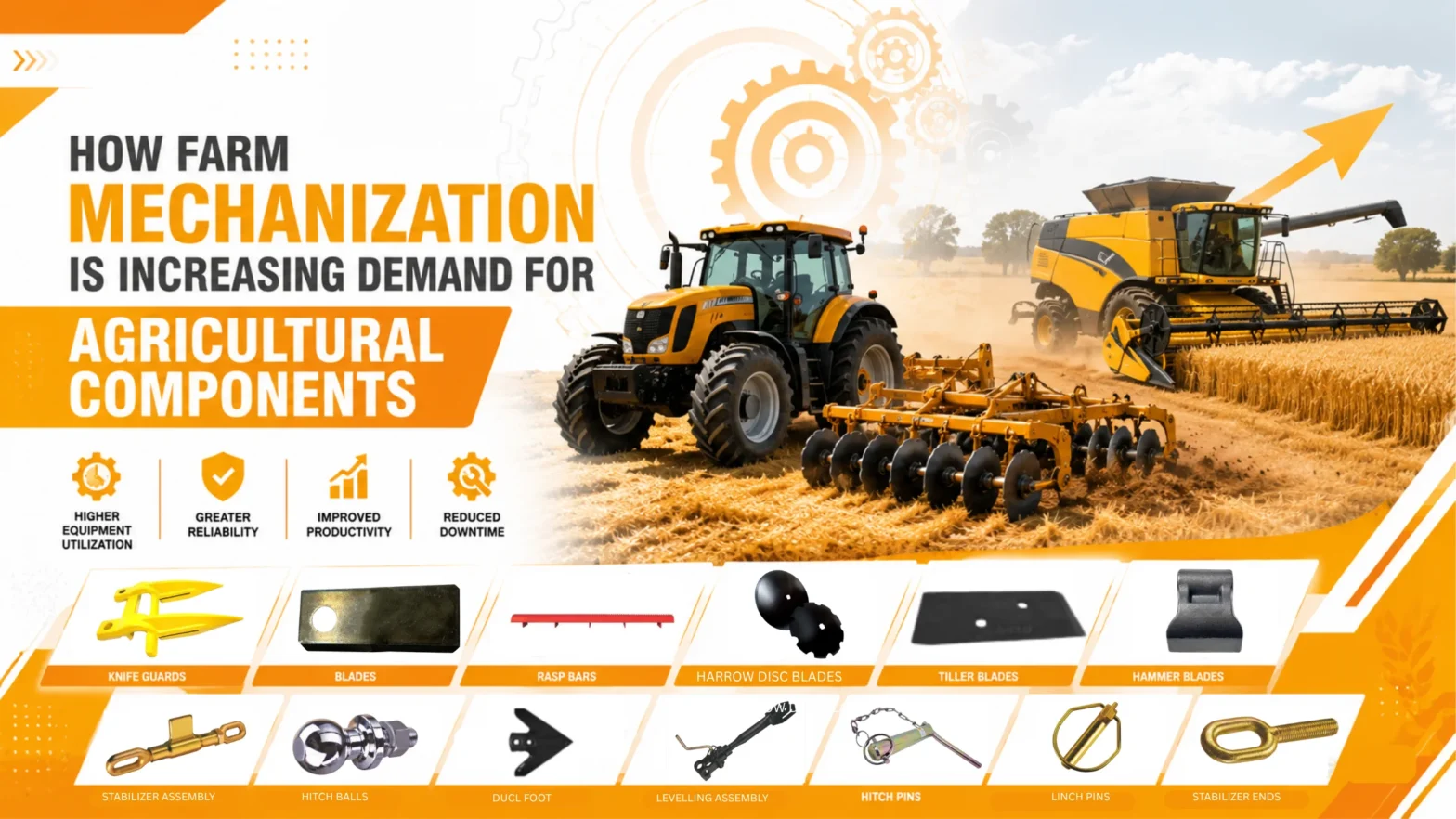
Modern farming depends heavily on agricultural machinery to ensure timely operations, higher productivity, and reduced manual effort. From harvesting crops to preparing fields and managing implements, machines are expected to perform efficiently under demanding conditions. However, continuous use naturally leads to wear and tear, making agricultural machinery replacement parts a critical aspect of farm maintenance. Using the right replacement parts not only improves machine performance but also helps farmers avoid costly breakdowns during peak agricultural seasons. This guide explains the major categories of agricultural replacement parts, their practical role in farming operations, and how choosing quality components contributes to long-term reliability. What Are Agricultural Machinery Replacement Parts? Agricultural machinery replacement parts are components used to restore worn or damaged machines to proper working condition. Constant exposure to dust, soil resistance, vibration, moisture, and heavy operational loads gradually reduces part efficiency. High-quality replacement parts help: In contrast, poor-quality or incompatible parts may lead to frequent failures, uneven performance, and higher repair expenses. Combine Harvester Replacement Parts and Their Role Combine harvesters are complex machines designed to cut, thresh, and clean crops in a single operation. Any failure in key components can directly affect harvesting speed and crop quality. A complete range of Combine Harvester Parts is designed to support smooth operation throughout the harvesting cycle. Important Combine Harvester Components Fingers and Knife GuardsFingers and knife guards support cutting blades and ensure clean, straight crop cutting. When these components wear out, blades vibrate excessively, leading to uneven cutting and higher blade damage. Timely replacement with reliable fingers and knife guards improves cutting accuracy and reduces maintenance issues. Harvester BladesHarvester blades are responsible for the actual cutting of crops. Sharp blades reduce crop loss, maintain harvesting speed, and minimize strain on the machine. Using compatible and durable harvester blades ensures consistent performance during long harvesting hours. Harvester RASP BarsRASP bars play a crucial role in threshing by separating grain from crop material. Worn RASP bars result in poor threshing efficiency and grain damage. High-quality harvester RASP bars help maintain grain quality while improving output. Harvester Plastic PartsPlastic components are widely used to reduce machine weight and resist corrosion. These parts improve durability, especially in moist or chemically treated fields. Reliable harvester plastic parts contribute to better machine balance and long-term reliability. Torsion Springs and Auger TynesTorsion springs maintain mechanical balance, while auger tynes ensure smooth movement of crop material. Properly fitted torsion springs and auger tynes reduce blockages and improve operational efficiency. Farm Implements Replacement Parts for Field Operations Farm implements such as ploughs, harrows, mulchers, and tillers face extreme soil pressure and abrasive conditions. Their performance largely depends on the quality of their replacement parts. A wide selection of Farm Implements Replacement Parts helps maintain efficiency across different farming activities. Common Farm Implement Components Hammer BladesHammer blades are used in mulchers and shredders for residue management. Durable hammer blades withstand repeated impact and ensure longer service life. Disc Harrow BladesDisc harrow blades are essential for soil preparation and residue mixing. Well-manufactured disc harrow blades ensure uniform soil penetration and reduce tractor load. Tillage Blades (MB Plough, Duck Foot, and Tiller Blades)Tillage blades loosen and turn soil for crop preparation. Properly shaped and hardened tillage blades improve soil finish while reducing fuel consumption. Disc Harrow AxlesAxles support the disc assembly and carry heavy operational loads. Strong disc harrow axles prevent misalignment and premature bearing failure. Bale SpearsBale spears are used for lifting and transporting hay and straw bales. Reliable bale spears ensure safe handling and stable load movement. Implements and General PinsPins secure implements to tractors and equipment. High-quality implements and general pins reduce vibration and improve operational safety. Three Point Linkage Kit Parts and Tractor Stability The three-point linkage system connects implements to tractors and plays a decisive role in lifting control, depth adjustment, load transfer, and overall tractor stability. In real field conditions, even minor wear in linkage components can lead to side sway, uneven working depth, excessive vibration, or sudden implement movement—all of which increase safety risks and reduce operational efficiency. Reliable Three Point Linkage Kit Parts include top links, levelling assemblies, stabilizers, draw bars, pins, and bushes. Correct selection ensures proper load distribution and smooth implements control. A detailed, component-wise explanation of this system is covered in our guide Three Point Linkage Kit Parts Explained: How They Ensure Tractor Stability, where we break down the role of top links, levelling assemblies, stabilizers, draw bars, pins, bushes, and other linkage components from a practical, safety-focused perspective. Tractor Accessories and Utility Parts In addition to major mechanical components, small utility parts play a critical role in daily tractor operation, preventive maintenance, and operator safety. Experienced tractor owners understand that many serious breakdowns begin with the failure of minor supporting components that are often ignored during routine servicing. Essential tractor accessories and utility parts include gauges for monitoring performance, weather caps for exhaust protection, grease nipples for lubrication, and silencer clamps for secure exhaust fitting. Regular inspection of these components helps maintain efficiency and safety. A detailed understanding of these components is covered in our guide on Tractor Accessories & Utility Parts: Essential Components for Daily Maintenance and Safe Operation, where we explain how gauges help monitor engine health, weather caps protect exhaust systems, grease nipples ensure proper lubrication, and silencer clamps maintain exhaust stability. How to Choose the Right Agricultural Replacement Parts When selecting replacement parts, always consider: Proper installation and routine inspection further extend part life and improve machine reliability. Conclusion Agricultural machinery replacement parts are critical to maintaining productivity, safety, and efficiency on the field. From combine harvester components to farm implements and tractor linkage systems, choosing high-quality parts reduces downtime and ensures smooth farming operations throughout the season. Investing in the right replacement parts is not an expense—it is a long-term investment in reliable and efficient agriculture. Frequently Asked Questions (FAQs)