
 (+91) 842-700-1426
  agriparts@jcblmail.com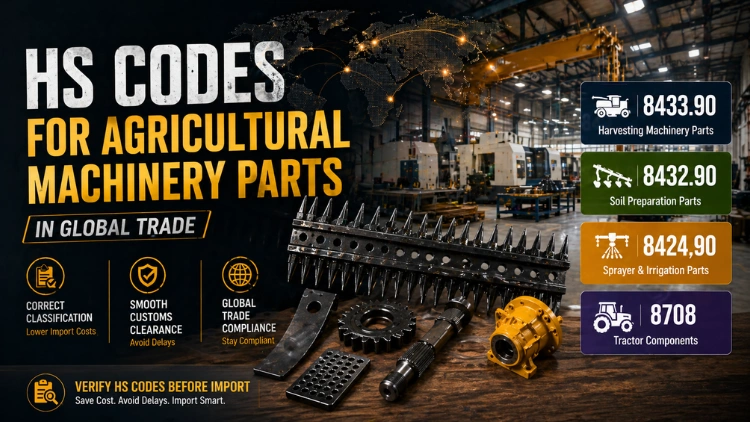
What are HS Codes for Agricultural Machinery Parts?
Incorrect HS classification can increase your import costs by up to 15% and lead to shipment delays or penalties at customs. For importers dealing with agricultural machinery parts, choosing the right HS code is critical for smooth global trade.
HS codes (Harmonized System codes) are globally standardized numerical codes used to classify traded goods, including agricultural machinery parts.
These codes are developed and maintained by the World Customs Organization and are used by more than 200 countries to ensure uniform classification in international trade.
For importers, HS codes are essential to:
- Determine import duties and taxes
- Ensure customs compliance
- Avoid shipment delays and penalties
- Calculate accurate landed cost before importing goods
The World Trade Organization supports global trade frameworks where HS classification plays a key role in tariff regulation and trade facilitation.
Most agricultural machinery parts fall under HS Chapter 84. Common classifications include:
- 8433.90 → Harvesting machinery parts
- 8432.90 → Soil preparation machinery parts
- 8424.90 → Sprayer and irrigation parts
- 8708 → Tractor and vehicle components
Most Common HS Codes for Agricultural Machinery Parts
| Product Category | Examples | HS Code | Description |
| Harvesting Machinery Parts | Rasp bars, cutter bars, blades | 8433.90 | Parts of harvesting machinery |
| Threshing Components | Concaves, drum parts | 8433.90 | Threshing machinery parts |
| Soil Preparation Parts | Rotavator blades, plough parts | 8432.90 | Soil preparation machinery parts |
| Tractor Spare Parts | Shafts, transmission parts | 8708 | Tractor and vehicle parts |
| Sprayer & Irrigation Parts | Pumps, nozzles | 8424.90 | Spraying equipment parts |
👉 Insight: HS Code 8433.90 is one of the most widely used classifications globally, especially for combine harvester parts like rasp bars and blades.This is particularly relevant for buyers sourcing combine harvester components such as rasp bars and blades from suppliers like JCBL Agri, where correct classification ensures accurate duty calculation.
Who Regulates HS Codes Globally?
HS codes are governed by:
1. World Customs Organization
- Develops and updates the HS classification system
- Ensures global uniformity
- Updates HS codes approximately every 5 years
2. World Trade Organization
- Supports global trade rules and tariff systems
- Uses HS codes for tariff negotiations and agreements
- Promotes smoother international trade
Together, these organizations ensure consistency and transparency in global import-export classification systems.
Why HS Codes Matter for Importers
1. Accurate Landed Cost Calculation
HS codes directly determine:
- Import duties
- Taxes (GST/VAT)
- Customs charges
Incorrect classification can increase total import cost by 5–15% due to penalties or overpaid duties.
2. Faster Customs Clearance
Correct HS classification reduces:
- Customs inspections
- Documentation errors
- Border delays
This improves supply chain efficiency and delivery timelines.
3. Duty Reduction via Trade Agreements
Using correct HS codes allows importers to benefit from:
- Free Trade Agreements (FTAs)
- Preferential tariff structures
4. Better Global Sourcing Decisions
HS codes help importers:
- Compare supplier pricing globally
- Analyze trade data
- Identify low-duty sourcing markets
Pro Tip for Importers
Never rely solely on supplier-provided HS codes. These are often generic and may not match your country’s classification system, leading to compliance issues.
How HS Codes Work in Import Classification
Step 1: Identify Product Function
Classification depends on usage—not product name:
- Rasp bar → harvesting machinery
- Rotavator blade → soil preparation
Step 2: Match HS Chapter
- Chapter 84 → Agricultural machinery
- Chapter 87 → Tractors and vehicles
Step 3: Select Subheading
Examples:
- Harvesting parts → 8433.90
- Soil preparation → 8432.90
Step 4: Apply Country-Specific Extensions
While HS codes are standardized up to 6 digits, countries extend them:
- India → ITC HS (8-digit system)
- United States → HTS (10-digit system)
- European Union → TARIC system
👉 The TARIC system (Integrated Tariff of the European Union) includes duties, restrictions, and trade regulations across EU member states.
Step 5: Verify Before Import
Always confirm HS codes using:
- Official customs databases
- Import country tariff schedules
- Licensed customs brokers
Real-World Example
Imagine an importer classifies a rotavator blade under 8433 (harvesting machinery) instead of 8432 (soil preparation equipment).
Result:
- Incorrect duty calculation
- Customs objections
- Shipment delays
This shows how even small classification errors can impact cost and logistics.
HS Code Systems in Major Import Markets
United States
- Uses 10-digit HTS system
- Strict compliance rules
- Errors can lead to fines or delays
European Union
- Uses TARIC classification system
- Covers duties, restrictions, and regulations
- Ensures uniformity across member countries
India
- Uses 8-digit ITC HS system
- Required for GST and customs compliance
- Major importer of agricultural machinery parts
Middle East & Africa
- Follow HS-based GCC tariff systems
- High demand for replacement parts
- Growing import-driven markets
How Importers Can Find the Correct HS Code
To ensure accuracy:
- Map each product clearly
- Identify function and application
- Match with correct HS chapter
- Verify using official databases
- Cross-check with experts
👉 Best Practice: Align product descriptions with terminology used by the World Customs Organization to avoid disputes.
Common Challenges for Importers
- Same part used in multiple machines
- Incorrect supplier HS codes
- Country-specific classification differences
- Frequent HS updates
- Documentation mismatches
Common Mistakes Importers Should Avoid
- Using one HS code for all parts
- Ignoring country-specific extensions
- Poor product descriptions
- Not verifying codes before shipment
Conclusion
For importers, HS codes are more than just regulatory numbers; they directly impact cost, compliance, and supply chain efficiency.
By correctly classifying agricultural machinery parts under systems governed by the World Customs Organization (WCO) and supported by the World Trade Organization(WTO), businesses can achieve:
- Lower landed costs
- Faster customs clearance
- Reduced compliance risks
- Smarter sourcing decisions
If you’re importing agricultural machinery parts, always verify your HS codes before shipment, as this small step can save significant time, cost, and operational risk. You can also check our guide on importing agri parts from India for a better understanding of the overall process.
FAQs
Rasp bars are typically classified under HS code 8433.90, as they are components of harvesting machinery.
No, different categories have different HS codes. For example, harvesting parts fall under 8433, while soil preparation parts are classified under 8432.
Yes, HS codes are standardized up to 6 digits, but countries use extended 8–10 digit codes for specific classifications.
Accurate HS classification is critical, as it affects import duties, customs compliance, and shipment clearance timelines.
HS codes are updated approximately every 5 years, so exporters should review classifications regularly or when revisions are announced.