
 (+91) 842-700-1426
  agriparts@jcblmail.com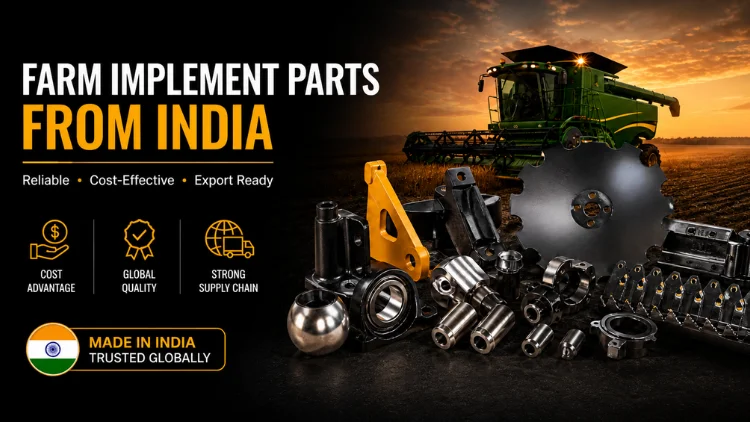
Global distributors source farm implement parts from India because the country offers a unique combination of cost efficiency, large-scale manufacturing, consistent quality, and export reliability. With a mature supplier ecosystem and strong global trade experience, India has become a strategic sourcing hub for agricultural parts across emerging and developed markets.
Key Takeaways: Why Global Distributors Choose India for Farm Implement Parts
- Cost-to-Value Advantage: India offers competitive pricing without compromising on durability, helping distributors maintain healthy margins.
- Scalable Manufacturing: A strong industrial ecosystem enables consistent production for both small and bulk orders.
- Global Quality Standards: Leading exporters follow internationally recognized certifications and strict quality control processes.
- Reliable Supply Chain: Established export infrastructure ensures predictable lead times and smooth global shipping.
- Flexible Partnerships: Indian suppliers support customization, private labeling, and adaptable order volumes.
- Diverse Supplier Base: Access to both OEM and aftermarket manufacturers allows distributors to streamline sourcing.
- Growing Global Trust: Increasing exports and repeat partnerships reflect India’s credibility in agricultural supply chains.
What Drives Global Demand for Farm Implement Parts from India?
India’s growing prominence in the agricultural supply chain is driven by both production capacity and global demand shifts. As distributors expand into cost-sensitive and high-growth markets, they increasingly look for sourcing regions that can deliver volume, consistency, and competitive pricing.
Indian exporters supply to regions such as Africa, the Middle East, Eastern Europe, and Latin America, where demand for durable and affordable farm equipment components is rising. Additionally, many distributors are diversifying sourcing beyond traditional markets, positioning India as a reliable alternative with scalable capabilities.
Why Is India Considered a Strategic Sourcing Hub for Distributors?
India’s advantage lies in its well-established manufacturing ecosystem. Specialized industrial clusters, particularly in regions like Punjab, Gujarat, and Maharashtra, enable efficient production through integrated vendor networks, skilled labor, and access to raw materials.
Distributors benefit from:
- A wide base of OEM and aftermarket suppliers
- The ability to source multiple components from a single region
- Strong technical expertise built over decades in agricultural manufacturing
This ecosystem reduces dependency on fragmented supply chains and improves procurement efficiency.
How Does India Deliver Cost Advantage Without Compromising Value?
India’s cost competitiveness is not just about lower prices-it’s about better value per unit over the long term. Manufacturers optimize costs through:
- Efficient labor utilization
- Economies of scale
- Streamlined production processes
For global distributors, this translates into:
- Improved margins
- Competitive pricing in local markets
- Sustainable sourcing without sacrificing durability or performance
Unlike low-cost alternatives that may compromise on quality, Indian suppliers often balance affordability with engineering reliability, making them suitable for long-term distribution.
How Do Indian Suppliers Maintain Consistency in Large-Scale Orders?
Consistency is a critical requirement for distributors handling bulk orders and repeat shipments. Indian manufacturers address this through:
- Standardized production protocols
- Batch-level quality checks
- Process-driven manufacturing systems
Many exporters invest in modern machinery and quality control labs, ensuring that each shipment meets defined specifications. This level of operational discipline is essential for distributors who rely on uniform product performance across markets.
What Quality and Compliance Standards Do Indian Exporters Follow?
To compete globally, Indian exporters align with international quality and compliance standards. Most established suppliers adhere to:
- ISO certifications (quality management systems)
- CE compliance (where applicable)
- Export documentation and traceability norms
Additionally, exporters often conduct:
- Pre-dispatch inspections
- Material testing
- Dimensional accuracy checks
These practices reduce risk for buyers and ensure that products meet regulatory and performance expectations in international markets.
Why Do Distributors Prefer Long-Term Partnerships with Indian Suppliers?
Beyond pricing and quality, distributors value relationship-driven sourcing, and Indian suppliers are known for their flexibility and responsiveness.
Key advantages include:
- Custom manufacturing and private labeling options
- Adaptability to changing order volumes
- Open communication and faster issue resolution
This partnership approach enables distributors to build stable, long-term supply chains, rather than relying on transactional sourcing.
How Reliable Is India for Global Supply Chain and Timely Delivery?
India has significantly strengthened its export infrastructure, making it a dependable sourcing destination for global buyers. Key strengths include:
- Access to major ports and logistics networks
- Experience in handling bulk export shipments
- Structured documentation and export processes
Suppliers with established export operations typically offer predictable lead times and shipment planning, which is crucial for distributors managing inventory across multiple regions.
How Does India Compare with Other Global Sourcing Markets?
| Factor | India | China | Europe |
| Cost Efficiency | High | Moderate | Low |
| Manufacturing Flexibility | High | Medium | Low |
| Quality Consistency | High | Variable | Very High |
| Customization | Strong | Moderate | Limited |
| Long-Term Value | High | Moderate | High (but expensive) |
India stands out for its balance of cost, quality, and flexibility, making it particularly suitable for distributors targeting diverse and price-sensitive markets.
What Factors Should Distributors Evaluate Before Choosing an Indian Supplier?
To ensure successful sourcing, distributors should conduct structured supplier evaluations. Key considerations include:
- Certifications and compliance standards
- Export experience and market presence
- Production capacity and scalability
- Quality assurance processes
- Communication and responsiveness
Red flags to watch for:
- Lack of documentation or certifications
- Inconsistent communication
- Unclear production timelines
A thorough evaluation helps mitigate risks and ensures reliable long-term partnerships.
Is India a Scalable Long-Term Sourcing Partner for Agricultural Parts?
India is increasingly viewed as a future-ready sourcing destination. With ongoing investments in manufacturing technology, infrastructure, and export facilitation, the country is well-positioned to support growing global demand.
Government initiatives promoting manufacturing and exports further strengthen India’s position as a long-term partner for agricultural supply chains. For distributors, this means access to a sourcing ecosystem that can scale alongside business growth.
Conclusion
India has evolved into more than just a cost-effective sourcing option-it is now a strategic partner for global distributors of farm implement parts. With its strong manufacturing ecosystem, export expertise, and ability to deliver consistent value, India enables distributors to build resilient and scalable supply chains in an increasingly competitive global market.
For businesses looking to optimize sourcing while maintaining quality and flexibility, India continues to stand out as a reliable and future-ready destination.
FAQs
Because India offers a strong combination of competitive pricing, reliable quality, and scalable manufacturing, making it ideal for long-term sourcing.
Yes, established exporters follow standardized production and quality control processes, ensuring consistency across large shipments.
India provides a balanced advantage of cost, flexibility, and quality, unlike regions that may excel in only one aspect.
Through certifications, batch testing, and process-driven manufacturing systems that maintain uniform standards.
Yes, many suppliers offer OEM and private labeling services, allowing distributors to build their own brand.