
 (+91) 842-700-1426
  agriparts@jcblmail.com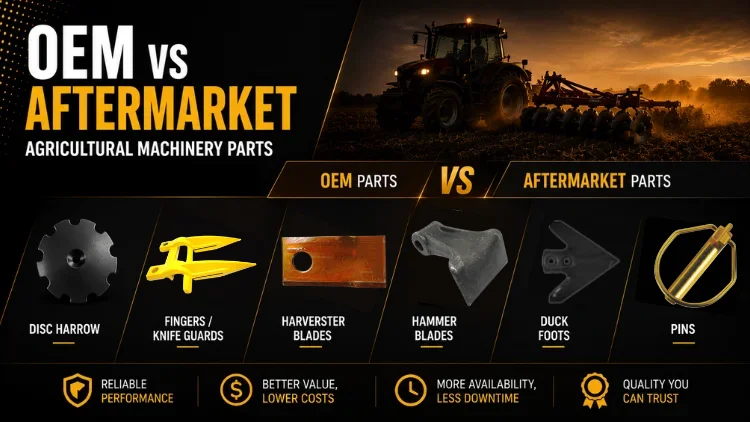
OEM vs. aftermarket agricultural machinery parts is a critical decision for buyers, balancing equipment reliability, maintenance costs, and supply chain efficiency.
OEM (Original Equipment Manufacturer) parts are made by or for the original equipment brand to match exact specifications. Aftermarket parts are produced by third-party manufacturers and offer alternative options in terms of pricing, availability, and sourcing flexibility.
As global demand for agricultural machinery grows, buyers across the USA, Europe, the Middle East, and Africa are increasingly evaluating which option delivers the best long-term value, performance, and supply reliability.
What Is the Difference Between OEM and Aftermarket Parts?
OEM parts are original components made to exact manufacturer specifications, while aftermarket parts are third-party alternatives designed to perform the same function, often with more pricing and sourcing flexibility.
What Are OEM Agricultural Machinery Parts?
OEM agricultural parts are original components manufactured to match the exact design, material, and performance standards of the equipment brand.
Key characteristics
- Exact fit and compatibility
- Consistent manufacturing standards
- Backed by brand specifications
- Typically distributed through authorized dealer networks
Best suited for:
- New or warranty-covered equipment
- Critical components (engine, transmission, hydraulics)
- Compliance-sensitive applications
What Are Aftermarket Agricultural Machinery Parts?
Aftermarket parts are replacement components manufactured by independent suppliers to function similarly to OEM parts.
Key characteristics
- Produced by third-party manufacturers
- Available in multiple quality tiers
- More flexible pricing options
- Wider distribution across markets
Aftermarket parts are not inherently low quality. Their performance depends on the manufacturer’s capability, materials, and quality control processes.
OEM vs Aftermarket Parts: Key Differences
| Factor | OEM Parts | Aftermarket Parts |
| Manufacturer | Original brand | Third-party supplier |
| Fit & Compatibility | Exact match | May vary by supplier |
| Quality Consistency | High | Varies |
| Cost | Higher upfront | Lower to moderate |
| Availability | Dealer-dependent | Widely available |
| Customization | Limited | Flexible |
OEM parts prioritize precision and consistency, while aftermarket parts offer cost flexibility and broader availability.
Cost vs Value: What Buyers Should Actually Evaluate
The real decision is not OEM vs. aftermarket, it is total cost of ownership (TCO).
What impacts total cost:
- Purchase price
- Replacement frequency
- Equipment downtime
- Maintenance efficiency
- Lifecycle performance
A lower-cost part that fails more often can increase overall operational expenses due to downtime, which is why many importers and distributors focus on long-term cost optimization strategies rather than only comparing initial purchase prices.
Performance, Durability & Reliability
OEM parts are engineered for consistent performance, while high-quality aftermarket parts can achieve comparable results depending on manufacturing standards.
Key performance factors:
- Material quality and heat treatment
- Precision in machining and tolerances
- Fit accuracy and alignment
- Quality testing and inspection
Performance differences are often driven more by supplier quality than by whether the part is OEM or aftermarket.
Availability & Supply Chain Considerations
Availability is a major differentiator, especially for global buyers.
Key differences:
- OEM parts rely on brand dealer networks
- Aftermarket parts are available through multiple suppliers
- Faster access reduces equipment downtime
In regions with limited dealer infrastructure, such as parts of Africa, the Middle East, and rural agricultural markets, aftermarket parts often provide more reliable access.
Global Demand & Trade Reality
Agricultural machinery parts are part of the broader global trade in engineering and farm equipment components.
Verified industry context
- The Food and Agriculture Organization highlights mechanization and maintenance as key drivers of agricultural productivity
- Trade data from UN Comtrade shows consistent global imports of tractor parts, harvester components, and farm equipment spares
- The USDA emphasizes the importance of equipment uptime and maintenance efficiency in farm operations
Reliable access to spare parts, OEM or aftermarket, is essential for minimizing downtime and maintaining productivity.
When to Choose OEM Parts
Choose OEM parts when:
- Equipment is under warranty
- Exact fit and compatibility are required
- The component is critical to machine performance
- Manufacturer compliance is necessary
- Downtime risk must be minimized
When to Choose Aftermarket Parts
Choose aftermarket parts when:
- Cost optimization is a priority
- Parts are non-critical (filters, wear parts, accessories)
- Faster availability is needed
- Multiple sourcing options are preferred
- Customization is required
What Experienced Buyers Actually Do
Most large buyers do not choose OEM or aftermarket exclusively; they use a hybrid sourcing strategy.
Common approach
- OEM parts for critical components
- Aftermarket parts for wear-and-tear replacements
Why this works:
- Maintains performance reliability
- Reduces overall maintenance costs
- Improves supply flexibility
This strategy is widely used by importers, distributors, and large farm operators, managing cost and uptime simultaneously.
Common Mistakes Buyers Should Avoid
- Choosing the lowest-cost part without evaluating quality
- Ignoring supplier credibility and certifications
- Not considering downtime costs
- Assuming all aftermarket parts are low quality
- Over-relying on OEM parts where alternatives are viable
Poor sourcing decisions often result in higher long-term costs, even if initial savings seem attractive.
OEM vs Aftermarket: Quick Decision Guide
Use this simple framework:
- Need maximum reliability → Choose OEM
- Need cost savings → Choose Aftermarket
- Critical component → OEM
- Wear-and-tear part → Aftermarket
- Limited availability → Aftermarket
- Warranty requirement → OEM
How to Choose a Reliable Supplier
Supplier quality is the most important factor in sourcing success.
Evaluate based on:
- Certifications (ISO and quality standards)
- Manufacturing capabilities
- Export experience
- Product consistency
- Quality inspection processes
Red flags:
- Lack of documentation
- Inconsistent specifications
- Poor communication
- No clear quality control
For global buyers, supplier reliability directly impacts product performance, delivery timelines, and business reputation.
Industries & Buyers That Use OEM vs Aftermarket Parts
Both OEM and aftermarket parts are widely used across:
- Agricultural equipment dealers
- Farm owners and operators
- Importers and distributors
- Repair and maintenance providers
Usage trend:
- OEM parts dominate in new equipment and critical applications
- Aftermarket parts dominate in maintenance and replacement cycles
Conclusion
Choosing between OEM and aftermarket agricultural machinery parts is not about selecting one over the other; it’s about making informed, application-based decisions.
For buyers across the USA, Europe, the Middle East, and Africa, the most effective approach is to balance cost, performance, and availability while working with reliable suppliers.
A strategic sourcing approach, often combining OEM and aftermarket parts, helps reduce downtime, control costs, and ensure consistent equipment performance in demanding agricultural operations.
FAQs
OEM parts are made by the original manufacturer, while aftermarket parts are produced by third-party suppliers.
Yes, high-quality aftermarket parts can be reliable, depending on the manufacturer and quality standards.
Neither is universally better; the choice depends on the application, cost considerations, and performance requirements.
Performance depends on quality; well-manufactured aftermarket parts can perform similarly to OEM parts.
OEM parts are best for critical components, warranty protection, and applications requiring exact compatibility.