Container Shipping Guide for Agricultural Machinery Parts Export

Exporting agricultural machinery parts globally is a high-value but logistics-sensitive operation. From avoiding transit damage and corrosion to ensuring smooth customs clearance, container shipping plays a critical role in profitability and delivery reliability. This guide breaks down how to ship agricultural machinery parts in containers efficiently, covering container types, packaging, costs, compliance, and expert best practices used by exporters shipping to the USA, EU, Africa, and Southeast Asia. Key Takeaways What Is Container Shipping for Agricultural Machinery Parts? This is the process of transporting spare components for tractors and harvesters in standardized containers via sea freight, ensuring safe handling, cost efficiency, and compliance with international export regulations. These shipments typically include: CKD (Completely Knocked Down) kits for assembly Types of Shipping Containers Used Choosing the right container directly impacts overall shipping costs, cargo protection, and regulatory compliance. Each container type is designed to handle specific sizes, weights, and loading requirements for agricultural machinery parts. 1. Standard Dry Containers (20ft & 40ft) Standard dry containers are the most widely used for shipping agricultural machinery parts. They are ideal for packed spare parts, boxed components, and palletized cargo, offering cost efficiency and easy handling. 2. High Cube Containers High cube containers are suitable for lightweight yet bulky machinery parts. With approximately one extra foot in height compared to standard containers, they allow better volume utilization and more efficient stacking. 3. Open Top Containers Open-top containers are designed for oversized machinery parts that cannot be easily loaded through standard doors. They have no fixed roof and are covered with tarpaulin, allowing crane-based loading. 4. Flat Rack Containers Flat rack containers are used for transporting heavy, irregular, or out-of-gauge agricultural machinery parts. Without side walls, they provide flexibility for loading large equipment such as frames and structures. Container Comparison Table Container Type Best For Max Weight Capacity Key Benefit 20ft Dry Dense spare parts ~28 tons Cost-effective for heavy cargo 40ft Dry Bulk shipments ~26 tons Better for volume High Cube Bulky items ~26 tons Extra height Open Top Oversized cargo ~26 tons Top loading Flat Rack Heavy machinery Varies Handles irregular shapes How to Choose the Right Container for Machinery Parts Step-by-Step Process to Ship Machinery Parts in a Container Expert Insight: Common Export Mistakes to Avoid Based on real export operations, many businesses face losses due to avoidable mistakes such as incorrect HS codes, poor packaging, and inefficient container utilization. For example, exporters shipping to African ports often experience delays due to incomplete documentation or port congestion. Packaging Guidelines for Agricultural Machinery Parts Improper packaging is one of the leading causes of export losses. Key Packaging Practices ISPM-15 Compliance All wooden packaging must comply with ISPM-15 standards to prevent quarantine issues. Packaging Checklist Documentation Required for Export Accurate documentation ensures smooth customs clearance and avoids shipment holds. Document Purpose Mandatory Commercial Invoice Declares transaction value Yes Packing List Details cargo contents Yes Bill of Lading Proof of shipment Yes Certificate of Origin Confirms origin country Often required Insurance Certificate Covers cargo risk Recommended Phytosanitary Certificate For wood packaging compliance Conditional Cost Breakdown of Container Shipping Understanding cost components helps in pricing and negotiation. Key Cost Elements Sample Cost Estimate (India → USA/EU) Cost Component Approximate Range Ocean Freight (20ft) $1,200 – $3,000 THC & Port Charges $150 – $400 Inland Transport $100 – $500 Documentation $50 – $150 Insurance 0.3% – 0.8% of cargo value Note: Rates vary based on season, route, and fuel prices. How to Calculate Container Load Efficiency Efficient loading reduces shipping cost per unit. Basic Formula CBM (Cubic Meter) = Length × Width × Height (in meters) Optimization Tips Common Challenges in Shipping Machinery Parts Shipping agricultural machinery parts internationally involves multiple risks that can impact cost, delivery timelines, and cargo safety. Understanding these common challenges and their solutions helps exporters ensure smoother, more reliable shipments. 1. Transit Damage Transit damage occurs mainly due to inadequate packaging or improper handling during loading and transport. Using shockproof crates, cushioning materials, and secure loading methods minimizes movement and protects parts effectively. 2. Rust & Corrosion Exposure to moisture during sea transit can lead to rust and corrosion, especially for metal components. Applying VCI materials and anti-rust coatings and including desiccants helps maintain product quality throughout the journey. 3. Customs Delays Customs delays are often caused by incorrect HS codes, incomplete documentation, or regulatory non-compliance. Double-checking product classification and ensuring accurate, complete paperwork help prevent costly delays and penalties. 4. Container Space Wastage Poor container planning leads to unused space and higher shipping costs per unit. Optimizing palletization, stacking efficiently, and planning load layouts improves space utilization and reduces overall logistics expenses. International Shipping Regulations & Compliance Understanding international shipping regulations is essential to avoid delays, penalties, and rejected shipments. Exporters must follow global standards, use correct trade terms, and comply with country-specific import requirements. ISPM-15 (Wood Packaging Regulation) ISPM-15 is a global standard for wooden packaging materials such as pallets and crates. It requires heat treatment or fumigation to prevent pest contamination, and it is mandatory for exports to most countries. Incoterms (Key Trade Terms) Incoterms define the responsibilities of buyers and sellers in international trade, including cost, risk, and delivery points. Choosing the right term ensures clarity and avoids disputes during shipping. Country-Specific Rules Each region has its own import regulations, documentation requirements, and clearance processes that exporters must follow carefully. Best Practices to Reduce Shipping Costs Conclusion Container shipping is essential for scaling agricultural machinery exports globally. By combining proper packaging, accurate documentation, and optimized container usage, exporters can significantly reduce risks, prevent damage, and control logistics costs. For businesses supplying agricultural machinery parts internationally, aligning product quality with efficient shipping practices ensures better customer satisfaction and long-term growth in competitive global markets. Looking for reliable agricultural machinery parts for export? Partner with a trusted supplier that understands global shipping requirements and delivers quality components ready for international markets. FAQs

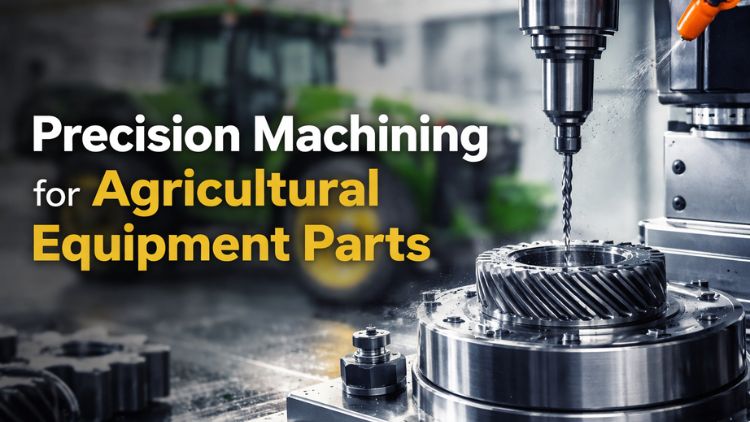
Precision Machining in Agricultural Machinery Parts Manufacturing

Modern agriculture depends heavily on machines that must perform reliably under tough conditions, dust, moisture, heavy loads, and long working hours. Whether it’s a tractor in the field or a harvester during peak season, even a small component failure can lead to costly downtime, delayed harvests, and revenue loss This is where precision machining plays a critical role. Precision machining ensures agricultural machinery parts are manufactured with extremely tight tolerances, improving performance, durability, and reliability, even in harsh operating environments. In today’s competitive agricultural equipment market, precision is not just about accuracy, it directly impacts machine uptime, lifecycle cost, and operational efficiency. What is Precision Machining? Precision machining is a manufacturing process where components are produced with high dimensional accuracy (often within microns) using advanced equipment such as CNC (Computer Numerical Control) machines. Unlike conventional machining, precision machining focuses on: Why Tolerances Matter In agricultural machinery, even minor dimensional deviations can lead to: Example: A transmission gear in a tractor must mesh perfectly with adjacent gears. A deviation of even a few microns can cause inefficient power transfer, overheating, or premature failure. Why Precision Matters in Agricultural Machinery Agricultural equipment operates in high-load, high-friction, and contamination-prone environments. Unlike controlled industrial settings, farm machinery faces unpredictable field conditions daily. Key Stress Factors: Precision machining directly addresses these challenges by improving component integrity. Key Roles of Precision Machining: Precision-machined components can significantly reduce failure rates and improve overall equipment effectiveness (OEE) in agricultural machinery. Key Agricultural Parts Manufactured Using Precision Machining Precision machining is essential for producing high-performance, load-bearing, and motion-critical components. Common Precision-Machined Parts: Component Type Function Precision Requirement Gear shafts & gears Power transmission High dimensional accuracy & surface finish Hydraulic valves & cylinders Fluid control systems Leak-proof tolerances Crankshafts & pistons Engine performance High strength & balance Bushings & bearings Reduce friction Tight clearance control Couplings & fasteners Mechanical stability Consistent threading & fit These components must maintain dimensional stability under stress, making precision machining indispensable. Benefits of Precision Machining for Agricultural Parts Manufacturing For Manufacturers Precision machining enables manufacturers to achieve operational efficiency and quality consistency at scale. For Buyers (OEMs, Exporters, Agri Equipment Companies) For B2B buyers, precision machining directly influences product reliability and lifecycle cost. Precision-machined components can reduce total cost of ownership (TCO) by lowering maintenance frequency and extending equipment life cycles. Technologies Used in Precision Machining Modern agricultural parts manufacturing relies on advanced technologies to achieve accuracy and efficiency. The key technologies include the following: These technologies allow manufacturers to produce parts that meet strict industry standards and performance requirements. Materials Used in Agricultural Machinery Parts Material selection is just as important as machining accuracy. Common Materials: Each material is chosen based on: Challenges in Precision Machining for Agriculture Despite its advantages, precision machining in agriculture comes with specific challenges: Manufacturers must balance cost, precision, and durability to remain competitive. How to Choose the Right Precision Machining Partner For B2B buyers, selecting the right manufacturing partner is critical. Checklist for Evaluation: A reliable precision machining manufacturing partner ensures consistent quality, timely delivery, and long-term cost savings. Future Trends in Precision Machining for Agriculture The industry is evolving with new technologies and smarter processes. Emerging Trends: These trends are helping manufacturers produce more efficient, durable, and environmentally friendly components. Conclusion Precision machining is no longer optional in agricultural machinery parts manufacturing; it has become essential for ensuring performance, durability, and operational efficiency. By maintaining tight tolerances and consistent quality, it enables manufacturers to improve production efficiency, helps buyers reduce maintenance costs and downtime, and ensures farmers can rely on equipment during critical operations. As agricultural demands continue to grow, the importance of precision-engineered components will only become more significant. FAQs
Agricultural Machinery Parts Manufacturer in India: What Importers Should Know

Key Takeaways The global agricultural machinery market is evolving rapidly, driven by mechanization, sustainability, and stricter regulatory standards. For importers, sourcing the right parts is no longer just about price, it’s about compliance, reliability, and long-term scalability. India has positioned itself as a global manufacturing hub for agricultural machinery parts. With strong engineering capabilities, export experience, and new trade advantages in 2026, India offers both cost and compliance benefits to global buyers. This guide helps importers, distributors, and OEM buyers understand what truly matters when sourcing from India in today’s regulatory and trade environment. Why Choose an Agricultural Machinery Parts Manufacturer in India? India offers a unique combination of affordability, quality, and scalability that makes it highly attractive for global buyers. Key Advantages: Types of Agricultural Machinery Parts Exported from India Indian manufacturers supply a broad spectrum of components used in modern farming equipment. Common Categories: 2026 Regulatory Update: TREM V Compliance (Critical for Importers) As of October 1, 2026, India’s TREM V emission norms require tractor parts, especially for engines above 75 HP and below 25 HP, to meet stricter, EU-aligned standards. For importers, this means ensuring all sourced engine, fuel, and exhaust components carry advanced Type Approval certification to avoid compliance issues or rejection in destination markets. What This Means: Why It Matters: Importers must ensure that sourced parts, especially engines and exhaust systems, are TREM V compliant, or they may face regulatory issues in their destination markets. Key Factors Importers Should Check Before Choosing a Manufacturer This is the most critical step for ensuring a successful import experience. 1. Certifications & Quality Standards Look for manufacturers with: 2. Manufacturing Capabilities Evaluate: 3. Export Experience Choose suppliers who: 4. Material Quality & Testing Ensure: 5. Pricing Transparency Check for: 6. Communication & Responsiveness Reliable suppliers: Import Regulations & Documentation You Must Know (2026 Update) Key Documents Required: New Addition (2026): FEMA Regulations 2026: What Importers Must Know Effective October 1, 2026, the updated FEMA regulations improve ease of doing business. Key Benefits: Value Insight: This makes India a more flexible sourcing partner for small and mid-sized importers, especially for trial orders and smaller MOQs. TREM IV vs TREM V: Quick Comparison for Importers Feature TREM IV TREM V (2026) Emission Standards Moderate Stricter (EU-aligned) Engine Efficiency Standard Improved Environmental Impact Higher emissions Lower emissions Compliance Requirement Basic certification Advanced Type Approval Export Compatibility Limited Global-ready Common Challenges Faced by Importers (And How to Avoid Them) Even experienced importers face issues. Being prepared reduces risk significantly. Incorrect Product Specifications: Confirm details with pre-production samples and approvals. How to Identify a Reliable Agricultural Machinery Parts Manufacturer in India Choosing the right partner is more important than choosing the lowest price. Practical Steps: Why Long-Term Partnerships Matter in Agricultural Imports Building a long-term relationship with a manufacturer offers multiple benefits: In global trade, reliability often matters more than cost savings. Conclusion India has positioned itself as a reliable and competitive hub for agricultural machinery parts manufacturing. For importers, the opportunity is significant—but success depends on careful supplier selection, quality checks, and a clear understanding of import processes. By focusing on certifications, communication, and long-term partnerships, importers can build a stable and profitable supply chain from India. FAQs

Disc Harrow Axles: Structural Strength, Load Capacity & Export Standards Guide

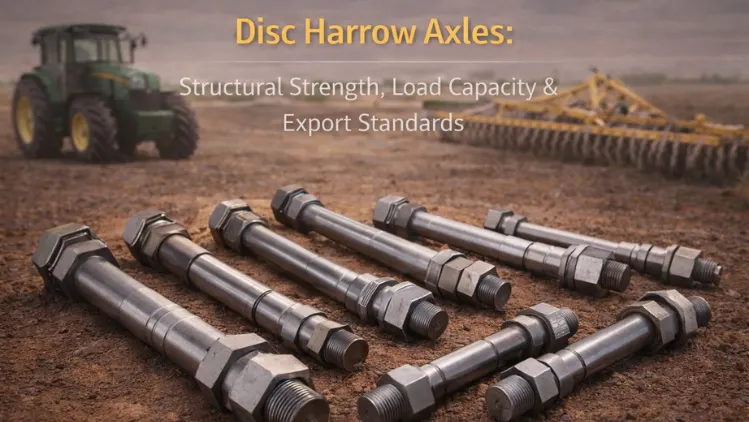
A disc harrow axle is a precision-engineered, load-bearing steel shaft that supports disc gangs, maintains alignment, and transmits torsional force in agricultural disc harrow assemblies. It operates under continuous bending stress, vibration, and torque loads, making material strength, heat treatment, and machining accuracy critical for long-term field performance. A qualified disc harrow axles manufacturer designs axles according to tensile strength requirements, hardness standards, dimensional tolerances, and export compliance norms to ensure safe and durable agricultural operation. This guide explains engineering standards, material grades, stress calculations, testing benchmarks, and procurement criteria used by OEMs and global importers. Function of Disc Harrow Axles in Implement Assembly The axle is the structural spine of the disc gang assembly. Its core functions include: 1. Structural Load Support The axle carries the combined weight of: Failure in this component compromises the entire implementation. 2. Torque Transmission During field penetration, rotational resistance from soil generates torsional forces. These forces are directly transferred to the axle shaft. High torsional strength prevents twisting or shear failure. 3. Bearing Interface Stability The axle must match bearing inner diameter tolerances (typically H7/h6 fits depending on the design). Improper fitment causes the following: 4. Alignment & Runout Control Straightness tolerance ensures discs cut soil uniformly. Excessive runout increases frame stress and uneven tillage depth. For a broader understanding of system integration, refer to our guide on farm implements replacement parts, where axle compatibility with other structural components is explained. Material Grades Used in Disc Harrow Axles Disc harrow axles are typically manufactured using EN8, EN19 (AISI 4140 equivalent), or 42CrMo4 alloy steel. Alloy grades are preferred for heavy-duty applications due to higher tensile strength (850–1100 MPa) and improved fatigue resistance under torsional loading. Commonly Used Grades Grade Equivalent Standard Tensile Strength Application Type EN8 IS 1570 / ASTM A29 550–700 MPa Standard-duty disc harrows EN19 AISI 4140 850–1000+ MPa (HT) Heavy-duty & export applications 42CrMo4 DIN Alloy Steel 900–1100 MPa (HT) High-load commercial implements Why Alloy Steel Is Preferred for Export Alloy steels such as EN19 and 42CrMo4 offer: Engineering Insight Torsional shear stress (τ) in a solid shaft increases proportionally with torque and inversely with shaft diameter. Therefore, both material grade and shaft diameter must be engineered together for safe load capacity. Heat Treatment & Hardness Standards Heat treatment improves wear resistance, torsional strength, and fatigue life of disc harrow axles by enhancing both surface durability and internal core toughness. Why Controlled Hardness Is Critical Excessive hardness can increase brittleness and crack susceptibility, while insufficient hardness may cause accelerated wear, plastic deformation, and reduced operational lifespan. Reputable manufacturers follow: Uniform hardness across the shaft minimizes stress concentration points, significantly reducing the risk of fatigue cracking under repeated cyclic loading conditions in field operations. Dimensional Accuracy & Machining Precision Dimensional accuracy is critical to the structural integrity and service life of disc harrow axles. Even minor deviations in diameter, concentricity, or straightness can cause bearing misalignment, uneven disc rotation, vibration stress, and premature component failure. Precision machining ensures compatibility with bearings, spacers, and disc assemblies under dynamic agricultural loads. 1. CNC Turning & Concentricity Modern CNC turning centers maintain tight dimensional tolerances and concentricity control across high-volume batch production. Proper concentricity minimizes rotational imbalance, reduces vibration, and improves torque transmission efficiency during field operation. 2. Thread Accuracy Threaded ends must conform to ISO metric thread standards to ensure secure fastening under high-vibration conditions. Incorrect pitch, flank angle, or thread depth can result in loosening, stripping, or uneven load distribution during operation. 3. Straightness Tolerance Straightness is typically controlled within defined limits based on shaft diameter and length specifications. Excessive runout increases bending stress, accelerates bearing wear, and compromises uniform soil penetration performance. 4. Surface Finish Surface roughness values (Ra) are carefully controlled in bearing seating zones to improve fitment accuracy, reduce frictional heat generation, and prevent micro-movement that may lead to fretting corrosion. Quality Verification & Documentation Before bulk procurement, buyers should verify technical documentation from a trusted disc harrow axles supplier, including: Traceable inspection documentation ensures compliance with engineering tolerances and reduces rejection risk in international shipments. Load Capacity & Stress Testing Load capacity determines whether a disc harrow axle can withstand torsional, bending, and cyclic field stresses without permanent deformation or premature failure. 1. Torque Testing Torque testing simulates rotational soil resistance under controlled laboratory conditions to verify torsional strength, shear limits, and resistance to twisting under operational load. 2. Static Load Testing Static load testing applies calibrated bending force to measure yield threshold, elastic recovery behavior, and structural deflection limits under defined weight conditions. 3. Fatigue Testing Fatigue testing replicates repeated cyclic stress to evaluate long-term durability and predict service life under continuous agricultural field operations. 4. Material Certification Mill Test Certificates (MTC) verify chemical composition, tensile strength, yield strength, elongation properties, and conformity of heat treatment to specified mechanical standards. Reputable manufacturers provide documentation aligned with ASTM, DIN, or equivalent international standards to ensure traceability and mechanical reliability. Common Failure Modes to Monitor Understanding failure patterns helps importers assess engineering quality before procurement. Importers should always request documented load testing benchmarks and inspection reports before approving bulk shipments. Bulk Procurement Considerations for OEMs & Importers Bulk sourcing decisions should be based on engineering compliance, production capability, and documentation transparency rather than pricing alone. 1. Manufacturing Certification Verify ISO 9001 quality management compliance and availability of third-party inspection reports to ensure standardized production control and process consistency. 2. Custom Engineering Capability A qualified manufacturer should support square section axles, custom shaft lengths, modified threading profiles, and OEM stamping based on technical drawings. 3. Production Capacity & Lead Time Standard export production cycles typically range between 3–6 weeks, depending on order volume, heat treatment scheduling, and machining requirements. 4. Traceability & Batch Control Each production batch should be traceable to raw material lot numbers, heat treatment records, and inspection documentation to ensure accountability and quality consistency. For export-ready sourcing, consult a verified agricultural implement parts manufacturer in India with established compliance systems and documented quality assurance protocols. Export… Continue reading Disc Harrow Axles: Structural Strength, Load Capacity & Export Standards Guide

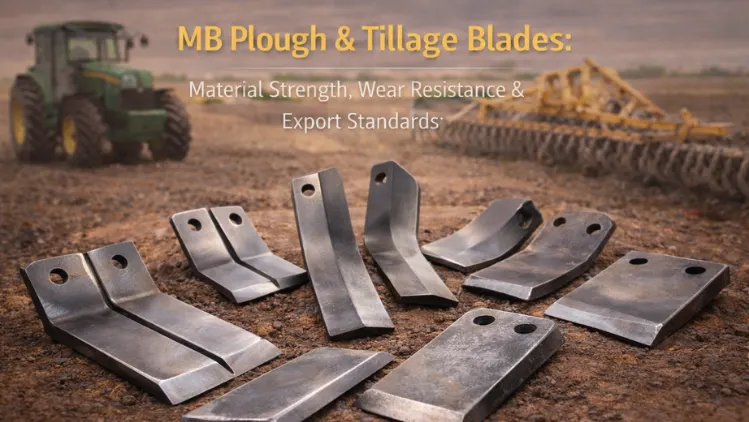
MB Plough & Tillage Blades: Material Strength, Wear Resistance & Export Standards Guide

Primary soil tillage exposes agricultural components to extreme draft forces, abrasive soil friction, and repeated impact loads. High-performance MB plough blades and tillage blades must withstand these stresses without cracking, bending, or premature edge wear. For global distributors, OEM buyers, and agricultural equipment suppliers, choosing a reliable tillage-blade manufacturer directly affects field performance, warranty claims, and long-term operating costs. This guide explains the engineering principles behind export-grade agricultural tillage blades, including material grades, 38–50 HRC hardness standards, structural load capacity, dimensional tolerances, and corrosion-resistant export packaging. MB Plough Blade Technical Specs at a Glance What Are MB Plough & Tillage Blades? MB plough blades and tillage blades are hardened steel agricultural components designed to cut, lift, and turn soil during primary tillage while resisting abrasive wear and heavy draft loads. Manufactured from boron or high-carbon steel and heat-treated to controlled hardness levels (38–50 HRC), these blades balance penetration efficiency with structural toughness. Their geometry, thickness, and metallurgical properties directly determine wear life and performance in sandy, clay, or rocky soil. Types of Tillage Blades Different soil conditions require specific blade geometries and structural characteristics. Blade Type Primary Use Soil Depth Wear Exposure MB Plough Blade Deep primary tillage 8–12 inches High Duck Foot Blade Surface weed control 2–4 inches Medium Cultivator Blade Soil mixing & aeration 4–8 inches High Reversible Point Heavy penetration Variable Very High For compatibility across equipment models, see our complete range of farm implement replacement parts to ensure correct fitment and interchangeability. Material Grades Used in Tillage Blades Material selection directly impacts wear resistance, structural toughness, and long-term fatigue life. The right steel grade determines how well a blade withstands abrasive soil, heavy draft loads, and repeated impact stress in demanding field conditions. 1. Boron Steel Boron steel typically contains small boron additions (≈0.001–0.005%), which significantly improve hardenability without compromising core strength. This allows deeper and more uniform heat treatment across the blade section. It offers 20–30% longer wear life compared to standard carbon steel, making it ideal for high-abrasion soil environments. The material provides an excellent balance between impact resistance and edge retention, reducing the risk of cracking in rocky terrain. 2. High Carbon Steel High-carbon steel is valued for its strength, sharpness retention, and reliable cutting performance. It maintains a firm edge under moderate soil resistance. This material is a cost-effective option for general farming applications. It performs well in medium-load conditions where extreme impact resistance is not required. 3. Alloy Steel Alloy steel offers enhanced toughness due to the addition of strengthening elements such as chromium or manganese. This improves resistance to deformation under heavy load. It also provides improved fatigue resistance, making it suitable for heavy-duty and rocky soil environments where repeated stress cycles can lead to premature failure in standard steels. Material Hardness Potential Wear Resistance Best Application Boron Steel 48–52 HRC (post treatment) Excellent Heavy-duty primary tillage High Carbon Steel 40–48 HRC Good General farming Alloy Steel 42–50 HRC Very Good Impact-heavy soils Heat Treatment & Hardness Standards The ideal hardness range for tillage blades is typically 38–50 HRC, depending on soil conditions and blade design. This range ensures: Process Advantage Ideal For Through Hardening Uniform durability Medium-load soils Edge Hardening Crack resistance Rocky terrain Case Hardening Surface wear protection Sandy soil Balancing penetration and durability is critical; excessive hardness increases brittleness, while insufficient hardness reduces wear life. Structural Strength & Load-Bearing Capacity Blade performance is not determined by material alone. Structural engineering influences stress distribution and fatigue resistance. Key strength factors: Proper load distribution prevents premature deformation under tractor draft forces and torsional stress. Quality Inspection & Dimensional Accuracy High-quality export blades undergo strict inspection protocols, such as: Dimensional accuracy ensures proper fitment and reduces installation errors for OEM clients. Bulk Procurement & OEM Customization For distributors and agricultural equipment manufacturers, supply reliability is essential. Typical considerations include the following: Working with a tillage-blade manufacturer in India allows cost-efficient, large-scale production combined with export-grade compliance and documentation. Export Packaging & Corrosion Protection International shipments require robust protection against moisture and transit damage. Standard export measures include: Proper packaging ensures blades arrive without oxidation or structural damage, maintaining dimensional precision and surface integrity. Conclusion MB plough blades and tillage blades must combine material strength, controlled hardness (38–50 HRC), structural reinforcement, and corrosion-resistant packaging to ensure long service life under heavy soil loads. Boron steel or high-carbon steel selection, precision heat treatment, and ISO-compliant dimensional accuracy directly impact wear resistance, crack prevention, and field performance. For importers and OEM buyers, choosing a technically reliable tillage-blade manufacturer ensures consistent quality, reduced downtime, and lower long-term operating costs. FAQs

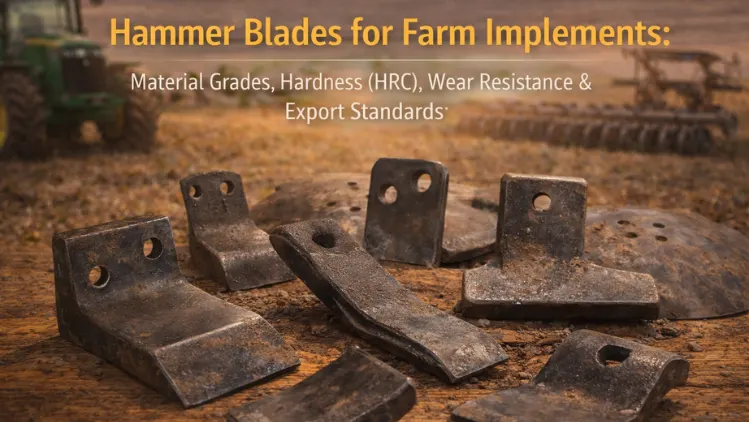
Hammer Blades for Farm Implements: Material Grades, Hardness (HRC), Wear Resistance & Export Standards

Hammer blades are critical rotating impact tools used in mulchers, shredders, and flail mowers to pulverize crop residue and vegetation. Manufactured from hardened steels such as Boron and High Carbon, these blades operate at 1500–3000 RPM and must withstand intense centrifugal force, abrasion, and repeated impact loading. For any professional hammer blades manufacturer, material selection, controlled hardness (HRC), and dimensional precision are essential to ensure durability in demanding agricultural environments. This guide explains how steel grade, heat treatment, wear resistance, and export standards influence performance and procurement decisions. What Are Hammer Blades? Hammer blades are high-impact agricultural cutting tools made from hardened alloy steels such as Boron or High Carbon steel. Operating at 1500–3000 RPM, they rely on centrifugal force and impact energy to shred crop residue. Standard blades are hardened to 45–55 HRC to balance wear resistance with impact toughness. Quick Specs Summary Feature Standard Specification Material Grades Boron Steel, High Carbon Steel, Alloy Steel Hardness Range 45–55 HRC Operational Speed 1500–3000 RPM Typical Thickness 8mm, 10mm, 12mm Mounting Tolerance ±0.5 mm What Are the Functions and Applications of Hammer Blades? Hammer blades function through a combination of impact and shear force, unlike straight knives that rely primarily on slicing. Primary Applications In high-speed operation, flail mower hammer blades repeatedly strike vegetation and occasionally stones or compact soil. Their balanced weight distribution ensures stable rotor movement and protects adjacent farm implements replacement parts from premature wear. Key performance requirements: Which Material Grades Are Used in Hammer Blades? Material selection determines durability, edge retention, and resistance to cracking. Boron Steel Boron steel offers excellent hardenability and impact strength. It performs well in mixed soil conditions where both abrasion and shock loading occur. Best For: Rocky terrain and high-impact environments. High Carbon Steel High carbon steel achieves higher hardness levels after heat treatment, delivering superior abrasion resistance. Best For: Sandy or abrasive soil conditions requiring extended edge retention. Alloy Steel Alloy steels enhanced with chromium or manganese improve fatigue resistance and structural stability. Best For: Heavy-duty hammer blades in continuous commercial use. Material Comparison Table Material Wear Resistance Impact Strength Best For Boron Steel High Very High Rocky or mixed terrain High Carbon Steel Very High Moderate Sandy loam & abrasive soil Alloy Steel High High Commercial heavy-duty shredding Real-World Performance Insight In controlled field testing within sandy loam environments, high carbon steel blades demonstrated approximately 15% greater edge retention compared to Boron steel. However, in rocky terrain, Boron steel showed superior crack resistance and lower breakage rates under repeated impact loads. This demonstrates that the “best” material depends on field conditions, not just hardness. What Is the Heat Treatment Process & Recommended Hardness (HRC)? Hammer blades undergo: Recommended Hardness Range: 45–55 HRC If hardness exceeds 55 HRC, brittleness increases and crack propagation risk rises under shock loading. From a materials science perspective, as hardness increases, fracture toughness generally decreases: As HRC increases, fracture toughness (K₍Ic₎) decreases, meaning extremely hard blades may resist wear but become more prone to sudden fracture under impact. Therefore, balancing hardness and toughness is essential for reliable performance at 1500–3000 RPM. What Design Variations & Technical Specifications Matter? Hammer blades are manufactured in multiple profiles: Precision hole diameter ensures secure mounting and prevents vibration that could damage surrounding farm equipment wear parts. What Quality Inspection & Testing Parameters Ensure Reliability? Quality control ensures durability and dimensional consistency. Inspection Standards Include: Reliable inspection standards are critical when sourcing from a bulk hammer blades supplier for international markets. What Factors Influence Wear Resistance & Field Performance? Several variables affect blade lifespan: Selecting the correct material grade significantly extends service intervals for mulcher replacement blades. What Should Importers Consider When Procuring in Bulk? When evaluating a bulk hammer blades supplier, importers should assess: Consistency across batches ensures predictable performance and customer satisfaction. What Export Packaging & Corrosion Protection Standards Are Used? Hammer blades exported internationally require moisture and corrosion protection. Standard practices include: Proper packaging prevents oxidation during long transit cycles. Common Technical Specifications Conclusion Hammer blades are high-impact agricultural components engineered for rotational stress, abrasion, and repeated shock loading. Optimal performance depends on selecting the appropriate steel grade, maintaining hardness within 45–55 HRC, ensuring dimensional precision, and applying strict quality control standards. Understanding wear resistance factors, heat treatment science, and export packaging practices allows buyers and importers to source durable heavy-duty hammer blades suited for demanding agricultural operations. FAQs

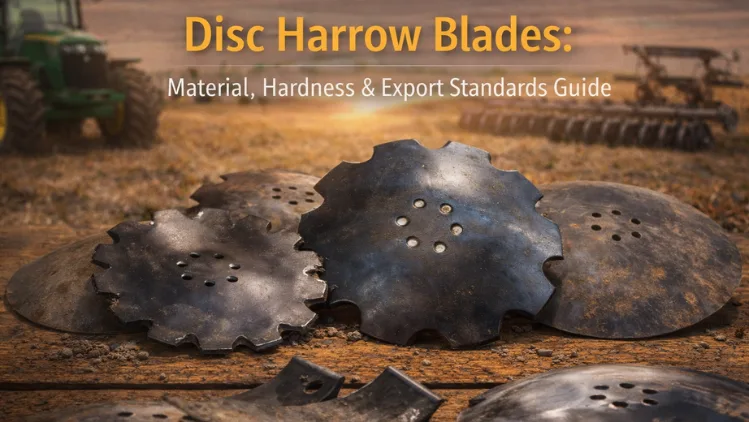
Disc Harrow Blades: Material, Hardness & Export Standards Guide

Disc harrow blades are circular, concave steel discs used in agricultural tillage equipment to cut, fracture, and mix soil during field preparation. Manufactured from hardened high-carbon or boron steel, these blades operate under high impact and abrasive conditions, making material grade and hardness control critical to performance. A reliable disc harrow blade manufacturer focuses on controlled metallurgy, precision heat treatment, and dimensional accuracy to ensure durability across diverse soil types, from sandy African fields to heavy clay farms in North America. In modern mechanized agriculture, disc blades are essential for residue management, soil aeration, and seedbed preparation. This guide explains different aspects of the disc harrow blades including materials, hardness standards, heat treatment processes, inspection criteria, export compliance, and bulk procurement considerations, helping importers and distributors evaluate quality with confidence. Disc Harrow Blades: Function & Working Principle Disc harrow blades work by rotating through soil, using their concave geometry and sharpened edge to penetrate, lift, and mix soil layers. Primary Functions: The concave design creates a slicing and rolling action, which improves soil pulverization while distributing organic residue evenly. Real-World Application Examples Disc blades are widely supplied as part of broader farm implements replacement parts, particularly in aftermarket distribution channels. Technical Specifications Overview Export-grade disc harrow blades must meet defined material, hardness, and dimensional standards to ensure durability and global equipment compatibility. The table below summarizes the key technical specifications buyers should verify before bulk procurement. Parameter Standard Range Technical Significance Material Grade Boron Steel / High Carbon Steel Determines wear resistance and hardenability in abrasive soil conditions Carbon Content 0.60% – 0.90% Controls achievable hardness and edge retention capability Boron Content 0.0005% – 0.003% Improves depth of hardness penetration during heat treatment Hardness (Rockwell HRC) 38–52 HRC Ensures balance between wear resistance and impact toughness Diameter 16” – 28” Influences working depth and soil penetration capacity Thickness 3 mm – 8 mm Affects structural strength and load-bearing performance Heat Treatment Method Through Hardening / Induction Hardening Controls surface durability and internal toughness balance Concavity Depth As per implement design Impacts soil turning efficiency and cutting performance Dimensional Tolerance ±0.5 mm (typical) Ensures proper mounting alignment and reduced vibration Surface Finish Shot Blasted / Anti-Rust Coated Enhances corrosion resistance during storage and transit Quality Documentation Mill Test Certificate (MTC) Verifies material composition and production traceability Reviewing these specifications helps importers assess quality consistency, wear resistance, and compliance standards. Confirming material composition, hardness range, and tolerance accuracy reduces performance risks and ensures reliable field operation. Material Grades Used in Disc Harrow Blades The most suitable materials for disc harrow blades are boron steel and high carbon steel due to their ability to achieve high hardness while maintaining structural integrity. Boron Steel Boron steel enhances hardenability, allowing uniform hardness penetration during heat treatment, even in thicker blades. Why Boron Improves Performance: Field Example: In sandy terrains where blades wear rapidly, boron steel discs often last 20–30% longer compared to standard carbon steel blades. High Carbon Steel High carbon steel (0.60–0.90% carbon) provides strong surface hardness and good edge retention. Suitable for: Material selection should align with soil abrasiveness and operating load. Heat Treatment Process & Hardness Standards The ideal hardness range for export-quality disc harrow blades is 38–52 HRC. This range ensures optimal wear resistance without excessive brittleness. Through Hardening The entire blade is heat-treated for uniform hardness. Suitable for heavy-duty applications. Induction Hardening Only the cutting edge is hardened; the core remains softer for shock absorption. Hardness vs Brittleness Real-World Example In clay-heavy soils requiring high torque, blades hardened above 52 HRC may crack under impact. A controlled 45–48 HRC range provides better longevity. Proper tempering reduces internal stress and enhances toughness. Blade Types & Technical Variations Disc harrow blades are available in different edge designs, diameters, thicknesses, and center hole configurations to match soil conditions, residue levels, and implement capacity. Selecting the correct technical variation directly affects penetration depth, fuel efficiency, residue incorporation, and blade lifespan. Plain Disc Blades Plain disc blades have a smooth, continuous cutting edge designed for uniform soil slicing and mixing. They are best suited for medium-residue fields and secondary tillage where consistent soil leveling is required. In loamy or moderately compacted soils, plain discs provide stable penetration without excessive soil disturbance. Their uniform edge ensures predictable soil flow, making them widely used in standard seedbed preparation operations. Notched Disc Blades Notched disc blades feature evenly spaced cutouts along the edge to improve soil grip and cutting efficiency in heavy residue conditions. The notches reduce slippage and enhance penetration in compacted or trash-heavy fields. For example, in post-wheat or corn harvest fields with dense straw coverage, notched discs cut through residue more effectively, reducing clogging and improving residue incorporation into the soil profile. Diameter Options & Working Depth Blade diameter determines working depth and soil penetration capacity. Larger diameters increase cutting depth but require greater tractor horsepower and stronger implement assemblies. Choosing the correct diameter ensures balanced soil disturbance and operational efficiency. Thickness Variations & Structural Strength Blade thickness influences load-bearing capacity, impact resistance, and service life. Thicker blades resist bending under high torque but increase implement weight and power requirements. Matching thickness with soil conditions helps reduce deformation and premature failure. Center Hole Configurations & Customization Center hole design ensures proper mounting alignment and vibration stability during operation. Common configurations include round, square, hexagonal, and custom-engineered patterns, depending on regional equipment standards. Buyers working with a disc harrow blade manufacturer can request customized diameter tolerances, concavity depth, thickness specifications, and batch stamping for traceability, ensuring compatibility with OEM and aftermarket equipment requirements. Quality Inspection & Testing Parameters Export-grade blades undergo systematic quality verification. Inspection Checklist: Consistent testing ensures reduced rejection rates in international markets. International Standards & Compliance Manufacturers supplying global markets typically follow: Compliance strengthens importer confidence and ensures compatibility with regional agricultural equipment standards. Common Failure Causes & Prevention Understanding common failure patterns in disc harrow blades helps manufacturers, importers, and end users improve operational lifespan, reduce downtime, and ensure consistent field… Continue reading Disc Harrow Blades: Material, Hardness & Export Standards Guide

Farm Implements Replacement Parts: A Technical Procurement Guide for Global Importers

Farm implements replacement parts are high-wear steel components used in tillage and soil preparation machinery such as disc harrows, MB ploughs, and rotary tillers. Typically manufactured from boron or high-carbon steel and hardened to 38–52 HRC, they are designed to withstand abrasion, torque stress, and impact in agricultural operations. Global distributors must evaluate material grade consistency, hardness control, dimensional precision, and export readiness before bulk procurement. This guide outlines the key technical and sourcing benchmarks for reliable long-term supply partnerships. Overview of Farm Implements Replacement Parts Farm implements replacement parts are periodically replaced, including soil-engaging and structural components that experience mechanical wear during agricultural field operations. These parts directly influence field productivity, fuel efficiency, and implement longevity. The importance of durable replacement components is reinforced by strong global market expansion. According to Grand View Research, the farm implements market was valued at USD 33.91 billion in 2024 and is projected to reach USD 61.18 billion by 2033, growing at a CAGR of 7.1%. The Asia Pacific accounted for 36.7% of global revenue in 2024, reflecting the region’s high demand for mechanization, while Europe remains one of the fastest-growing markets. As agricultural enterprises scale operations and adopt precision and high-capacity equipment, equipment utilization hours increase, accelerating wear cycles and replacement frequency. The trend toward commercial and large-scale farming further intensifies this demand. The expansion of cultivated areas and increasing tractor penetration globally have led to a greater dependency on mechanized tillage and soil preparation systems. Since tractors function as the primary power source for cultivators, harrows, and plough assemblies, higher tractor usage directly drives replacement demand for compatible blades, axles, and structural components. Why Wear Occurs Wear in farm implement components occurs due to abrasive soil friction, impact loading, high torque stress during deep tillage, and moisture-induced corrosion. Soil composition significantly affects wear rates. Sandy soils accelerate edge erosion, while clay-heavy soils increase structural load stress and torque resistance. In intensive operations, replacement cycles typically range between 250 and 400 working hours, depending on soil type, operating depth, and equipment load. For importers, uniform hardness distribution, metallurgical consistency, and dimensional compatibility remain critical to ensuring performance reliability across batches and markets. Key Categories of Farm Implements Parts Farm implement replacement demand is concentrated around high-wear soil-engaging and structural components that directly influence durability, load-bearing performance, and field productivity. The following categories represent the most commonly sourced parts in global trade. Hammer Blades Hammer blades are used in rotary tillers and flail implements for soil breaking and residue management. Typically manufactured from boron or alloy steel and hardened to 38–45 HRC, they require high impact resistance and fatigue strength for continuous operation. Disc Harrow Blades Disc harrow blades are the primary soil-cutting components used in secondary tillage operations. Commonly produced from 30MnB5 boron steel with 48–52 HRC hardness, they are available in 4–8 mm thickness and 16″–24″ diameters for abrasive conditions. MB Plough / Tillage Blades MB plough and tillage blades are designed for deep soil inversion and high-penetration primary tillage. Manufactured from boron or high-carbon steel with 48–52 HRC hardness, they balance wear resistance and structural toughness in heavy-duty applications. Disc Harrow Axles Disc harrow axles support blade assemblies and withstand rotational and torsional loads during operation. Produced from high-strength alloy steel, they require precise machining, high tensile strength, and load-tested durability for long service life. Implements & General Pins Implements and general pins maintain alignment and secure mechanical assemblies under dynamic stress. Typically made from hardened alloy steel, they demand tight dimensional tolerances, corrosion resistance, and a controlled surface finish to prevent premature failure. Material Grades Used in Farm Implements Parts Material grade selection directly impacts wear resistance, toughness, and operational lifespan. Boron Steel (e.g., 30MnB5) High Carbon Steel Alloy Steel Comparison Insight:Boron steel provides higher hardenability and improved wear resistance at similar hardness levels compared to conventional high-carbon steel, while maintaining better structural toughness. In high-abrasion environments, boron steel with controlled heat treatment typically offers the best balance of wear resistance and structural durability. For detailed specifications and performance comparisons, refer to our comprehensive agricultural machinery replacement parts guide. Heat Treatment & Hardness Standards The ideal hardness range for most tillage blades is between 38–52 HRC, achieved through controlled quenching and tempering processes. Common Processes Hardness Range Typical hardness range for tillage blades: 38–52 HRC (Rockwell Hardness Scale). Uniform hardness is critical. Inconsistent hardening can cause: Proper distortion control during quenching ensures dimensional stability. Quality Inspection & Testing Protocol Reliable manufacturers follow documented inspection processes aligned with global quality control standards. Standard Checks Include: Importers should request inspection reports before shipment confirmation. Technical Comparison Table Part Type Material Grade Hardness (HRC) Primary Application Disc Harrow Blade 30MnB5 Boron Steel 48–52 Soil cutting Tillage Blade Boron/High Carbon 48–52 Deep tillage Hammer Blade Alloy/Boron Steel 38–45 Rotary tilling Axle Alloy Steel As per load design Structural support Bulk Procurement Considerations for Importers When sourcing in volume, importers should evaluate: Partnering with a trusted bulk farm implement parts supplier improves cost efficiency and supply chain stability. Export Packaging & Anti-Corrosion Protection Tillage components are vulnerable to rust during sea freight. Recommended export measures include: HS Code classification typically falls under 8432 (agricultural or horticultural machinery parts). Proper packaging ensures corrosion resistance during long transit cycles. Why Source Farm Implements Replacement Parts from India India has become a preferred sourcing destination due to: Indian suppliers offer diverse SKU ranges, private labeling capabilities, and consolidated container shipments for global distributors. How to Evaluate a Reliable Manufacturer When selecting an agricultural implement parts manufacturer from India, importers should assess: Supplier audits reduce procurement risk and ensure long-term reliability. Conclusion Farm implement replacement parts directly influence agricultural efficiency, machine uptime, and operating costs. For global importers, successful procurement depends on material grade validation, controlled heat treatment, rigorous inspection protocols, and export-ready packaging. Working with a technically capable manufacturer with in-house testing and export expertise ensures consistent quality across batches and markets. For bulk inquiries, private labeling requirements, or technical specification discussions, connect with an experienced… Continue reading Farm Implements Replacement Parts: A Technical Procurement Guide for Global Importers

Tractor Accessories & Utility Parts: Essential Components for Daily Maintenance and Safe Operation

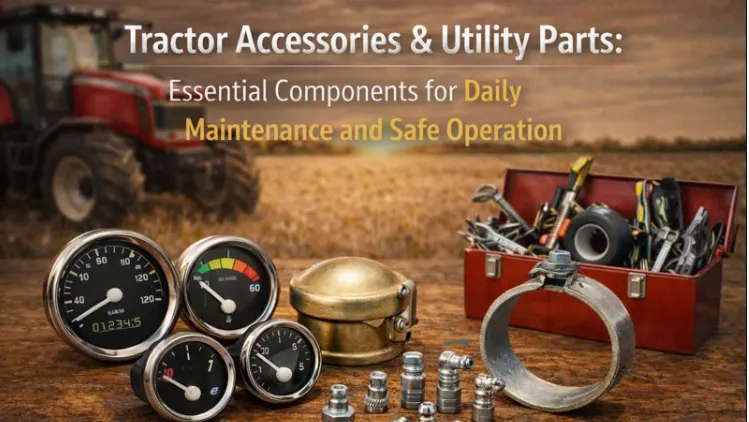
In everyday farming operations, tractor performance is not defined only by major mechanical systems like the engine or transmission. In reality, many breakdowns and safety issues begin with the failure of small utility components that are often overlooked during routine maintenance. Tractor accessories and utility parts play a critical role in monitoring performance, ensuring proper lubrication, protecting vital systems, and maintaining overall operational safety. Experienced tractor operators understand that ignoring these small components often leads to bigger, more expensive failures. This guide explains tractor accessories and utility parts from a practical, field-level perspective, focusing on how they contribute to reliability, safety, and long-term equipment health. What Are Tractor Accessories & Utility Parts? Tractor accessories and utility parts are supporting components that assist in daily operation, monitoring, protection, and preventive maintenance of tractors. While these parts may not directly generate power, they ensure that power is used safely and efficiently. A complete range of Tractor Accessories & Utility Parts helps operators: Neglecting these parts often results in minor issues escalating into major mechanical failures. Why Utility Parts Are Critical in Real Farming Conditions Tractors operate in dusty, muddy, high-temperature, and vibration-heavy environments. Under such conditions, even small failures—like improper lubrication or blocked exhaust—can severely impact performance. From an experienced maintenance perspective: Regular inspection and timely replacement of utility parts is one of the most cost-effective maintenance practices in farming. Gauges: Monitoring Tractor Health in Real Time Gauges provide real-time information about tractor performance, allowing operators to make informed decisions during operation. Reliable tractor gauges help monitor: Why gauges matter When gauges malfunction or are ignored, operators lose visibility into critical systems. Overheating, low oil pressure, or electrical faults may go unnoticed until irreversible damage occurs. Experienced operators rely on gauges not just during breakdowns, but as preventive tools to adjust load, speed, or operating time before problems escalate. Weather Caps: Protecting the Exhaust System Weather caps are installed on tractor exhaust outlets to prevent rainwater, debris, and foreign objects from entering the exhaust system. Durable weather caps play a simple but vital role in engine protection. Consequences of missing or damaged weather caps In regions with unpredictable weather or outdoor tractor storage, weather caps significantly reduce long-term engine damage. Grease Nipples: The Foundation of Preventive Maintenance Grease nipples enable proper lubrication of moving joints and components, reducing friction and wear. High-quality grease nipples ensure that grease reaches critical contact points effectively. Why grease nipples should never be ignored When grease nipples are blocked, damaged, or missing: Experienced mechanics often replace grease nipples proactively because they are inexpensive yet critical to long-term machine health. Silencer Clamps: Securing the Exhaust System Silencer clamps hold exhaust components firmly in place, preventing movement, leaks, and vibration. Strong silencer clamps ensure proper alignment of exhaust systems under continuous vibration and thermal expansion. Problems caused by faulty silencer clamps Replacing worn silencer clamps early prevents damage to more expensive exhaust components. How Professionals Maintain Tractor Utility Parts From a professional maintenance standpoint, utility parts are checked more frequently than major components. The logic is simple: early detection costs less than late repair. Best practices include: These small steps significantly improve tractor reliability and lifespan. Common Mistakes Operators Make with Utility Parts Despite their importance, utility parts are often neglected. Common mistakes include: Each of these mistakes increases the risk of major mechanical failure. How to Choose the Right Tractor Accessories & Utility Parts Experienced operators follow a few simple rules: Utility parts may be small, but quality matters as much as it does for major components. Conclusion Tractor accessories and utility parts form the backbone of daily maintenance, safety, and operational reliability. Gauges, weather caps, grease nipples, and silencer clamps may seem minor, but their failure often leads to serious mechanical issues and costly downtime. By inspecting and replacing these components regularly, tractor owners can prevent breakdowns, extend equipment life, and maintain consistent performance throughout the farming season. Reliable tractors are built not just on power—but on attention to the smallest details. Frequently Asked Questions (FAQs)