
 (+91) 842-700-1426
  agriparts@jcblmail.com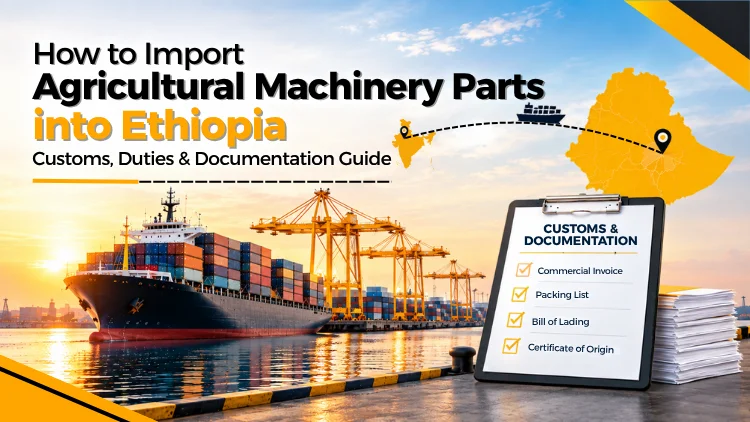
Importing agricultural machinery parts into Ethiopia requires more than selecting an overseas supplier and arranging shipment. Ethiopian importers, machinery distributors, and agricultural equipment businesses need to confirm the correct commodity classification, applicable customs duties and taxes, required documentation, and customs-clearance requirements before an order is dispatched.
The most important point is that agricultural machinery parts do not have one universal import duty or HS code. The applicable treatment depends on the specific product classification and transaction details. Ethiopia’s Customs Trade Portal provides tariff search, tax simulation, and transaction guidance tools that importers can use to verify current requirements.
Ethiopia’s Import Requirements for Agricultural Machinery Parts
Before purchasing agricultural machinery spare parts from an international supplier, an Ethiopian importer should establish that the business, product, and transaction meet the applicable import requirements.
Commercial imports are generally channelled through Ethiopian importers or registered distribution agents, with import licensing and foreign-exchange requirements forming part of the import process. Access to foreign currency has also been identified as a significant consideration for Ethiopian importers.
For machinery parts, importers should confirm:
- Exact product and part number
- Technical specifications and intended machinery application
- Country of origin
- HS/commodity classification
- Applicable customs duty and taxes
- Required import and customs documents
- Estimated landed cost before placing the purchase order
This preparation helps prevent a common B2B problem: discovering the actual customs cost or documentation requirement only after the goods have been shipped.
How to Classify Agricultural Machinery Parts for Ethiopian Customs
Why the HS Code Matters
The Harmonized System (HS) or commodity code is central to customs assessment. It helps determine the tariff treatment and can also influence applicable taxes and documentation requirements.
Ethiopia’s Customs Trade Portal allows traders to search tariff information and provides a transaction guide based on details including the commodity code, procedure code, and country of origin.
Agricultural machinery parts should therefore not be classified simply as “farm machinery parts” without checking the specific product. A tractor component, combine-harvester part, hydraulic component, or general mechanical part may require different classification depending on its characteristics and function.
How to Verify the Correct Commodity Code
Before shipment, Ethiopian importers should:
- Identify the exact part and its technical specifications.
- Determine the appropriate HS/commodity classification.
- Search the classification in Ethiopia’s Customs Trade Portal.
- Check the applicable tariff and tax treatment.
- Confirm whether any product-specific documentation is required.
Do not rely solely on an overseas supplier’s HS code. The Ethiopian importer’s customs treatment should be verified against Ethiopia’s applicable tariff system.
Import Duties and Taxes on Agricultural Machinery Parts in Ethiopia
How Is Customs Duty Calculated?
Ethiopian customs duties are generally assessed according to the applicable tariff classification and customs value. The International Trade Administration reports customs duty rates ranging from 0% to 35%, with duty calculated on the CIF value of imported goods.
This does not mean that agricultural machinery parts automatically attract a particular rate within that range.
The practical calculation is:
Customs Duty = Applicable Tariff Rate × Customs Value
The exact rate should be checked for the specific commodity code before importing.
VAT on Imported Machinery Parts
Ethiopia applies a standard 15% VAT to imports, subject to applicable exemptions.
Importers should therefore consider VAT when estimating the total cost of an overseas machinery-parts purchase rather than comparing suppliers only on the quoted product price.
What About Excise Tax and Surtax?
Excise tax is product-specific and should not automatically be assumed to apply to agricultural machinery parts. The applicable treatment depends on the goods and current tax rules.
Surtax treatment also requires care. Ethiopia’s Ministry of Finance states that reforms introduced in 2022 removed the surtax on goods with a customs duty rate of 15% or lower, while the government has continued to work toward phasing the surtax out of the tax system.
Therefore, importers should verify the current treatment for the specific commodity rather than applying a blanket surtax percentage.
How to Calculate the Landed Cost of Agricultural Machinery Parts
For B2B procurement, the relevant figure is not the supplier’s unit price but the landed cost.
A practical calculation is:
Landed Cost = Product Cost + Freight + Insurance + Customs Duty + Applicable Taxes + Clearance and Logistics Costs
Ethiopia’s Customs Trade Portal includes a tax simulator that requires information such as the country of origin, commodity code, CIF value, currency, and exchange rate to calculate the applicable taxation.
Importers should use this type of calculation before confirming a purchase order. It allows distributors, machinery dealers, and procurement teams to compare suppliers based on their expected final cost in Ethiopia.
Documents Required to Import Agricultural Machinery Parts into Ethiopia
The exact documentation depends on the product and transaction. Ethiopia’s Customs Trade Portal provides an interactive transaction guide that identifies applicable documents based on the import, commodity code, procedure, and country of origin.
Common commercial and shipping documents can include:
| Document | Purpose |
| Commercial invoice | Shows seller, buyer, product, and transaction value |
| Packing list | Includes quantities, packages, and weights |
| Bill of Lading/Air Waybill | Provides shipment and transport information |
| Certificate of origin | Establishes country of origin where required |
| Customs declaration | Provides information for customs assessment |
| Import license/registration documents | Supports the importer’s authorization |
| Product-specific certificates | Required where applicable |
Why Document Accuracy Matters
The product description, quantities, weights, values, and origin information should be consistent across the shipment documents.
For machinery parts, descriptions should be specific enough to identify the actual product. “Machine parts” provides considerably less useful information than a description that identifies the part name, part number, machinery application, and relevant technical specifications.
Accurate documentation also makes it easier to verify the correct commodity classification and estimate the shipment’s customs liability before arrival.
Customs Clearance Process for Agricultural Machinery Parts in Ethiopia
Once the shipment reaches Ethiopia, the customs-clearance process generally involves several stages:
Step 1: Submit Import and Shipment Documentation
The importer or authorized representative prepares the required customs and commercial documents.
Step 2: Complete the Customs Declaration
The shipment is declared using the relevant customs procedure and commodity information.
Step 3: Customs Classification and Valuation
Customs assesses the declared goods, classification, and customs value to establish the applicable tax liability.
Step 4: Pay Applicable Duties and Taxes
The importer pays the customs duty and other applicable taxes and charges assessed for the shipment.
Step 5: Customs Release
Following completion of the applicable customs procedures, the goods can be released for onward transportation.
Ethiopia’s Customs Trade Portal supports electronic services, including e-SAD submission and tracking, e-Manifest tracking, and T1 tracking.
Ethiopia is landlocked, and a large share of its international trade moves through Djibouti. The country has also introduced electronic single-window services and other trade-facilitation measures.
Common Customs Problems When Importing Machinery Parts
- Incorrect HS Classification: Using an inappropriate commodity code can result in incorrect duty and tax assessment or additional customs queries.
- Vague Product Descriptions: Descriptions such as “spare parts” may not provide enough information to clearly identify the imported goods.
- Inconsistent Documents: Differences between the invoice, packing list, transport documents, and customs declaration can create avoidable processing issues.
- Unexpected Import Costs: A supplier’s quotation does not represent the complete import cost. Freight, insurance, customs duty, taxes, and clearance expenses can materially change the final landed cost.
- Checking Requirements Too Late: Waiting until the shipment is already in transit to verify classification, duties, and documentation leaves less room to correct errors.
How Ethiopian Importers Can Reduce Customs Delays and Unexpected Costs
Before ordering agricultural machinery parts, Ethiopian importers should:
- Confirm the exact part and technical specification.
- Verify the HS/commodity code.
- Check the current Ethiopian tariff treatment.
- Estimate customs duty and applicable taxes.
- Calculate the expected landed cost.
- Confirm the required transaction documents.
- Ensure invoice and packing-list details are consistent.
- Confirm the country of origin.
- Coordinate documentation with the overseas supplier before shipment.
This approach gives procurement teams greater control over both customs compliance and purchasing costs.
Importing Agricultural Machinery Parts from India to Ethiopia
For Ethiopian buyers sourcing agricultural machinery parts from India, the same customs principles apply. The importer should confirm the product classification, country of origin, commercial value, shipping terms and required documentation before dispatch.
Indian manufacturers and exporters can support smoother transactions by providing accurate part numbers, technical descriptions, commercial invoices, packing lists and applicable origin documentation.
The key is coordination: the Ethiopian importer and Indian supplier should agree on the product description and shipment documentation before the goods leave India.
Agricultural Machinery Parts Import Checklist for Ethiopia
Before Ordering
- Identify the exact part and specification
- Confirm the HS/commodity code
- Check applicable duties and taxes
- Estimate landed cost
- Verify importer and payment requirements
Before Shipment
- Prepare commercial invoice
- Prepare packing list
- Confirm transport documentation
- Check certificate-of-origin requirements
- Verify product-specific documents
- Cross-check all shipment information
Before Customs Clearance
- Complete the customs declaration
- Verify the assessed duties and taxes
- Submit required documentation
- Complete payment and release procedures
Conclusion
Importing agricultural machinery parts into Ethiopia becomes more predictable when customs requirements are addressed before shipment. For Ethiopian importers and machinery distributors, the key controls are accurate HS classification, verified tariff and tax treatment, complete documentation, and realistic landed-cost calculations. Using the Ethiopian Customs Trade Portal to check tariff information, transaction-specific documentation, and tax estimates can help buyers make better purchasing decisions and reduce avoidable customs issues.
FAQs
There is no single duty rate for all agricultural machinery parts. The applicable customs duty depends on the specific HS/commodity classification and current Ethiopian tariff treatment. Ethiopia’s Customs Trade Portal should be checked for the relevant product.
The standard VAT rate on imports is 15%, subject to applicable exemptions.
Identify the exact product and technical specifications first, then verify the appropriate commodity classification using Ethiopia’s Customs Trade Portal.
Common documents include the commercial invoice, packing list, transport document, and, where applicable, certificate of origin, customs declaration, importer documentation, and product-specific certificates. Exact requirements depend on the transaction and commodity classification.
Ethiopia’s Customs Trade Portal provides a tax simulator using information such as commodity code, country of origin, and CIF value.
Yes. Importers should not assume that a complete machine and its individual spare parts have the same tariff classification or duty treatment. Each product should be classified according to the applicable Ethiopian tariff.