
 (+91) 842-700-1426
  agriparts@jcblmail.com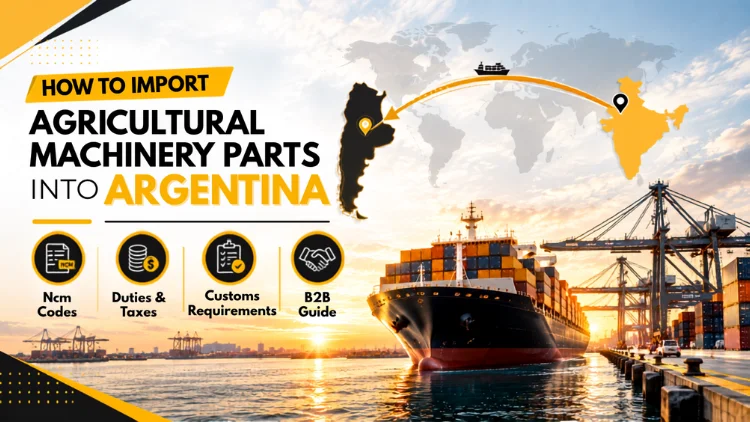
Importing agricultural machinery parts into Argentina requires accurate NCM classification, customs documentation, tariff verification, and regulatory planning. For manufacturers, distributors, dealers, and procurement teams, the process starts before the shipment leaves the supplier’s country.
Argentina uses the MERCOSUR Common Nomenclature (NCM) to classify imported goods. Because different agricultural machinery components can have different classifications, importers should verify the exact NCM position, applicable tariff treatment, and any product-specific requirements before shipping.
How to Import Agricultural Machinery Parts into Argentina
A typical B2B import process involves:
- Identify the exact part and its technical specifications.
- Determine the applicable NCM classification.
- Check current tariffs, taxes, and trade preferences.
- Verify whether additional regulatory requirements apply.
- Confirm the Argentine importer’s customs registration.
- Prepare commercial and shipping documents.
- Arrange international transportation.
- Submit the applicable customs declaration.
- Complete customs review and applicable payments.
- Arrange release and inland delivery.
The exact procedure can vary according to the product, NCM classification, origin, and import regime.
What NCM Code Is Used for Agricultural Machinery Parts in Argentina?
There is no single NCM code for all agricultural machinery parts. Classification depends on the machinery, component, and function.
Examples of potentially relevant headings include:
| Agricultural machinery category | Example parts heading |
| Soil preparation and cultivation machinery | 8432.90 |
| Harvesting and threshing machinery | 8433.90 |
| Other agricultural machinery | 8436.99 |
| Grain and seed processing machinery | 8437.90 |
Argentina’s agricultural nomenclature identifies 8432.90 for parts of certain soil-preparation and cultivation machinery and 8433.90 for parts of harvesting and threshing machinery. Other agricultural and grain-processing machinery have separate parts classifications.
These are examples, not universal classifications. A tractor component, hydraulic component, engine component, or electrical part may require classification elsewhere depending on its characteristics and function.
How to Determine the Correct NCM Code
Before placing an order, obtain:
- Manufacturer part number
- Detailed product description
- Technical specifications
- Material and construction details
- Function of the component
- Compatible machinery
- Product drawings or datasheets
- Country of origin
- New or used status
Then verify the relevant NCM position using the current MERCOSUR and Argentine tariff information.
Argentina’s VUCE/CIVUCE provides foreign-trade information that can help users investigate tariff preferences, regulations, rules of origin, and other requirements associated with a nomenclature position.
Import Duties and Taxes on Machinery Parts
Import costs in Argentina depend on the specific NCM classification, origin, and applicable regime. Therefore, there is no single import-duty rate that applies to every agricultural machinery part.
Potential landed cost components include the following:
- Import duty
- Statistical tax, where applicable
- IVA (VAT)
- Other applicable taxes or perceptions
- Customs brokerage
- Port and terminal charges
- Freight and insurance
- Inland transportation
Argentina’s current framework provides for a 3% statistical tax on definitive imports for consumption, subject to applicable limits and exemptions, with the measure extended through December 31, 2027.
Always check the current treatment for the specific NCM code and shipment rather than relying on a general percentage.
How Much Does It Cost to Import Agricultural Machinery Parts?
A practical B2B landed cost calculation is:
Product value + freight + insurance + import duty + applicable taxes + customs costs + port charges + inland transportation = estimated landed cost
For procurement teams, this calculation is more useful than comparing supplier prices alone. A lower factory price may not produce the lowest final cost once freight, customs, and Argentine import charges are included.
Argentina Import Requirements for Agricultural Machinery Parts
Commercial importers must meet applicable ARCA customs registration requirements. Depending on the type of customs operator, requirements can include tax registration, biometric registration, and access to electronic customs systems such as SICNEA and SITA.
Importers should establish their customs status before dispatch and coordinate with an appropriate despachante de aduana (customs broker) where required.
Product-specific requirements should also be checked against the NCM classification. Not every machinery component automatically requires the same permits, certificates, or agency intervention.
Documents Required to Import Machinery Parts into Argentina
The exact document set depends on the shipment and product, but B2B imports commonly involve:
| Document | Purpose |
| Commercial invoice | Identifies goods, seller, buyer, and transaction value |
| Packing list | Details packages, quantities and weights |
| Bill of lading/Air Waybill | Documents international transportation |
| Certificate/proof of origin | Supports origin requirements or preferential treatment |
| Technical specifications | Helps establish product identity and classification |
| Customs declaration | Declares the goods to customs |
| Additional certificates | Required where applicable to the product or regime |
Descriptions, quantities, part numbers, and values should remain consistent across the documentation.
Customs Clearance Process in Argentina
The basic clearance sequence is:
Product classification → Documentation → Customs declaration → Customs review → Applicable payments → Release → Delivery
Accurate technical descriptions are particularly important for machinery parts because customs classification depends on the goods’ nature and function.
Before dispatch, the importer and supplier should cross-check the invoice, packing list, technical documents, and transport information to identify discrepancies before arrival.
Does Country of Origin Affect Agricultural Machinery Imports?
Yes. Country of origin can influence preferential tariff eligibility, rules of origin and other trade measures.
Before selecting an overseas supplier, Argentine buyers should check the following:
- Origin of the goods
- Applicable trade agreement
- Rules of origin
- Preferential tariff treatment
- Any applicable trade-remedy measures
This can be particularly relevant when sourcing agricultural machinery parts from Brazil, China, India, the United States, or Europe.
Can You Import Used Agricultural Machinery Parts into Argentina?
Used machinery and parts require additional scrutiny.
Argentina has specific rules for certain used goods, including products within relevant NCM Chapters 84–90. Importers should verify the individual tariff position and applicable used-goods regime before shipping.
Do not assume that a special regime for used production lines or capital equipment applies automatically to ordinary used spare parts. The treatment depends on the goods and applicable classification.
What Should an Exporter Provide to an Argentine Buyer?
An international supplier can make the import process easier by providing:
- Accurate manufacturer part number
- Detailed product description
- Technical datasheet
- Dimensions and weight
- Material information
- Machinery compatibility
- Country of origin
- Commercial invoice
- Packing list
- Product drawings or photographs where useful
- HS classification information for reference
The Argentine importer should still verify the applicable Argentine NCM classification rather than relying solely on the supplier’s HS code.
Common Mistakes When Importing Agricultural Machinery Parts
Avoid these common B2B errors:
- Assuming every tractor or farm-equipment part has the same NCM code
- Using a supplier’s classification without verification
- Providing vague product descriptions
- Ignoring country-of-origin requirements
- Calculating cost from import duty alone
- Shipping used components without checking the applicable regime
- Leaving classification questions until the goods reach Argentina
- Using inconsistent information across commercial documents
Pre-Shipment Checklist
Before sending agricultural machinery parts to Argentina, confirm:
- Part number and technical specifications identified
- NCM classification verified
- Country of origin confirmed
- Current tariff treatment checked
- Importer customs requirements confirmed
- Product-specific requirements reviewed
- Invoice and packing list prepared
- Transport documentation arranged
- Customs broker coordinated where applicable
- Landed cost calculated
- Used-goods requirements checked, if applicable
Conclusion
Successful agricultural machinery parts imports into Argentina depend on accurate NCM classification, current tariff verification, complete documentation, and advance customs planning. For B2B buyers and international suppliers, confirming these details before shipment can help prevent avoidable classification issues, unexpected costs, and clearance delays.
Regulatory note: Argentine customs tariffs, classifications, and import procedures can change. Verify the current requirements for the specific product and NCM position before every commercial shipment.
FAQs
There is no universal code. Examples include 8432.90 for certain cultivation-machinery parts and 8433.90 for certain harvesting and threshing machinery parts. The exact NCM classification depends on the product and its function.
The applicable duty depends on the specific NCM classification, country of origin, and tariff regime. Importers should verify the current rate for the exact NCM position.
Common documents include a commercial invoice, packing list, transport document, and, where applicable, proof of origin, technical documentation, and additional certificates.
Potentially, but used goods can be subject to specific restrictions or requirements. The exact NCM classification and applicable used-goods regime should be checked before shipment.
Importers can use official MERCOSUR NCM and Argentine VUCE/CIVUCE resources to research tariff classifications, preferences, and regulatory information.