
 (+91) 842-700-1426
  agriparts@jcblmail.com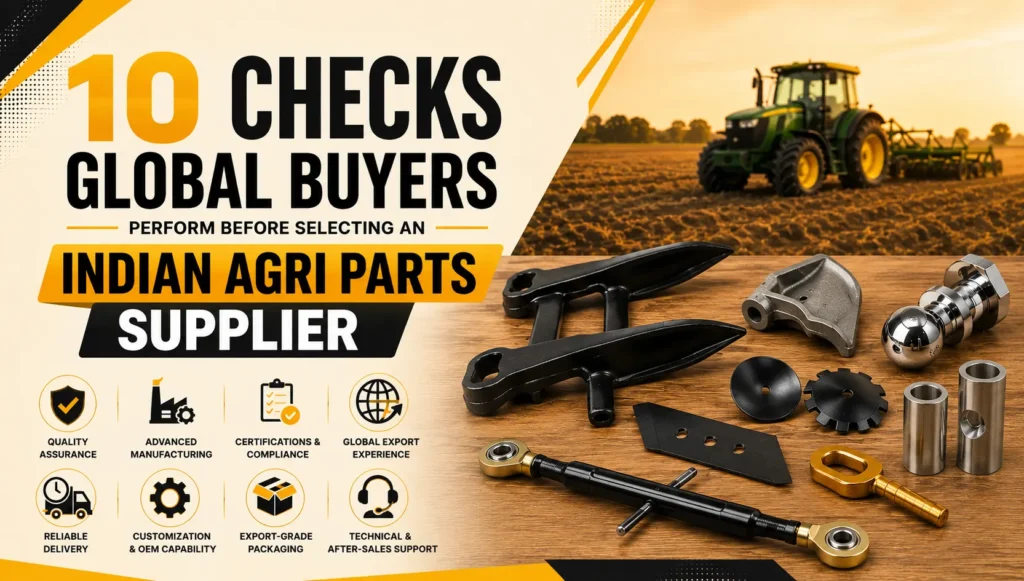
India has become a preferred sourcing destination for agricultural parts due to its manufacturing capabilities, competitive pricing, and growing export network. However, experienced importers, distributors, OEMs, and procurement managers do not select suppliers based on price alone.
Before placing orders, global buyers conduct a detailed evaluation of suppliers to ensure product quality, reliable deliveries, regulatory compliance, and long-term supply chain stability.
What Do Global Buyers Check Before Sourcing Agri Parts from India?
Global buyers typically evaluate product quality, manufacturing infrastructure, quality control systems, certifications, export experience, production capacity, delivery reliability, customization capabilities, packaging standards, and after-sales support before sourcing agri parts from India. These checks help reduce procurement risks and ensure consistent product performance.
10 Checks Global Buyers Perform Before Selecting an Indian Agri Parts Supplier
1. Product Quality and Material Standards
Product quality is often the first criterion buyers evaluate because it directly impacts equipment performance, durability, and customer satisfaction.
Many buyers request product samples, dimensional inspection reports, and Material Test Certificates (MTCs) before approving a supplier. These documents help verify that parts meet required specifications and can withstand demanding agricultural applications.
Key factors buyers assess include the following:
- Material grade and composition
- Wear resistance
- Corrosion resistance
- Dimensional accuracy
- Surface finish quality
- Product durability under field conditions
A supplier that consistently delivers high-quality products helps reduce warranty claims and replacement costs.
2. Manufacturing Infrastructure
A supplier’s manufacturing capabilities play a major role in ensuring consistent quality and timely deliveries.
Global buyers often evaluate:
- Manufacturing facilities
- Production machinery
- Tooling capabilities
- Automation levels
- Engineering expertise
- Process standardization
Well-equipped manufacturers are generally better positioned to maintain product consistency across multiple production batches.
3. Quality Control Systems
Strong quality control processes are essential for minimizing defects and ensuring repeatable product quality.
Buyers typically look for quality checks at every stage of production, including:
- Incoming Material Inspection: Verification of raw materials before production begins.
- In-Process Inspection: Monitoring products during manufacturing to identify issues early.
- Final Product Inspection: Comprehensive testing before packaging and shipment.
- Traceability Systems: The ability to track materials and production batches throughout the manufacturing process.
A robust quality management system provides confidence that future orders will match approved samples.
4. Certifications and Compliance
Certifications help buyers verify that suppliers follow recognized quality management standards.
Common documents reviewed during supplier evaluation include:
- ISO quality management certifications
- Product testing reports
- Inspection records
- Quality assurance documentation
- Export compliance documents
These certifications often serve as an indicator of a supplier’s commitment to consistent manufacturing practices.
5. Export Experience
Manufacturing expertise alone is not enough for successful international sourcing.
Buyers often prioritize suppliers with proven export experience because they understand:
- International shipping requirements
- Customs documentation
- Packaging regulations
- Market-specific compliance needs
- Global customer expectations
Experienced exporters are generally better equipped to avoid shipment delays and documentation errors.
6. Production Capacity
A supplier may produce excellent products but still struggle to fulfill larger orders.
For this reason, buyers assess the following:
- Monthly production capacity
- Scalability for future demand
- Workforce availability
- Production planning systems
- Capacity utilization levels
This helps determine whether a supplier can support long-term procurement requirements.
7. Lead Time Reliability
Late deliveries can disrupt entire supply chains.
Before entering long-term agreements, buyers evaluate:
- Average lead times
- On-time delivery performance
- Inventory management practices
- Raw material sourcing stability
- Emergency order capabilities
Reliable delivery performance is often considered just as important as product quality.
8. Customization and OEM Capabilities
Many distributors and equipment manufacturers require products tailored to their specific market requirements.
Buyers often assess whether suppliers can provide:
- OEM manufacturing
- Private labeling
- Product modifications
- Custom specifications
- Engineering support
- Specialized packaging
Customization capabilities allow buyers to differentiate their products in competitive markets.
9. Packaging Standards
Agricultural parts frequently travel thousands of miles before reaching customers.
Poor packaging can result in product damage, increased returns, and customer dissatisfaction.
Buyers typically evaluate:
- Export-grade packaging
- Moisture protection
- Protective wrapping
- Product labeling
- Container optimization
Proper packaging helps ensure products arrive in excellent condition.
10. Technical and After-Sales Support
Long-term supplier relationships often depend on the level of support provided after shipment.
Buyers commonly look for:
- Technical documentation
- Product specifications
- Installation guidance
- Warranty support
- Responsive customer service
Strong after-sales support helps resolve issues quickly and improves overall procurement efficiency.
Supplier Evaluation Matrix for Agri Parts Sourcing
| Evaluation Area | Why Buyers Check It |
| Product Quality | Ensures durability and performance |
| Manufacturing Infrastructure | Supports consistency and scalability |
| Quality Control | Reduces defects and returns |
| Certifications | Verifies quality standards |
| Export Experience | Minimizes shipping and compliance risks |
| Production Capacity | Supports long-term demand |
| Lead Time Reliability | Prevents supply chain disruptions |
| Customization Capabilities | Meets market-specific requirements |
| Packaging Standards | Protects products during transit |
| Technical Support | Improves customer satisfaction |
Documents Global Buyers Commonly Request
Before approving an agri parts supplier, procurement teams often request supporting documentation.
Commonly requested documents include:
- Material Test Certificates (MTCs)
- Product specification sheets
- Quality inspection reports
- Dimensional inspection reports
- Product testing reports
- Export documentation
- Packaging specifications
- Certificates of origin
Providing accurate documentation helps build trust and demonstrates manufacturing transparency.
Supplier Audit Checklist for Global Buyers
Before finalizing a supplier, buyers should verify:
- Product quality standards
- Material certifications
- Manufacturing capabilities
- Quality control procedures
- Export experience
- Production capacity
- Lead time reliability
- Packaging standards
- Customization capabilities
- Technical support availability
This checklist helps buyers identify reliable suppliers and reduce procurement risks.
Red Flags Buyers Should Watch For
During supplier evaluation, certain warning signs may indicate potential risks.
Common red flags include:
- Inconsistent product specifications
- Limited quality documentation
- Unclear pricing structures
- Lack of export experience
- Poor communication responsiveness
- Unrealistically low pricing
- Inability to provide product samples
- Frequent delivery delays
Identifying these issues early can prevent costly sourcing mistakes.
Conclusion
Successful agri parts sourcing requires a thorough evaluation process that goes far beyond comparing prices. Global buyers carefully assess product quality, manufacturing capabilities, quality control systems, certifications, export expertise, production capacity, delivery performance, and customer support before selecting a supplier.
By following a structured supplier evaluation framework, buyers can reduce procurement risks, improve supply chain reliability, and build long-term partnerships with trusted agri parts manufacturers in India.
FAQs
Product quality is usually the most important factor. Global buyers evaluate material quality, manufacturing standards, durability, and dimensional accuracy to ensure the parts perform reliably in agricultural applications and meet customer expectations.
Export experience helps ensure that the supplier understands international shipping procedures, customs documentation, packaging requirements, and market-specific regulations. This reduces the risk of shipment delays and compliance issues.
Buyers commonly request Material Test Certificates (MTCs), product specification sheets, quality inspection reports, testing reports, export documentation, and certificates of origin to verify product quality and manufacturing standards.
Buyers assess whether the manufacturer performs incoming material inspections, in-process quality checks, final product inspections, and maintains traceability systems. These processes help ensure consistent product quality across every order.
Production capacity determines whether a supplier can handle large orders, meet delivery schedules, and support future business growth. Buyers often evaluate manufacturing output and scalability to avoid supply chain disruptions.