
 (+91) 842-700-1426
  agriparts@jcblmail.com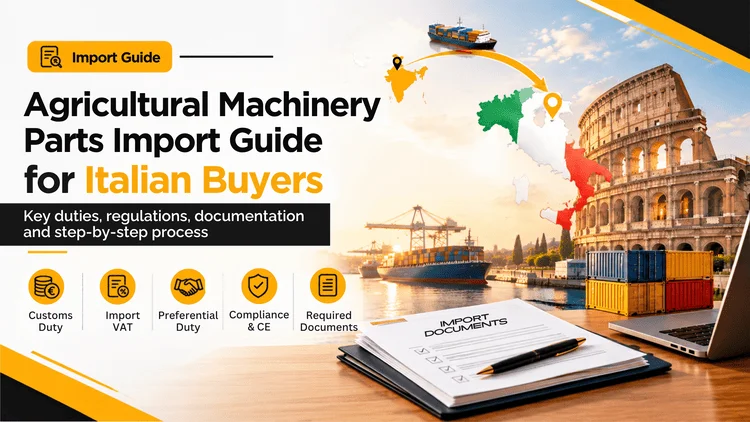
Import duties on agricultural machinery parts in Italy are not fixed. The applicable rate depends on the part’s CN/TARIC classification, customs origin, and the tariff measures applicable to that product. Imports of agricultural machinery replacement parts from outside the EU may also be subject to Italian import VAT and, depending on the product and origin, additional measures such as tariff preferences, quotas, or trade-defense duties. Product-specific EU regulations must also be checked before the parts are placed on the Italian market.
Agricultural Machinery Parts Import to Italy: At a Glance
| Import factor | What determines it? |
| Customs duty | CN/TARIC classification and origin |
| Import VAT | Italian VAT rules and applicable tax base |
| Preferential duty | Origin and applicable EU trade agreement |
| Trade-defense measures | Product and country of origin |
| Product compliance | Type and intended use of the part |
| CE marking | Required only where applicable EU legislation mandates it |
Italy is part of the EU customs territory, so imports from non-EU countries are subject to the EU customs framework rather than a separate Italian customs tariff. TARIC integrates the EU Common Customs Tariff with tariff preferences, quotas, trade-defence measures, prohibitions, and restrictions. Its data is transmitted daily to national customs administrations.
What Is the Import Duty on Agricultural Machinery Parts in Italy?
There is no single import duty rate for agricultural machinery parts. The correct rate must be determined for the specific product.
To establish the applicable duty, an importer should:
- Identify the exact part and its technical characteristics.
- Determine its CN classification and applicable TARIC code.
- Establish its customs origin.
- Check the current TARIC measures for that classification and origin.
- Check whether a preferential tariff, quota, anti-dumping duty, or other measure applies.
TARIC distinguishes measures such as third-country duties, tariff preferences, tariff quotas, anti-dumping duties, and countervailing duties. It does not provide national VAT rates, so import VAT must be checked separately under Italian tax rules.
Does Country of Origin Affect the Duty?
Yes. Customs origin is not simply the country from which the goods are shipped. EU origin rules determine where goods originate for customs purposes, and origin can affect preferential tariffs and trade-defence measures.
If an EU trade agreement applies, an importer may qualify for a reduced or zero customs duty when the product meets the relevant preferential-origin rules, and the required proof of origin is available.
How Are Agricultural Machinery Parts Classified?
Correct classification is central to calculating customs duty and identifying other import requirements.
The EU uses the Combined Nomenclature (CN), an eight-digit customs classification system based on the international Harmonized System (HS). TARIC adds further EU tariff and trade measures to the classification. Classification can also determine whether licenses, restrictions, certificates, or other measures apply.
For agricultural machinery parts, classification should be based on the actual characteristics of the component, including:
- Function and intended use
- Material and construction
- Technical specifications
- Whether it is a dedicated machinery component or a general-purpose item
- The machinery or equipment for which it is designed
Can Importers Obtain a Binding Tariff Classification?
Where classification is uncertain, businesses can consider applying for Binding Tariff Information (BTI). A BTI decision provides legally binding tariff-classification information under the EU customs framework and can help establish the correct classification for future imports.
This is particularly useful when a component could reasonably fall under more than one tariff heading.
What Regulations Apply to Agricultural Machinery Parts in Italy?
There is no single EU regulation covering every agricultural machinery part. The applicable requirements depend on the product, its function, the machinery or vehicle for which it is intended, and the legislation within its scope.
EU Machinery Regulation
Regulation (EU) 2023/1230 establishes health and safety requirements for machinery, related products, and partly completed machinery within its scope. It covers machinery as well as products such as interchangeable equipment, safety components, lifting accessories, and removable mechanical transmission devices.
The regulation will generally apply from 20 January 2027. Its transitional provisions also address products placed on the market under the existing Machinery Directive framework before that date.
Agricultural and Forestry Tractor Parts
Tractor components require particular attention.
The Machinery Regulation excludes agricultural and forestry tractors, together with systems, components, separate technical units, parts and equipment designed for tractors that fall within Regulation (EU) No 167/2013.
Regulation 167/2013 establishes EU requirements for the approval and market surveillance of agricultural and forestry vehicles and covers specified systems, components, separate technical units, parts and equipment designed for those vehicles.
Therefore, an importer should not automatically classify every tractor component under the Machinery Regulation. The product must first be assessed against the relevant regulatory scope.
Do Agricultural Machinery Parts Need CE Marking in Italy?
Not automatically. CE marking is required only for products covered by specific EU harmonization legislation that requires it. A product outside that legislation must not carry the CE marking simply because it is imported or sold in the EU.
Where CE legislation applies, the responsible manufacturer must meet the relevant conformity requirements. Depending on the legislation and product, these can include:
- Conformity assessment
- Technical documentation
- EU Declaration of Conformity
- Required product information
- CE marking
Importers also have responsibilities to verify that products placed on the EU market comply with applicable requirements.
A Simple Regulatory Decision Path
For an agricultural machinery part:
Is it a tractor component covered by Regulation 167/2013?
→ Check the requirements under that framework.
Is it a machinery product or related product within the Machinery Regulation?
→ Check the applicable machinery requirements.
Does another EU harmonization law apply?
→ Follow that legislation and its conformity requirements.
Does no CE-marking legislation apply?
→ Do not affix CE marking merely because the part is imported into Italy.
What Documents Are Required to Import Agricultural Machinery Parts into Italy?
The exact documents depend on the product, origin, and customs procedure. Commonly relevant documents include:
- Commercial invoice
- Packing list
- Transport document
- Customs declaration
- CN/TARIC classification information
- Origin information or proof of preferential origin, where applicable
- Product and technical documentation, where required
- EU Declaration of Conformity or other conformity documentation, where applicable
An EORI number is mandatory for customs clearance in the EU, including import, export, and transit operations.
Italy’s Agenzia delle Dogane e dei Monopoli (ADM) operates the national electronic customs declaration system for imports.
How to Import Agricultural Machinery Parts into Italy
A practical import process is:
- Identify the exact part and collect its technical specifications.
- Determine the CN/TARIC classification.
- Establish customs origin.
- Check the applicable TARIC duty and trade measures.
- Calculate customs value and import taxes.
- Check the product-specific EU regulatory framework.
- Determine whether CE marking or other conformity requirements apply.
- Prepare commercial, customs, and technical documents.
- Verify the EORI and customs-declaration requirements.
- Submit the customs declaration and complete clearance.
Checking these points before shipment allows importers to estimate landed costs more accurately and reduce avoidable customs or compliance problems.
Common Mistakes When Importing Agricultural Machinery Parts
- Using one generic HS code: Different components can have different classifications.
- Confusing shipping origin with customs origin: Origin is determined under EU customs rules.
- Treating customs duty and VAT as the same charge: They are separate import costs.
- Assuming every part needs CE marking: CE marking depends on applicable EU legislation.
- Applying the Machinery Regulation to every tractor component: Covered tractor parts may instead fall under Regulation 167/2013.
- Checking tariffs after shipment: The applicable TARIC classification and measures should be established before importing.
Conclusion
Importing agricultural machinery parts into Italy requires more than knowing the applicable customs duty. Importers should verify the correct CN/TARIC classification, customs origin, tariff measures, import taxes, and product-specific EU compliance requirements before shipment. A part-by-part assessment helps businesses calculate landed costs accurately, prepare the right documentation, and avoid unnecessary customs or regulatory delays.
FAQs
There is no universal rate. The applicable duty depends on the part’s CN/TARIC classification, customs origin, and the tariff measures applicable to that product.
Import VAT may apply separately from customs duty. The applicable amount depends on Italian VAT rules and the relevant import tax base.
Not necessarily. CE marking is required only when specific applicable EU legislation requires it.
There is no single HS code for all agricultural machinery parts. Classification depends on the specific product and its technical characteristics.
Not necessarily. Tractor systems, components, separate technical units, parts, and equipment covered by Regulation 167/2013 are excluded from the Machinery Regulation’s scope.
Common documents include the commercial invoice, packing list, transport document, customs declaration, classification and origin information, and applicable conformity documentation. Exact requirements depend on the product and customs procedure.