
 (+91) 842-700-1426
  agriparts@jcblmail.com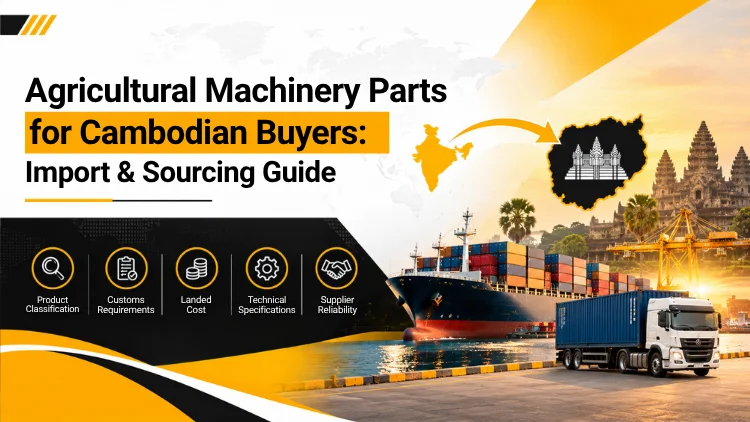
For Cambodian agricultural machinery distributors, dealers, repair businesses, and equipment operators, importing replacement parts is often a practical way to maintain equipment availability and meet customer demand. But a successful shipment involves more than finding a competitive supplier.
Importing agricultural machinery parts into Cambodia requires attention to product classification, customs requirements, landed cost, technical specifications, and supplier reliability.
This guide explains the key considerations for Cambodian businesses sourcing agricultural machinery parts internationally, including from India.
What Agricultural Machinery Parts Can Be Imported into Cambodia?
Agricultural machinery parts cover a broad range of replacement, maintenance, and wear components. Common categories include:
- Tractor replacement parts
- Rotavator and tillage-equipment components
- Harvesting-machine parts
- Planting and seeding equipment components
- Agricultural pump and irrigation parts
- Transmission and drivetrain components
- Bearings, shafts, gears, and bushings
- Blades, tines, and other wear parts
The important point for importers is that these products do not necessarily have one common HS code. Classification depends on the specific product, its function, and the applicable tariff rules.
How to Find the Correct HS Code for Agricultural Machinery Parts in Cambodia
The HS/AHTN code is one of the first things to establish before importing. Cambodia uses an eight-digit Harmonized System classification that conforms to the ASEAN Harmonized Tariff Nomenclature (AHTN). The classification is used to determine the applicable tariff and other customs requirements.
How should you classify an agricultural machinery part?
Follow this process:
Identify the exact part → determine its function → check the applicable AHTN classification → verify the tariff and import measures
For example, a tractor component, rotavator blade, bearing, or pump component should not automatically be assigned the same HS code simply because each is used in agricultural machinery.
Do not rely on a generic “agricultural machinery parts HS code.” Confirm the classification for the actual product being imported. Cambodia’s National Trade Repository provides commodity-search facilities for checking tariff classifications and applicable measures.
What Duties and Taxes Apply to Imported Machinery Parts in Cambodia?
The applicable import duty depends on the product’s HS/AHTN classification, country of origin, and applicable tariff treatment. Cambodia also applies VAT to imports, with a general VAT rate of 10%, although specific exemptions and preferential treatments can apply.
Importers should therefore calculate the complete landed cost before placing a bulk order.
A simple landed-cost calculation
Landed cost = Product price + Freight + Insurance + Customs duty + VAT + Clearance and handling costs
The supplier offering the lowest unit price is not necessarily the lowest-cost option after freight, taxes, and clearance are included.
Preferential tariff treatment may also be available under applicable trade agreements when the goods satisfy the relevant rules of origin.
What Documents Are Required to Import Agricultural Machinery Parts into Cambodia?
Commercial importers generally need to prepare a customs declaration together with supporting documentation.
Common documents include:
- Commercial invoice or contract of sale
- Packing list
- Bill of Lading or Air Waybill
- Customs declaration
- Certificate of Origin, where applicable
- Insurance documentation, where applicable
- Licenses, permits, or certificates where required for the particular commodity
Cambodia’s National Trade Repository states that commercial importers must be registered appropriately, including business and VAT registration, and customs declarations are submitted through ASYCUDA World.
Importers should also check whether the specific part is subject to any additional regulatory requirements before shipment.
How to Import Agricultural Machinery Parts into Cambodia: Step-by-Step
A practical import process looks like this:
- Identify the exact part: Confirm the part number, dimensions, material, application, and machinery model it is intended for.
- Determine the HS/AHTN code: Establish the correct classification before calculating the shipment’s tariff and taxes.
- Check import requirements and costs: Verify applicable duty, VAT, preferential treatment, and any product-specific requirements.
- Select an overseas supplier: Assess manufacturing capability, quality controls, production capacity, and export experience, not just the quoted price.
- Approve specifications or samples: For a new supplier, verify dimensions, fitment, and performance before committing to a large production run.
- Finalize commercial terms: Agree on MOQ, pricing, Incoterms, payment terms, packaging, and delivery schedule.
- Prepare shipping documentation: Ensure the invoice, packing list, transport documents, and applicable origin documents contain consistent information.
- Submit the customs declaration: The importer or its customs broker submits the required declaration and supporting documents through the applicable Cambodian customs process.
- Clear and inspect the shipment: After customs procedures and payment of applicable duties and taxes, inspect the shipment for quantity, packaging, and product conformity before distribution.
How Should Cambodian Importers Choose an Agricultural Machinery Parts Supplier?
For B2B procurement, supplier evaluation should go beyond price.
| Factor | What to check |
| Product capability | Materials, dimensions, part range and compatibility |
| Quality control | Inspection, testing and batch consistency |
| Production capacity | MOQ, capacity and lead time |
| Export capability | Documentation and international shipping experience |
| Repeat-order consistency | Ability to maintain the same specifications across batches |
For recurring imports, batch-to-batch consistency is particularly important. A supplier may produce an acceptable first sample but still create problems if subsequent batches vary in dimensions, hardness, material, or finish.
Why Consider India for Agricultural Machinery Parts?
India is one potential sourcing base for Cambodian buyers looking for agricultural machinery and replacement components.
Its manufacturing sector offers capabilities across tractor and implement components, forged and machined parts, aftermarket components, and custom manufacturing.
There is also an established Cambodia–India agricultural machinery trade relationship. In 2024, Cambodia imported approximately US$95.5 million of wheeled tractors under HS 870190, including about US$15.98 million from India.
This does not mean India is the right source for every part. Cambodian importers should compare suppliers based on technical fit, quality, landed cost, production capacity, and delivery reliability.
Common Mistakes When Importing Agricultural Machinery Parts into Cambodia
Avoid these six mistakes:
- Using one HS code for every part: Different components can have different classifications.
- Assuming agricultural parts are automatically duty-free: Tariff treatment should be verified for the specific product and origin.
- Choosing a supplier solely on unit price: Freight, taxes, defects, and replacement costs can change the actual economics.
- Skipping compatibility checks: Confirm dimensions and specifications before bulk production.
- Ignoring landed cost: Calculate the complete cost of getting the parts into Cambodia.
- Submitting inconsistent documentation: Commercial and shipping documents should accurately describe the same goods, quantities, and transactions.
Conclusion
Successful agricultural machinery parts importing into Cambodia starts before the shipment leaves the supplier. Correct HS/AHTN classification, accurate landed-cost calculations, complete documentation, verified specifications, and consistent manufacturing can reduce the risk of customs issues, unsuitable parts, and unexpected costs.
For Cambodian distributors, dealers, and machinery businesses, the strongest long-term sourcing strategy is therefore not simply finding the lowest-priced component. It is establishing a supply relationship that delivers the right specifications, dependable quality, and predictable repeat supply.
FAQs
Yes. Cambodian businesses can import agricultural machinery parts subject to the applicable customs, tariff, documentation, and product-specific requirements.
There is no single HS code for every agricultural machinery part. The correct AHTN classification depends on the specific product and its function.
Not necessarily. The applicable tariff depends on the product classification, country of origin, and any preferential or other tariff treatment that applies.
Common documents include a commercial invoice, packing list, transport document, and customs declaration. Additional certificates, permits, or origin documents may be required depending on the product and import arrangement.
Yes. India already supplies agricultural machinery to Cambodia, and Cambodian businesses can evaluate Indian manufacturers for replacement and component sourcing based on product specifications, quality, and commercial requirements.