
 (+91) 842-700-1426
  agriparts@jcblmail.com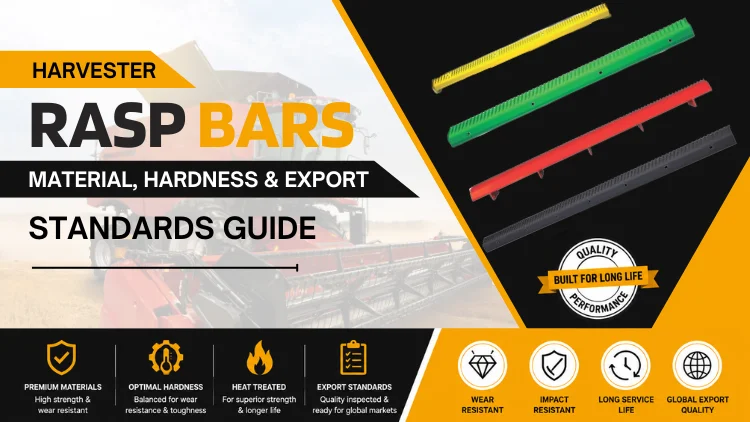
Selecting the right harvester RASP bar is about much more than finding a replacement part that fits. The material composition, hardness, heat treatment, manufacturing precision, and quality inspection standards directly influence threshing efficiency, wear resistance, and the overall service life of a combine harvester.
For importers, OEMs, agricultural equipment distributors, and bulk buyers, understanding these technical specifications helps reduce maintenance costs, minimize downtime, and ensure consistent field performance. This guide explains the key factors that define a high-quality harvester RASP bar and the export standards buyers should evaluate before placing an order.
Why Material Selection Matters in Harvester RASP Bars
During harvesting, RASP bars repeatedly strike crop material while being exposed to dust, sand, stones, and continuous friction. These conditions create severe abrasive wear and impact loading.
The steel used in manufacturing determines how well the component resists:
- Surface wear
- Cracking under impact
- Deformation during prolonged use
- Fatigue caused by continuous operation
Poor-quality steel may initially appear cost-effective but often wears out faster, resulting in frequent replacements and increased maintenance expenses.
High-quality steel provides an ideal balance between hardness and toughness, allowing the RASP bar to maintain its tooth profile while resisting fractures under heavy loads. The right material hardness helps improve wear resistance while maintaining the toughness needed for demanding harvesting conditions.
Key takeaway: Material quality is the foundation of durability, wear resistance, and long-term harvesting performance.
Common Materials Used for Harvester RASP Bars
Different manufacturers use different steel grades depending on the intended application.
| Material | Advantages | Best Application |
| Medium Carbon Steel | Good strength and economical | Light-duty harvesting |
| High Carbon Steel | Improved wear resistance | Standard agricultural operations |
| Boron Steel | Excellent hardenability after heat treatment | Heavy-duty field conditions |
| Alloy Steel | Superior strength, durability, and fatigue resistance | OEM and export-grade products |
1. Medium Carbon Steel
Medium carbon steel offers a practical balance of strength and cost. It is suitable for standard harvesting conditions where operating hours and abrasive wear are moderate.
2. High Carbon Steel
Higher carbon content improves hardness and wear resistance, making these RASP bars more suitable for extended harvesting seasons.
3. Boron Steel
Boron steel responds exceptionally well to heat treatment, producing components with excellent surface hardness while maintaining core toughness. It is commonly used for heavy-duty agricultural applications.
4. Alloy Steel
Premium alloy steels are engineered for high strength, impact resistance, and longer service life. They are widely preferred for OEM production and export markets that demand consistent product quality.
Recommended Hardness for Long Service Life
Hardness is one of the most important indicators of RASP bar quality because it determines resistance to abrasion.
However, harder is not always better.
Excessive hardness can make the component brittle, increasing the likelihood of cracking during heavy impact. On the other hand, insufficient hardness accelerates wear, causing the teeth to lose their effectiveness prematurely.
An ideal RASP bar achieves a balance between:
| Property | Importance |
| Uniform Surface Hardness | Improves wear resistance |
| Tough Core Structure | Absorbs repeated impacts |
| Controlled Heat Treatment | Prevents premature failure |
| Consistent Hardness Across Production | Ensures predictable performance |
Rather than focusing on a specific Rockwell Hardness (HRC) value, buyers should verify that the manufacturer follows controlled heat treatment processes and performs hardness testing as part of quality assurance. The optimum hardness depends on the steel grade, product design, and intended harvesting conditions.
Why Heat Treatment Is Essential
Even premium steel cannot deliver maximum performance without proper heat treatment.
A controlled heat treatment process enhances mechanical properties while maintaining structural integrity.
Typical manufacturing workflow:
Raw Material Selection → Forging or Pressing → Machining → Heat Treatment → Surface Finishing → Quality Inspection → Export Packaging
The heat treatment process generally includes:
- Hardening: Improves surface wear resistance by increasing hardness.
- Tempering: Reduces brittleness while improving toughness and impact resistance.
- Stress Relief: Minimizes internal stresses generated during manufacturing, helping maintain dimensional stability.
Properly heat-treated RASP bars retain their working profile longer and withstand continuous harvesting operations with reduced risk of cracking or distortion.
Manufacturing Features That Improve Performance
High-quality manufacturing is equally important as material selection.
1. Precision Tooth Geometry
Uniform tooth profiles ensure efficient crop feeding and threshing. Inconsistent tooth geometry can reduce harvesting efficiency and accelerate uneven wear.
2. Dimensional Accuracy
Precision machining ensures the RASP bar fits correctly on the threshing drum without requiring modifications during installation.
3. Accurate Mounting Holes
Correct hole spacing and positioning simplify installation while preventing alignment issues that could affect harvesting performance.
4. Consistent Thickness
Uniform thickness distributes operational loads evenly, reducing localized stress and extending component life.
5. High Surface Quality
A clean, burr-free finish improves corrosion resistance and reduces the likelihood of surface defects becoming crack initiation points.
6. Controlled Manufacturing Processes
Reliable manufacturers use calibrated equipment and standardized production methods to ensure every batch meets the same dimensional and mechanical requirements.
Export Quality Standards Buyers Should Check
International buyers should evaluate more than price when sourcing harvester RASP bars. Consistent quality and documented inspection processes are equally important.
A reputable manufacturer should provide the following:
- Material Traceability: Documentation confirming the steel grade used for production.
- Dimensional Inspection: Verification that every critical dimension falls within specified tolerances.
- Hardness Testing: Routine hardness checks to ensure consistent mechanical properties throughout production.
- Surface Quality Inspection: Visual and dimensional inspection to identify cracks, burrs, deformation, or machining defects.
- Corrosion Protection: Protective coatings or rust-prevention treatments suitable for storage and overseas transportation.
- Batch Identification: Production batch marking enables traceability and quality control.
- Export Packaging: Strong export packaging protects components from moisture, corrosion, and handling damage during international shipping.
- Quality Documentation: Inspection reports, packing lists, and other relevant documentation help buyers verify product consistency and streamline import processes.
Quality Inspection Checklist Before Buying Harvester RASP Bars
Before approving a shipment, buyers should verify the following:
| Inspection Point | Why It Matters |
| Material Grade | Determines strength and durability |
| Heat Treatment | Improves wear resistance and toughness |
| Hardness Consistency | Ensures predictable field performance |
| Dimensions | Guarantees proper fitment |
| Mounting Hole Accuracy | Enables easy installation |
| Tooth Profile | Maintains threshing efficiency |
| Surface Finish | Reduces corrosion risk |
| Packaging Quality | Prevents shipping damage |
| Batch Traceability | Supports quality assurance |
This checklist helps procurement teams evaluate suppliers objectively and reduce the risk of receiving inconsistent products.
How to Choose the Right Export Supplier
Choosing a reliable manufacturer is just as important as selecting the right product.
Consider suppliers that demonstrate:
- In-house manufacturing capabilities
- Consistent raw material sourcing
- Documented quality inspection procedures
- Heat treatment expertise
- Precision machining capabilities
- OEM and custom manufacturing support
- Bulk production capacity
- Export packaging experience
- Transparent technical documentation
- Reliable delivery schedules
A manufacturer with established quality systems is more likely to deliver consistent products across multiple production batches, reducing procurement risks for distributors and OEM customers.
Conclusion
A high-quality harvester RASP bar is defined by more than its appearance. Its long-term performance depends on carefully selected steel, controlled heat treatment, balanced hardness, precision manufacturing, and rigorous quality inspection.
For OEMs, importers, distributors, and agricultural machinery suppliers, evaluating these technical factors before purchasing helps ensure reliable harvesting performance, longer component life, and greater value over time. By partnering with a manufacturer that follows consistent production and export-quality practices, buyers can source RASP bars that meet demanding agricultural applications while supporting dependable global supply chains.
FAQs
High-quality alloy steel, boron steel, and high-carbon steel are commonly preferred because they provide an excellent balance of strength, wear resistance, and durability after proper heat treatment.
Hardness improves resistance to abrasive wear. However, the ideal RASP bar combines sufficient surface hardness with a tough core to prevent cracking under repeated impact.
Manufacturers typically use controlled hardening and tempering processes to improve wear resistance while maintaining toughness and structural stability.
Importers should verify material specifications, hardness testing, dimensional accuracy, mounting hole alignment, surface finish, batch traceability, and export packaging quality.
Yes. Many manufacturers offer OEM and custom production based on technical drawings, dimensions, steel grade requirements, and specific harvesting equipment models.