
 (+91) 842-700-1426
  agriparts@jcblmail.com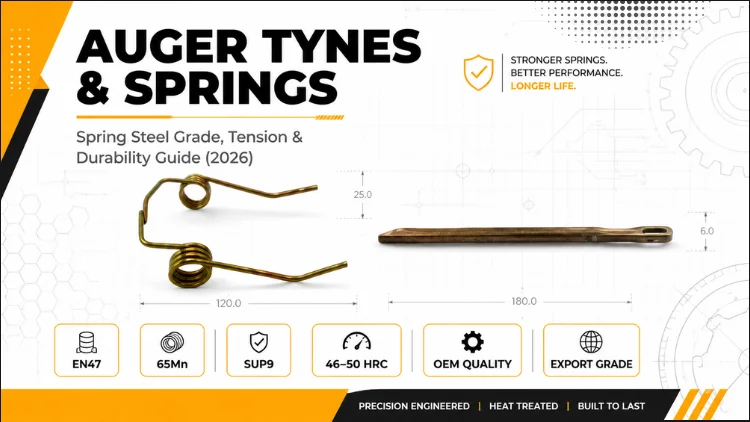
Auger tynes and springs are subjected to continuous bending, vibration, and impact while handling crops, residue, and soil. Their performance depends less on appearance and more on factors such as spring steel grade, heat treatment, hardness, working tension, and fatigue resistance. Choosing the wrong material or improper tension settings can lead to premature cracking, deformation, reduced field efficiency, and higher maintenance costs.
This guide explains how to select the right spring steel for auger tynes and springs, recommended hardness and tension values, key durability factors, and what OEMs and international buyers should verify before purchasing.
What Are Auger Tynes & Springs?
Auger tynes and springs are flexible steel components used in agricultural machinery to guide, lift, or control crop material while absorbing shock loads. They are commonly installed in combine harvesters, seed drills, straw management systems, and other harvesting or tillage equipment where repeated flexing is unavoidable.
Their primary purpose is to maintain consistent performance under cyclic loading without permanent deformation or failure.
Which Spring Steel Grade Is Best for Auger Tynes & Springs?
The steel grade determines how well a spring withstands repeated stress, maintains elasticity, and resists wear. High-quality spring steels offer better fatigue life and load retention than ordinary carbon steel.
| Spring Steel Grade | Typical Hardness (HRC) | Fatigue Resistance | Typical Application |
| EN47 (50CrV4 equivalent) | 46–50 | Excellent | Heavy-duty harvesters and OEM components |
| 65Mn | 44–50 | Good | Standard agricultural applications |
| SUP9 (55Cr3 equivalent) | 45–51 | Excellent | Premium OEM and export-grade springs |
EN47 (50CrV4 Equivalent)
EN47 is one of the most widely used spring steels for heavy-duty agricultural components. Its chromium-vanadium composition provides high fatigue strength, excellent toughness, and reliable performance under continuous bending.
It is suitable for machines operating in demanding harvesting conditions where long service life is essential.
65Mn
65Mn offers a balance between cost and performance. It provides good elasticity, satisfactory wear resistance, and consistent mechanical properties, making it suitable for standard farming applications with moderate workloads.
SUP9 (55Cr3 Equivalent)
SUP9 is designed for applications requiring high resilience and excellent load recovery. It performs well under repeated stress and is frequently specified for export-quality agricultural machinery components.
For heavy-duty and export applications, EN47 and SUP9 generally provide better fatigue resistance and durability than standard carbon spring steels.
Recommended Tension for Auger Springs
Spring tension should be measured through working deflection, not by visual tightness. Correct tension allows the spring to flex repeatedly while returning to its original position without permanent deformation.
| Tine Thickness | Recommended Working Deflection | Typical Use |
| 6 mm | 8–12 mm | Light-duty applications |
| 8 mm | 12–18 mm | Medium-duty harvesters |
| 10 mm | 18–25 mm | Heavy-duty agricultural equipment |
Spring stiffness is calculated using:
k = F ÷ δ
Where:
- k = spring stiffness
- F = applied force
- δ = spring deflection
If the working deflection exceeds the spring’s design limit, fatigue life decreases significantly. Excessive preload can also increase stress concentration, leading to earlier failure.
Hardness and Heat Treatment Requirements
Material selection alone does not guarantee durability. Proper heat treatment determines whether the spring maintains its strength and elasticity throughout its service life.
A typical manufacturing process includes:
- Austenitizing at 830–870°C
- Oil quenching
- Tempering between 420–520°C
- Final hardness of approximately 46–50 HRC for EN47
| Parameter | Recommended Value |
| Austenitizing Temperature | 830–870°C |
| Quenching | Oil |
| Tempering | 420–520°C |
| Final Hardness | 46–50 HRC |
Over-hardening can make the spring brittle, increasing the likelihood of cracking under impact. Insufficient hardness, on the other hand, causes faster wear and permanent bending. Maintaining the specified hardness range helps achieve the best balance between strength and flexibility.
Factors That Determine Durability
The service life of auger tynes and springs depends on multiple engineering factors rather than steel grade alone.
1. Fatigue Resistance
Agricultural springs experience thousands of loading cycles during every harvesting season. High fatigue strength enables the spring to withstand repeated bending without developing microscopic cracks that eventually lead to failure.
2. Heat Treatment Consistency
Uniform heat treatment ensures consistent hardness throughout the component. Variations in hardness can create weak zones that reduce structural reliability.
3. Shot Peening
Shot peening introduces beneficial compressive stresses on the spring surface, improving fatigue resistance and helping prevent crack initiation during cyclic loading.
4. Surface Finish
Smooth surfaces reduce stress concentrations. Decarburized or rough surfaces are more susceptible to fatigue cracking under repeated operation.
5. Corrosion Protection
Protective coatings such as phosphate treatment, powder coating, or anti-corrosion finishes help reduce rust formation, especially in humid environments and regions with seasonal rainfall.
6. Dimensional Accuracy
Correct coil geometry, wire diameter, and tine dimensions ensure even stress distribution throughout the spring, reducing localized overload.
Long-lasting auger springs depend on the combination of quality spring steel, controlled heat treatment, accurate dimensions, and proper operating tension.
How to Inspect Tension Retention and Spring Quality
Routine inspection helps identify early signs of fatigue before complete failure occurs.
| Inspection Test | Acceptable Limit | Replace If |
| Free length reduction | Less than 2% | Greater than 3% |
| Permanent deformation | Less than 1.5 mm | More than 2 mm |
| Surface cracks | None | Any visible crack |
| Hardness variation | ±2 HRC | Greater than ±3 HRC |
During maintenance, also inspect for:
- Uneven coil spacing
- Corrosion around stress points
- Twisting or distortion
- Loss of elasticity under normal load
Replacing worn springs before complete failure helps prevent damage to surrounding machine components.
Export Buyer Checklist for Auger Tynes & Springs
International buyers often require technical documentation that verifies product quality and manufacturing consistency.
India
- Material Test Certificate (MTC)
- Hardness inspection report
- Dimensional inspection records
- Batch traceability
Europe
- EN47 or equivalent steel certification
- RoHS-compliant surface coating (where applicable)
- Consistent hardness and mechanical property reports
Middle East and Africa
- Corrosion-resistant coating
- Fatigue performance testing
- Heavy-duty field validation
North America
- ASTM-equivalent material declaration
- Manufacturing traceability
- Mechanical testing documentation
Providing complete technical documentation increases buyer confidence and supports long-term OEM partnerships.
Conclusion
Selecting high-quality auger tynes and springs requires evaluating more than just dimensions or price. The right spring steel grade, controlled heat treatment, appropriate hardness, proper working tension, and strong fatigue resistance all contribute to longer service life and dependable field performance.
For manufacturers, OEMs, and international buyers, sourcing auger tynes and springs from a reliable manufacturer or exporter with verified material certifications, mechanical testing, and consistent quality control helps reduce downtime, improve equipment reliability, and ensure long-term performance in demanding agricultural applications.
FAQs
EN47 and SUP9 are widely preferred for heavy-duty agricultural machinery because they provide excellent fatigue resistance, toughness, and long-term elasticity.
For EN47 spring steel, a final hardness of 46–50 HRC after proper heat treatment offers an effective balance between strength and flexibility.
Common causes include incorrect heat treatment, excessive working deflection, poor material quality, surface cracks, corrosion, and improper installation.
No. Durability depends more on fatigue strength, heat treatment quality, and correct spring design than on thickness alone.
Request a Material Test Certificate, hardness test report, dimensional inspection report, and batch traceability records before placing large OEM or export orders.