
 (+91) 842-700-1426
  agriparts@jcblmail.com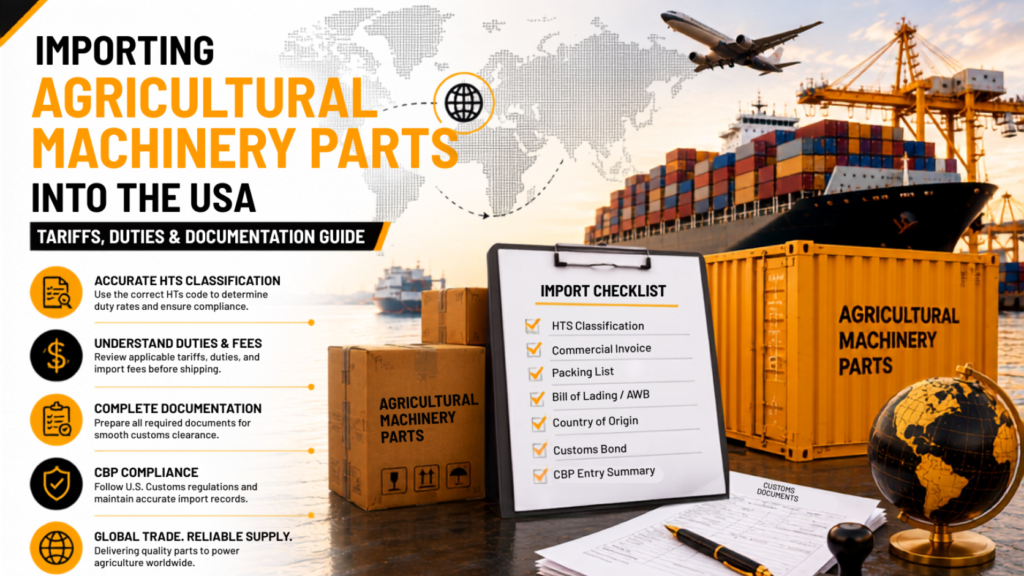
Importing agricultural machinery parts into the USA requires more than arranging international shipping. Businesses must correctly classify products, determine applicable tariffs and duties, prepare customs documentation, and comply with U.S. Customs and Border Protection (CBP) regulations. Errors in HTS classification or import paperwork can lead to customs delays, unexpected costs, and compliance issues. This guide explains the essential customs requirements for importing agricultural machinery parts into the United States, helping distributors, OEMs, wholesalers, and procurement teams streamline the import process.
How Do You Import Agricultural Machinery Parts into the USA?
To import agricultural machinery parts into the USA, businesses must identify the correct Harmonized Tariff Schedule (HTS) code, determine applicable import duties and fees, prepare accurate customs documentation, comply with CBP regulations, and ensure product information, valuation, and country of origin are correctly declared before customs clearance.
Step 1: Classify Agricultural Machinery Parts Using the Correct HTS Code
The first step in importing agricultural machinery parts is assigning the correct 10-digit Harmonized Tariff Schedule (HTS) code. The HTS code determines:
- Applicable import duty rates
- Additional tariffs, if applicable
- Eligibility under trade agreements
- Statistical reporting requirements
- Import restrictions
It is important to distinguish between the HS Code and the HTS Code. The six-digit HS Code is an international product classification system, while the U.S. HTS extends it to ten digits for tariff assessment and customs reporting.
Using an incorrect HTS classification can result in shipment delays, duty reassessments, or CBP compliance reviews. For complex machinery components, businesses may consider requesting a CBP Binding Ruling to confirm the correct classification before importing.
Step 2: Understand U.S. Tariffs, Duties & Import Fees
Import costs vary depending on the product’s HTS classification, country of origin, customs value, and applicable trade measures. There is no single duty rate for all agricultural machinery parts.
Common import charges include:
- Customs Duty: Determined by the HTS classification and country of origin.
- Merchandise Processing Fee (MPF): Applied to most formal entries at 0.3464% of the customs value, subject to CBP’s current minimum and maximum fee limits.
- Harbor Maintenance Fee (HMF): A 0.125% fee on commercial cargo imported through designated U.S. seaports. It does not apply to air shipments.
What Factors Affect Import Duties?
Import duties depend on several variables:
| Factor | Why It Matters |
| HTS Classification | Determines duty rate and tariff treatment |
| Country of Origin | Influences tariff eligibility and trade measures |
| Customs Value | Used to calculate duties and fees |
| Trade Agreements | May reduce or eliminate duties for eligible goods |
| Product Description | Supports accurate customs classification |
Example Duty Calculation
Suppose a shipment of agricultural machinery parts has a customs value of $50,000. The total import cost would typically include:
Customs Value × Applicable Duty Rate + Merchandise Processing Fee + Harbor Maintenance Fee (if shipped by ocean) + Any Additional Applicable Tariffs
Because duty rates vary by HTS code and origin, businesses should verify the applicable rate before shipping.
Required Documentation for Importing Agricultural Machinery Parts into the USA
Accurate documentation is essential for smooth customs clearance. Missing or inconsistent paperwork is one of the most common reasons for import delays.
| Document | Purpose |
| Commercial Invoice | Declares product details, value, and seller information |
| Packing List | Verifies shipment contents and quantities |
| Bill of Lading or Air Waybill | Transportation document |
| HTS Classification | Determines tariff classification |
| Country of Origin Information | Supports tariff eligibility and marking requirements |
| CBP Entry Summary (Form 7501) | Official customs entry documentation |
| Customs Bond (when required) | Guarantees payment of duties, taxes, and fees |
Ensure all documents contain consistent product descriptions, quantities, and values to reduce the likelihood of customs examinations.
U.S. Customs Compliance Requirements.
Importers are responsible for exercising reasonable care when importing goods into the United States. Key compliance requirements include the following:
- Correct HTS classification
- Accurate customs valuation
- Proper country-of-origin declaration and marking
- Complete and truthful commercial documentation
- Maintaining import records as required by CBP
- Compliance with intellectual property protections for branded parts
Many businesses also work with a licensed customs broker to help prepare customs entries and manage regulatory requirements.
Common Reasons Agricultural Machinery Parts Are Delayed at U.S. Customs
Most customs delays are preventable. Common issues include:
- Incorrect HTS codes
- Missing or inaccurate commercial invoices
- Incorrect customs valuation
- Country-of-origin discrepancies
- Inconsistent product descriptions across documents
- Missing customs bond when required
- Incomplete customs entry information
Reviewing documentation before shipment significantly reduces clearance risks.
Best Practices for Smooth Customs Clearance
Following established import compliance practices can save time and reduce costs.
- Verify the correct HTS code before shipping.
- Confirm the country of origin for every shipment.
- Maintain consistent information across all import documents.
- Use detailed product descriptions instead of generic terms like “machine parts.”
- Review current tariff requirements before each import.
- Keep organized import records for future audits.
- Partner with an experienced customs broker for complex or high-value shipments.
Conclusion
Importing agricultural machinery parts into the USA requires careful attention to tariff classification, customs duties, documentation, and CBP compliance. By using the correct HTS code, accurately declaring customs value and country of origin, maintaining complete documentation, and verifying applicable import fees before shipping, businesses can minimize delays and improve supply chain efficiency. Whether you are an OEM, distributor, or procurement team, a proactive compliance strategy helps ensure smoother customs clearance, predictable import costs, and reliable access to the U.S. market.
FAQs
Yes. Most agricultural machinery parts are subject to import duties or other customs fees. The exact duty depends on the HTS classification, country of origin, customs value, and any applicable trade measures.
Typical documents include a commercial invoice, packing list, bill of lading or air waybill, HTS classification, country-of-origin information, CBP Entry Summary (Form 7501), and a customs bond when required.
Import duties are generally calculated using the shipment’s customs value and the applicable HTS duty rate, along with required fees such as the Merchandise Processing Fee (MPF) and, for eligible ocean shipments, the Harbor Maintenance Fee (HMF).
A customs broker is not legally required for every shipment, but many businesses use one to ensure accurate customs documentation, tariff classification, and regulatory compliance.
An incorrect HTS classification can lead to shipment delays, duty reassessments, customs examinations, penalties, or additional compliance actions by CBP.