
 (+91) 842-700-1426
  agriparts@jcblmail.com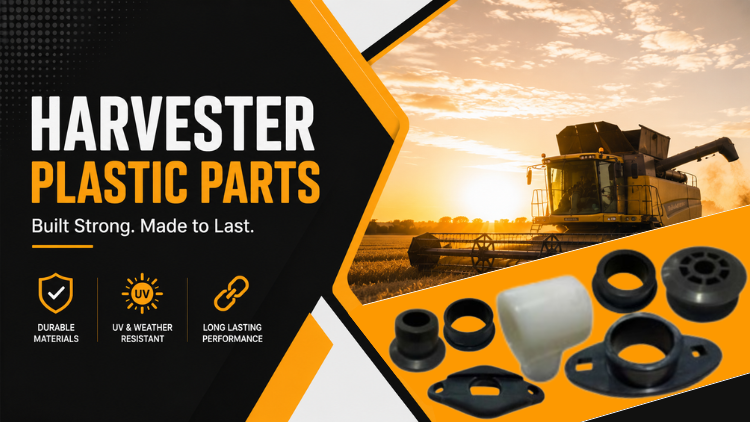
Modern harvesters operate in some of the toughest working conditions. Dust, crop residue, moisture, UV exposure, chemicals, vibration, and continuous mechanical stress can shorten the lifespan of poorly designed components. That’s why material selection for harvester plastic parts is as important as the component’s design itself.
Engineering plastics have become a preferred choice for many harvester components because they offer an effective balance of strength, weight, corrosion resistance, and manufacturing flexibility. However, no single material is suitable for every application. The right choice depends on the part’s function, operating environment, and expected service life.
This guide explains how to select the right plastic materials for harvester components and the key factors that influence long-term field durability.
What Makes a Plastic Suitable for Harvester Parts?
A suitable plastic for harvester applications should provide:
- High impact resistance against stones and debris
- UV stability for prolonged outdoor exposure
- Abrasion resistance from soil and crop residue
- Chemical resistance to fertilizers, pesticides, and lubricants
- Moisture resistance to prevent degradation
- Dimensional stability under changing temperatures
- Long-term durability under vibration and repeated mechanical loads
Selecting materials based on these performance requirements helps manufacturers improve component reliability in demanding agricultural environments.
Why Material Selection Matters in Harvester Plastic Parts
Unlike components used in controlled industrial settings, harvester plastic parts are continuously exposed to changing weather and field conditions. A material that performs well in one application may fail prematurely in another if environmental factors are overlooked.
Some of the most common operating challenges include:
- Continuous sunlight during harvesting seasons
- Abrasive contact with soil, grains, and crop residue
- Exposure to fertilizers, pesticides, oils, and cleaning chemicals
- Heavy vibration during long operating hours
- Rain, humidity, and muddy environments
- Seasonal temperature variations
Choosing a material that matches these operating conditions helps maintain dimensional stability, structural integrity, and consistent performance throughout the equipment’s service life.
Key Properties to Evaluate Before Choosing Plastic Materials
| Material Property | Why It Matters |
| Impact Resistance | Helps prevent cracking from debris and accidental impacts. |
| UV Resistance | Reduces degradation caused by prolonged sunlight exposure. |
| Abrasion Resistance | Minimizes wear from dust, soil, and harvested crops. |
| Chemical Resistance | Supports durability when exposed to agricultural chemicals and lubricants. |
| Moisture Resistance | Prevents water absorption and maintains performance in wet conditions. |
| Temperature Stability | Allows reliable performance across seasonal temperature changes. |
| Dimensional Stability | Maintains accurate fit during repeated operation. |
| Fatigue Resistance | Handles continuous vibration and cyclic loading. |
Rather than focusing on a single property, manufacturers often evaluate these characteristics together to determine the most suitable material for each component.
Common Materials Used for Harvester Plastic Parts
1. High-Density Polyethylene (HDPE)
HDPE is widely used for agricultural applications because of its excellent moisture resistance, chemical resistance, and impact performance. It also performs well in outdoor environments when properly UV-stabilized.
Common applications:
- Grain handling components
- Fluid tanks
- Protective covers
- Storage bins
2. Polypropylene (PP)
Polypropylene offers a lightweight solution with good resistance to many agricultural chemicals. It is commonly selected for non-load-bearing components that require durability and cost efficiency.
Common applications:
- Machine guards
- Protective shields
- Interior covers
- Utility compartments
3. Nylon (Polyamide)
Nylon is valued for its high mechanical strength and excellent wear resistance. It performs well in components subjected to friction or repeated movement.
Common applications:
- Bushings
- Bearings
- Rollers
- Mechanical housings
4. ABS (Acrylonitrile Butadiene Styrene)
ABS combines good impact resistance with an attractive surface finish, making it suitable for visible machine components that require dimensional accuracy.
Common applications:
- Dashboard panels
- Cabin interiors
- Equipment covers
- Control housings
5. Glass-Filled Engineering Plastics
When higher stiffness and structural performance are required, manufacturers often choose glass fiber-reinforced engineering plastics. These materials provide improved rigidity and dimensional stability under mechanical loads.
Common applications:
- Mounting brackets
- Structural supports
- Heavy-duty housings
Choosing the Right Material for Different Harvester Components
| Harvester Component | Recommended Material | Primary Performance Requirement |
| Side Panels | HDPE | Impact and weather resistance |
| Grain Tank Components | HDPE | Moisture and chemical resistance |
| Protective Guards | PP | Lightweight durability |
| Bearings & Bushings | Nylon | Wear resistance |
| Cabin Components | ABS | Surface quality and impact resistance |
| Structural Brackets | Glass-Filled Plastics | Strength and stiffness |
Material selection should always consider the component’s functional requirements rather than relying on one material across the entire machine.
Factors That Influence Field Durability
1. UV Exposure
Prolonged sunlight can gradually reduce the mechanical properties of plastics. UV-stabilized materials help improve outdoor performance and maintain appearance over time.
2. Abrasion
Harvesters constantly interact with dust, grains, straw, and soil particles. Materials with higher abrasion resistance generally perform better in high-contact areas.
3. Mechanical Impact
Unexpected impacts from stones, tools, or transported materials require plastics capable of absorbing energy without cracking.
4. Moisture and Weather
Rain, humidity, and regular washing expose components to continuous moisture. Low water absorption helps preserve dimensional stability and performance.
5. Chemical Exposure
Agricultural equipment frequently comes into contact with fertilizers, pesticides, lubricants, fuels, and cleaning agents. Selecting chemically compatible materials helps reduce the risk of surface damage or premature degradation.
6. Continuous Vibration
Harvesters operate for extended periods across uneven terrain. Materials with good fatigue resistance are better suited to repeated mechanical loading.
Manufacturing Practices That Improve Part Durability
Material selection alone cannot guarantee long service life. Manufacturing quality also plays a significant role.
Key practices include:
- Using consistent raw material grades
- Selecting the appropriate moulding process for the part geometry
- Maintaining accurate moulding parameters to reduce internal stresses
- Reinforcing components where higher strength is required
- Performing dimensional and quality inspections before production release
Combining suitable materials with controlled manufacturing processes helps improve consistency across production batches.
Material Selection Checklist for OEMs
Before finalizing a material, manufacturers should evaluate:
- Expected operating environment
- Load and stress requirements
- Outdoor UV exposure
- Chemical compatibility
- Temperature range
- Moisture conditions
- Component geometry
- Manufacturing process suitability
- Long-term maintenance expectations
- Cost-to-performance balance
A structured evaluation reduces the likelihood of premature component replacement and supports more reliable equipment performance.
Common Material Selection Mistakes to Avoid
Several issues can reduce field durability if material selection is not carefully planned:
- Prioritizing cost over performance requirements
- Ignoring UV stabilization for outdoor components
- Underestimating abrasion in high-wear areas
- Overlooking compatibility with agricultural chemicals
- Using general-purpose plastics for structural applications
- Selecting materials without considering operating temperatures
Matching material properties to the actual working environment is often more effective than choosing the highest-strength material available.
Conclusion
The performance of harvester plastic parts depends on selecting materials that match real-world agricultural operating conditions. Factors such as UV exposure, abrasion, moisture, chemicals, vibration, and mechanical loading should all be evaluated before choosing a material.
Whether the application requires HDPE for weather resistance, nylon for wear performance, polypropylene for lightweight durability, or reinforced engineering plastics for structural strength, selecting the right material and following robust manufacturing practices contributes to components that are better suited for demanding field environments. For OEMs and agricultural equipment manufacturers, a performance-driven material selection approach remains one of the most effective ways to support durability and long-term product reliability.
Frequently Asked Questions
There is no universal best material. The ideal choice depends on the component’s function, operating conditions, and required mechanical and environmental performance.
UV-resistant materials help reduce degradation caused by prolonged sunlight exposure, supporting longer service life for outdoor components.
Engineering plastics such as nylon are commonly used in applications involving repeated friction and mechanical movement because of their wear-resistant properties.
In certain applications, engineered plastics may be selected where their mechanical properties, weight, corrosion resistance, and manufacturing advantages align with the component’s functional requirements. The decision should be based on engineering design and application-specific requirements.