
 (+91) 842-700-1426
  agriparts@jcblmail.com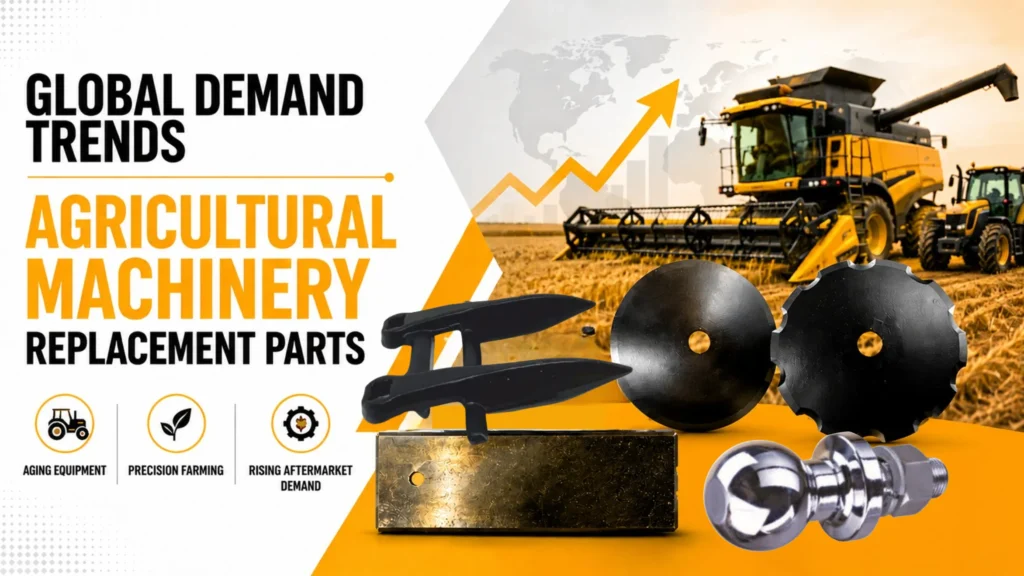
Global demand for agricultural machinery replacement parts is growing due to aging equipment fleets, rising mechanization, and increased adoption of precision farming technologies. As farmers focus on extending machinery lifespan and minimizing downtime, demand for engine components, hydraulic systems, filters, bearings, transmission parts, and electronic controls continues to rise. This blog examines the key demand drivers, regional trends, and procurement factors shaping the agricultural machinery replacement parts market.
What Is Driving Global Demand for Agricultural Machinery Replacement Parts?
Global demand for agricultural machinery replacement parts is rising because farmers are extending equipment lifespans, increasing preventive maintenance spending, adopting precision agriculture technologies, and delaying new machinery purchases due to rising equipment costs.
The primary demand drivers include:
- Aging tractor and harvester fleets
- Rising equipment operating hours
- Increased mechanization in developing economies
- Expansion of precision farming technologies
- Growth of aftermarket distribution networks
- Focus on minimizing equipment downtime
- Rising costs of new agricultural machinery
This combination of economic and operational factors is reshaping procurement strategies across the agricultural equipment industry.
Agricultural Machinery Replacement Parts Market Overview
The agricultural machinery replacement parts market forms a critical segment of the global farm equipment ecosystem. As machinery remains in service longer, replacement components become essential for maintaining operational efficiency and reducing downtime.
Industry estimates value the global farm equipment aftermarket parts market at approximately USD 54.8 billion in 2025, and it is expected to reach USD 92.6 billion by 2034. Rising demand is being driven not only by replacement needs but also by increasing investment in machine productivity, reliability, and digital farming technologies.
OEM vs. Aftermarket Parts: What’s Driving Buyer Preferences?
| Factor | OEM Parts | Aftermarket Parts |
| Compatibility | Manufacturer-certified | Varies by supplier |
| Cost | Higher | Typically lower |
| Availability | May involve longer lead times | Often readily available |
| Supplier Options | Limited | Extensive |
| Customization | Limited | Often broader |
Many distributors and fleet operators increasingly use a hybrid sourcing strategy that combines OEM and aftermarket components based on equipment age, availability requirements, and maintenance budgets.
Aging Equipment Fleets Are Increasing Replacement-Part Consumption
One of the strongest demand drivers is the aging global machinery fleet.
Millions of tractors, harvesters, and agricultural implements remain in operation well beyond their original service life. In mature agricultural markets, farm equipment often remains operational for more than a decade, increasing the need for ongoing maintenance and replacement components.
As equipment ages, demand rises for:
- Engine & Exhaust Accessories
- Farm Implements
- Combine Harvester Parts
- Three Point Linkage Parts
Rather than investing in entirely new machinery, many farm operators are extending equipment life through refurbishment and preventive maintenance programs.
Rising Mechanization in Emerging Markets Is Expanding Long-Term Parts Demand
Agricultural mechanization continues to accelerate across Asia-Pacific, Latin America, and Africa.
As tractors, harvesters, seeders, and spraying equipment become more widely adopted, the installed machinery base expands. Every new machine entering service creates long-term demand for replacement parts throughout its operational lifecycle.
Why Asia-Pacific Is the Fastest-Growing Market
Several factors are supporting growth:
- Government mechanization initiatives
- Labor shortages in agriculture
- Increasing farm productivity requirements
- Growing commercial farming operations
- Expanding agricultural equipment dealer networks
Countries such as India, China, Vietnam, and Indonesia are expected to remain important growth engines for replacement part suppliers.
Equipment Downtime Reduction Is Driving Preventive Maintenance Spending
Equipment downtime has become one of the most significant cost concerns for agricultural operations.
During planting and harvesting seasons, machinery failures can disrupt operations, delay production schedules, and increase labor costs.
As a result, procurement teams are increasingly shifting from reactive maintenance toward preventive maintenance strategies.
Procurement Trends Influenced by Downtime Reduction
- Higher inventory stocking levels
- Multi-supplier sourcing strategies
- Predictive maintenance programs
- Faster replacement part fulfillment
- Increased investment in critical spare parts
These trends are creating new opportunities for suppliers capable of delivering reliable inventory availability and shorter lead times.
Regional Demand Trends for Agricultural Machinery Replacement Parts
Regional Market Comparison
| Region | Market Status | Growth Outlook |
| North America | Mature aftermarket market | Stable growth |
| Europe | Advanced mechanization | Moderate growth |
| Asia-Pacific | Expanding machinery base | Fastest growth |
| Latin America | Commercial farming expansion | High growth potential |
| Middle East & Africa | Developing market | Emerging opportunity |
North America
North America remains one of the largest replacement parts markets due to its extensive installed equipment base, aging machinery fleets, and widespread adoption of advanced agricultural technologies.
Europe
European demand is increasingly driven by modernization initiatives, sustainability requirements, and precision agriculture investments.
Asia-Pacific
Asia-Pacific represents the strongest growth opportunity due to accelerating mechanization and expanding commercial farming operations.
Latin America
Demand continues to rise as commercial agriculture expands across major crop-producing regions.
Middle East and Africa
Government-supported agricultural development programs are contributing to gradual machinery adoption and replacement part demand growth.
Supply Chain Trends Shaping Agricultural Parts Procurement
Procurement strategies are evolving rapidly across the agricultural equipment industry.
Key trends include:
- Supplier diversification
- Nearshoring and regional sourcing
- Inventory optimization
- Lead-time reduction
- Cost management initiatives
- Digital procurement platforms
Many distributors are increasingly balancing OEM and aftermarket sourcing channels to improve inventory resilience and control procurement costs.
Future Outlook: Agricultural Machinery Replacement Parts Demand Through 2030
Several long-term trends are expected to support market growth through 2030:
- Continued aging of global equipment fleets
- Expansion of precision agriculture technologies
- Rising farm mechanization rates
- Increased preventive maintenance adoption
- Growing demand for electronic replacement components
- Expansion of global aftermarket distribution networks
As agricultural equipment becomes more technologically advanced and expensive to replace, replacement parts will remain a critical investment for maintaining productivity and minimizing downtime.
Conclusion
Global demand for agricultural machinery replacement parts is being driven by aging equipment fleets, expanding mechanization, preventive maintenance adoption, and the increasing use of precision agriculture technologies. While North America and Europe remain major aftermarket markets, Asia-Pacific is emerging as the fastest-growing region due to rapid machinery adoption and agricultural modernization. For distributors, OEMs, and aftermarket suppliers, success will increasingly depend on inventory availability, procurement agility, and the ability to support both traditional mechanical components and next-generation precision farming systems. As machinery lifecycles continue to lengthen, replacement parts will remain essential to sustaining agricultural productivity worldwide.
FAQs
Demand for agricultural machinery replacement parts is increasing due to aging equipment fleets, rising mechanization, higher machinery utilization, and growing adoption of precision agriculture technologies.
Filters, bearings, hydraulic seals, engine components, transmission parts, tires, cutting blades, and electrical systems are the most frequently replaced agricultural machinery parts.
Asia-Pacific has the fastest-growing demand for agricultural machinery replacement parts due to rapid mechanization and expanding commercial farming activities.
OEM parts are manufactured by the original equipment manufacturer, while aftermarket parts are produced by third-party suppliers and are often available at lower costs.
Replacement parts reduce downtime by preventing equipment failures, improving machinery reliability, and supporting continuous farm operations.