
 (+91) 842-700-1426
  agriparts@jcblmail.com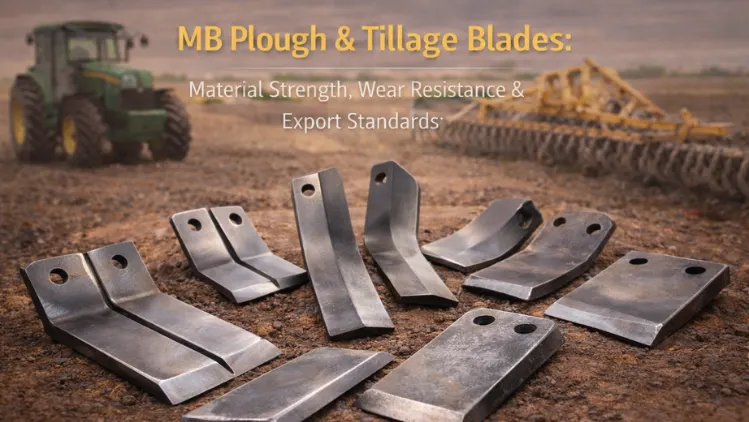
Primary soil tillage exposes agricultural components to extreme draft forces, abrasive soil friction, and repeated impact loads. High-performance MB plough blades and tillage blades must withstand these stresses without cracking, bending, or premature edge wear. For global distributors, OEM buyers, and agricultural equipment suppliers, choosing a reliable tillage-blade manufacturer directly affects field performance, warranty claims, and long-term operating costs.
This guide explains the engineering principles behind export-grade agricultural tillage blades, including material grades, 38–50 HRC hardness standards, structural load capacity, dimensional tolerances, and corrosion-resistant export packaging.
MB Plough Blade Technical Specs at a Glance
- Material: Boron Steel / High Carbon Steel / Alloy Steel
- Hardness: 38–50 HRC (Rockwell Scale)
- Thickness Range: 8 mm – 14 mm
- Heat Treatment: Through hardened / Edge hardened
- Coating: Anti-rust oil / Powder coating / VCI wrap
- Dimensional Tolerance: ISO-compliant manufacturing standards
- Application: Primary soil tillage, deep ploughing, heavy-load cultivation
What Are MB Plough & Tillage Blades?
MB plough blades and tillage blades are hardened steel agricultural components designed to cut, lift, and turn soil during primary tillage while resisting abrasive wear and heavy draft loads.
Manufactured from boron or high-carbon steel and heat-treated to controlled hardness levels (38–50 HRC), these blades balance penetration efficiency with structural toughness. Their geometry, thickness, and metallurgical properties directly determine wear life and performance in sandy, clay, or rocky soil.
Types of Tillage Blades
Different soil conditions require specific blade geometries and structural characteristics.
- MB Plough Blades: Used for deep soil inversion in moldboard plough systems. Designed for maximum load-bearing and penetration depth.
- Duckfoot Blades: Wide cutting profile for shallow cultivation and weed control. Ideal for surface-level soil management.
- Cultivator Blades: Used for secondary tillage and soil aeration. Moderate load capacity with high surface wear exposure.
- Reversible Plough Points: Dual-edge design allows flipping after wear, increasing service life.
| Blade Type | Primary Use | Soil Depth | Wear Exposure |
| MB Plough Blade | Deep primary tillage | 8–12 inches | High |
| Duck Foot Blade | Surface weed control | 2–4 inches | Medium |
| Cultivator Blade | Soil mixing & aeration | 4–8 inches | High |
| Reversible Point | Heavy penetration | Variable | Very High |
For compatibility across equipment models, see our complete range of farm implement replacement parts to ensure correct fitment and interchangeability.
Material Grades Used in Tillage Blades
Material selection directly impacts wear resistance, structural toughness, and long-term fatigue life. The right steel grade determines how well a blade withstands abrasive soil, heavy draft loads, and repeated impact stress in demanding field conditions.
1. Boron Steel
Boron steel typically contains small boron additions (≈0.001–0.005%), which significantly improve hardenability without compromising core strength. This allows deeper and more uniform heat treatment across the blade section.
It offers 20–30% longer wear life compared to standard carbon steel, making it ideal for high-abrasion soil environments. The material provides an excellent balance between impact resistance and edge retention, reducing the risk of cracking in rocky terrain.
2. High Carbon Steel
High-carbon steel is valued for its strength, sharpness retention, and reliable cutting performance. It maintains a firm edge under moderate soil resistance.
This material is a cost-effective option for general farming applications. It performs well in medium-load conditions where extreme impact resistance is not required.
3. Alloy Steel
Alloy steel offers enhanced toughness due to the addition of strengthening elements such as chromium or manganese. This improves resistance to deformation under heavy load.
It also provides improved fatigue resistance, making it suitable for heavy-duty and rocky soil environments where repeated stress cycles can lead to premature failure in standard steels.
| Material | Hardness Potential | Wear Resistance | Best Application |
| Boron Steel | 48–52 HRC (post treatment) | Excellent | Heavy-duty primary tillage |
| High Carbon Steel | 40–48 HRC | Good | General farming |
| Alloy Steel | 42–50 HRC | Very Good | Impact-heavy soils |
Heat Treatment & Hardness Standards
The ideal hardness range for tillage blades is typically 38–50 HRC, depending on soil conditions and blade design.
This range ensures:
- Sufficient soil penetration
- Resistance to edge deformation
- Through Hardening: Uniform hardness across the blade thickness. Suitable for consistent wear environments.
- Edge Hardening: Hard cutting edge with a tougher core. Improves impact resistance in rocky terrain.
- Case Hardening: A hard surface layer with a ductile core. Used when surface wear dominates.
| Process | Advantage | Ideal For |
| Through Hardening | Uniform durability | Medium-load soils |
| Edge Hardening | Crack resistance | Rocky terrain |
| Case Hardening | Surface wear protection | Sandy soil |
Balancing penetration and durability is critical; excessive hardness increases brittleness, while insufficient hardness reduces wear life.
Structural Strength & Load-Bearing Capacity
Blade performance is not determined by material alone. Structural engineering influences stress distribution and fatigue resistance.
Key strength factors:
- Thickness range: typically 8–14 mm for heavy-duty blades
- Reinforced cutting edges
- Optimized curvature for soil flow
- Stress-relief holes to reduce cracking
- Controlled grain structure after heat treatment
Proper load distribution prevents premature deformation under tractor draft forces and torsional stress.
Quality Inspection & Dimensional Accuracy
High-quality export blades undergo strict inspection protocols, such as:
- Rockwell hardness testing (HRC verification)
- Dimensional tolerance checks (±0.5–1.0 mm typical)
- Crack detection via visual and dye penetration inspection
- Surface finish examination
- Batch traceability documentation
Dimensional accuracy ensures proper fitment and reduces installation errors for OEM clients.
Bulk Procurement & OEM Customization
For distributors and agricultural equipment manufacturers, supply reliability is essential.
Typical considerations include the following:
- Minimum Order Quantity (MOQ)
- Custom hole patterns
- Thickness modification
- Private labeling
- Custom stamping with brand identification
- Lead time (4–8 weeks, depending on volume)
Working with a tillage-blade manufacturer in India allows cost-efficient, large-scale production combined with export-grade compliance and documentation.
Export Packaging & Corrosion Protection
International shipments require robust protection against moisture and transit damage.
Standard export measures include:
- Anti-rust oil coating
- Powder coating for corrosion resistance
- VCI wrapping (Volatile Corrosion Inhibitor)
- Palletized packing
- Shrink wrapping
- Container moisture control
Proper packaging ensures blades arrive without oxidation or structural damage, maintaining dimensional precision and surface integrity.
Conclusion
MB plough blades and tillage blades must combine material strength, controlled hardness (38–50 HRC), structural reinforcement, and corrosion-resistant packaging to ensure long service life under heavy soil loads.
Boron steel or high-carbon steel selection, precision heat treatment, and ISO-compliant dimensional accuracy directly impact wear resistance, crack prevention, and field performance.
For importers and OEM buyers, choosing a technically reliable tillage-blade manufacturer ensures consistent quality, reduced downtime, and lower long-term operating costs.
FAQs
Boron steel is widely considered the best material grade for MB plough and tillage blades because it offers superior hardenability, wear resistance, and impact strength. Small boron additions improve edge retention while maintaining core toughness. For moderate soil conditions, high carbon steel is also used, but boron steel provides longer service life in heavy-duty and abrasive environments.
The ideal hardness range for tillage blades is typically 38–50 HRC. This range balances soil penetration with crack resistance. Hardness below 38 HRC may reduce wear life, while hardness above 50 HRC increases brittleness and risk of fracture in rocky soil. Controlled heat treatment ensures optimal toughness and edge retention.
Importers verify heat treatment quality through Rockwell hardness testing reports, mill test certificates, and batch traceability documentation. Reputable manufacturers also conduct microstructure analysis and crack inspections. Consistent hardness readings across multiple sample points confirm uniform heat treatment and structural reliability.
Heavy-duty tillage blades are typically available in 8 mm to 14 mm thickness ranges, depending on soil type and load requirements. Thicker blades offer improved load-bearing capacity and longer wear life in compact or rocky soils, while standard thickness options are used for general farming applications.
Export-grade tillage blades are packed using anti-rust oil coating, powder coating, VCI wrapping, and palletized packaging to prevent corrosion and transit damage. Moisture control measures and shrink wrapping are commonly applied for container shipments to ensure blades arrive rust-free and dimensionally intact.