
 (+91) 842-700-1426
  agriparts@jcblmail.com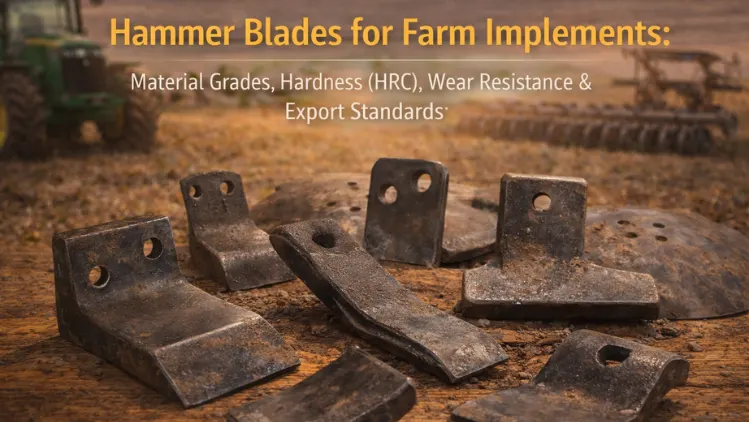
Hammer blades are critical rotating impact tools used in mulchers, shredders, and flail mowers to pulverize crop residue and vegetation. Manufactured from hardened steels such as Boron and High Carbon, these blades operate at 1500–3000 RPM and must withstand intense centrifugal force, abrasion, and repeated impact loading.
For any professional hammer blades manufacturer, material selection, controlled hardness (HRC), and dimensional precision are essential to ensure durability in demanding agricultural environments. This guide explains how steel grade, heat treatment, wear resistance, and export standards influence performance and procurement decisions.
What Are Hammer Blades?
Hammer blades are high-impact agricultural cutting tools made from hardened alloy steels such as Boron or High Carbon steel. Operating at 1500–3000 RPM, they rely on centrifugal force and impact energy to shred crop residue. Standard blades are hardened to 45–55 HRC to balance wear resistance with impact toughness.
Quick Specs Summary
| Feature | Standard Specification |
| Material Grades | Boron Steel, High Carbon Steel, Alloy Steel |
| Hardness Range | 45–55 HRC |
| Operational Speed | 1500–3000 RPM |
| Typical Thickness | 8mm, 10mm, 12mm |
| Mounting Tolerance | ±0.5 mm |
What Are the Functions and Applications of Hammer Blades?
Hammer blades function through a combination of impact and shear force, unlike straight knives that rely primarily on slicing.
Primary Applications
- Mulchers
- Shredders
- Flail mowers
- Crop residue management systems
- Land clearing equipment
In high-speed operation, flail mower hammer blades repeatedly strike vegetation and occasionally stones or compact soil. Their balanced weight distribution ensures stable rotor movement and protects adjacent farm implements replacement parts from premature wear.
Key performance requirements:
- High impact strength
- Resistance to deformation
- Stable high-RPM rotation
- Uniform mass distribution
Which Material Grades Are Used in Hammer Blades?
Material selection determines durability, edge retention, and resistance to cracking.
Boron Steel
Boron steel offers excellent hardenability and impact strength. It performs well in mixed soil conditions where both abrasion and shock loading occur.
Best For: Rocky terrain and high-impact environments.
High Carbon Steel
High carbon steel achieves higher hardness levels after heat treatment, delivering superior abrasion resistance.
Best For: Sandy or abrasive soil conditions requiring extended edge retention.
Alloy Steel
Alloy steels enhanced with chromium or manganese improve fatigue resistance and structural stability.
Best For: Heavy-duty hammer blades in continuous commercial use.
Material Comparison Table
| Material | Wear Resistance | Impact Strength | Best For |
| Boron Steel | High | Very High | Rocky or mixed terrain |
| High Carbon Steel | Very High | Moderate | Sandy loam & abrasive soil |
| Alloy Steel | High | High | Commercial heavy-duty shredding |
Real-World Performance Insight
In controlled field testing within sandy loam environments, high carbon steel blades demonstrated approximately 15% greater edge retention compared to Boron steel. However, in rocky terrain, Boron steel showed superior crack resistance and lower breakage rates under repeated impact loads.
This demonstrates that the “best” material depends on field conditions, not just hardness.
What Is the Heat Treatment Process & Recommended Hardness (HRC)?
Hammer blades undergo:
- Through hardening
- Controlled quenching
- Tempering to relieve internal stress
Recommended Hardness Range: 45–55 HRC
- 45–50 HRC: Improved impact resistance
- 50–55 HRC: Enhanced abrasion resistance
If hardness exceeds 55 HRC, brittleness increases and crack propagation risk rises under shock loading.
From a materials science perspective, as hardness increases, fracture toughness generally decreases:
As HRC increases, fracture toughness (K₍Ic₎) decreases, meaning extremely hard blades may resist wear but become more prone to sudden fracture under impact.
Therefore, balancing hardness and toughness is essential for reliable performance at 1500–3000 RPM.
What Design Variations & Technical Specifications Matter?
Hammer blades are manufactured in multiple profiles:
- Straight Hammer Blades: Provide consistent vertical impact for shredding dense biomass.
- Curved Hammer Blades: Enhance airflow and cutting efficiency in flail mower systems.
- Key Technical Specifications:
- Thickness: 8–12 mm
- Hardness: 45–55 HRC
- Hole Tolerance: ±0.5 mm
- Balanced weight for vibration control
- Rotor compatibility based on mounting design
Precision hole diameter ensures secure mounting and prevents vibration that could damage surrounding farm equipment wear parts.
What Quality Inspection & Testing Parameters Ensure Reliability?
Quality control ensures durability and dimensional consistency.
Inspection Standards Include:
- Dimensional Accuracy: Dimensional inspection verifies blade thickness, hole alignment, and profile symmetry to ensure proper rotor fitment, stable mounting, and reduced vibration during high-speed operation.
- Hardness Testing: Rockwell hardness (HRC) testing confirms blades meet the 45–55 HRC requirement and maintain uniform surface hardness for balanced wear resistance and impact strength.
- Impact Testing: Impact testing, including controlled drop tests, evaluates fracture resistance and ensures blades withstand repeated shock loads without cracking or structural failure.
- Surface Finish Inspection: Surface inspection ensures burr removal, smooth edge finishing, and anti-corrosion treatment to prevent premature rusting and improve durability in field conditions.
- Dynamic Balance Testing: Dynamic balance testing verifies even weight distribution, preventing excessive vibration, reducing rotor stress, and protecting adjacent components during high-speed rotation.
- Procurement Reliability: Strict inspection standards are essential when sourcing from a bulk hammer blades supplier to guarantee consistent quality, export compliance, and long-term field performance.
Reliable inspection standards are critical when sourcing from a bulk hammer blades supplier for international markets.
What Factors Influence Wear Resistance & Field Performance?
Several variables affect blade lifespan:
- Soil Composition—Sandy Conditions: Sandy soil contains abrasive particles that accelerate edge wear, reducing blade sharpness faster and shortening the overall service life of hammer blades.
- Soil Composition—Rocky Terrain: Rocky terrain increases impact stress and shock loading, raising the risk of edge chipping, deformation, or cracking under repeated high-speed strikes.
- Operating Speed: Higher RPM increases centrifugal force and cutting-edge stress, intensifying abrasion and impact pressure, which can accelerate wear if hardness and toughness are not properly balanced.
- Maintenance & Replacement Cycle: Delayed blade replacement causes rotor imbalance, reduces shredding efficiency, and places additional strain on bearings and surrounding farm equipment wear parts.
- Common Wear Indicators: Rounded edges, visible cracks, reduced cutting efficiency, and increased vibration indicate blade deterioration and signal the need for timely replacement.
- Material Selection Impact: Selecting the correct steel grade and hardness range significantly extends service intervals and improves long-term durability of mulcher replacement blades in demanding field conditions.
Selecting the correct material grade significantly extends service intervals for mulcher replacement blades.
What Should Importers Consider When Procuring in Bulk?
When evaluating a bulk hammer blades supplier, importers should assess:
- Minimum Order Quantity (MOQ)
- Production lead time
- Material certification
- Heat treatment reports
- Dimensional inspection documentation
- Custom stamping options
- Pre-production sample approval
Consistency across batches ensures predictable performance and customer satisfaction.
What Export Packaging & Corrosion Protection Standards Are Used?
Hammer blades exported internationally require moisture and corrosion protection.
Standard practices include:
- Anti-rust oil coating
- Individual poly wrapping
- Palletized stacking
- Moisture-resistant container loading
- Secure strapping for sea freight
Proper packaging prevents oxidation during long transit cycles.
Common Technical Specifications
- Hardness: 45–55 HRC
- Thickness: 8–12 mm
- Steel Grades: Boron, High Carbon, Alloy Steel
- Mounting Tolerance: ±0.5 mm
- Operating Speed: 1500–3000 RPM
- Applications: Mulchers, shredders, flail mowers
Conclusion
Hammer blades are high-impact agricultural components engineered for rotational stress, abrasion, and repeated shock loading. Optimal performance depends on selecting the appropriate steel grade, maintaining hardness within 45–55 HRC, ensuring dimensional precision, and applying strict quality control standards.
Understanding wear resistance factors, heat treatment science, and export packaging practices allows buyers and importers to source durable heavy-duty hammer blades suited for demanding agricultural operations.
FAQs
The recommended hardness range is 45–55 HRC. Lower values improve impact resistance, while higher values increase wear resistance in abrasive soil conditions.
High carbon steel generally provides superior abrasion resistance. However, Boron steel performs better in high-impact rocky environments due to improved toughness.
Importers should request tolerance reports (typically ±0.5 mm), inspection documentation, and pre-shipment sample verification before approving bulk production.
Typical thickness ranges from 8–12 mm with hardness between 45–55 HRC. Exact dimensions depend on rotor compatibility and equipment type.
Export packaging typically includes anti-rust oil coating, poly wrapping, palletized loading, and moisture-resistant container handling for safe sea freight transit.