
 (+91) 842-700-1426
  agriparts@jcblmail.com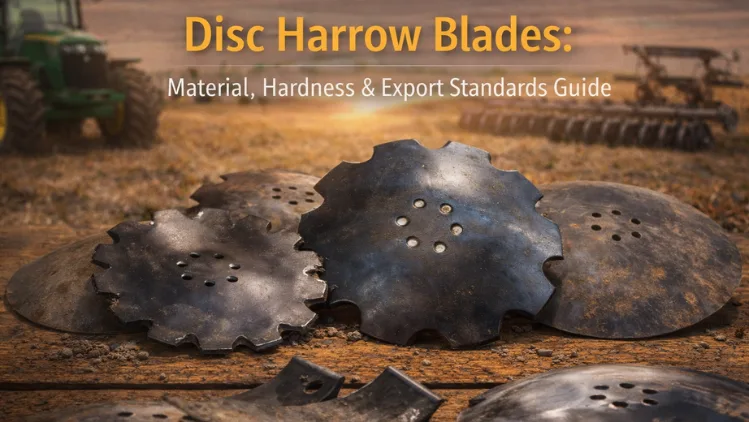
Disc harrow blades are circular, concave steel discs used in agricultural tillage equipment to cut, fracture, and mix soil during field preparation. Manufactured from hardened high-carbon or boron steel, these blades operate under high impact and abrasive conditions, making material grade and hardness control critical to performance.
A reliable disc harrow blade manufacturer focuses on controlled metallurgy, precision heat treatment, and dimensional accuracy to ensure durability across diverse soil types, from sandy African fields to heavy clay farms in North America. In modern mechanized agriculture, disc blades are essential for residue management, soil aeration, and seedbed preparation.
This guide explains different aspects of the disc harrow blades including materials, hardness standards, heat treatment processes, inspection criteria, export compliance, and bulk procurement considerations, helping importers and distributors evaluate quality with confidence.
Disc Harrow Blades: Function & Working Principle
Disc harrow blades work by rotating through soil, using their concave geometry and sharpened edge to penetrate, lift, and mix soil layers.
Primary Functions:
- Cutting compacted soil
- Mixing crop residue into the topsoil
- Breaking clods
- Leveling the seedbed
The concave design creates a slicing and rolling action, which improves soil pulverization while distributing organic residue evenly.
Real-World Application Examples
- Corn residue management in the U.S. Midwest: Notched 24” blades efficiently cut and incorporate heavy stalk residue after harvest, reducing the need for burning.
- Sandy soils in parts of Africa: Boron steel blades with higher wear resistance extend operational life where abrasion is severe.
- Clay soil operations in Europe: Through-hardened 22” discs provide balanced toughness to prevent cracking under high torque loads.
Disc blades are widely supplied as part of broader farm implements replacement parts, particularly in aftermarket distribution channels.
Technical Specifications Overview
Export-grade disc harrow blades must meet defined material, hardness, and dimensional standards to ensure durability and global equipment compatibility. The table below summarizes the key technical specifications buyers should verify before bulk procurement.
| Parameter | Standard Range | Technical Significance |
| Material Grade | Boron Steel / High Carbon Steel | Determines wear resistance and hardenability in abrasive soil conditions |
| Carbon Content | 0.60% – 0.90% | Controls achievable hardness and edge retention capability |
| Boron Content | 0.0005% – 0.003% | Improves depth of hardness penetration during heat treatment |
| Hardness (Rockwell HRC) | 38–52 HRC | Ensures balance between wear resistance and impact toughness |
| Diameter | 16” – 28” | Influences working depth and soil penetration capacity |
| Thickness | 3 mm – 8 mm | Affects structural strength and load-bearing performance |
| Heat Treatment Method | Through Hardening / Induction Hardening | Controls surface durability and internal toughness balance |
| Concavity Depth | As per implement design | Impacts soil turning efficiency and cutting performance |
| Dimensional Tolerance | ±0.5 mm (typical) | Ensures proper mounting alignment and reduced vibration |
| Surface Finish | Shot Blasted / Anti-Rust Coated | Enhances corrosion resistance during storage and transit |
| Quality Documentation | Mill Test Certificate (MTC) | Verifies material composition and production traceability |
Reviewing these specifications helps importers assess quality consistency, wear resistance, and compliance standards. Confirming material composition, hardness range, and tolerance accuracy reduces performance risks and ensures reliable field operation.
Material Grades Used in Disc Harrow Blades
The most suitable materials for disc harrow blades are boron steel and high carbon steel due to their ability to achieve high hardness while maintaining structural integrity.
Boron Steel
Boron steel enhances hardenability, allowing uniform hardness penetration during heat treatment, even in thicker blades.
Why Boron Improves Performance:
- Promotes deeper martensitic transformation
- Improves wear resistance in abrasive soils
- Maintains impact strength
Field Example: In sandy terrains where blades wear rapidly, boron steel discs often last 20–30% longer compared to standard carbon steel blades.
High Carbon Steel
High carbon steel (0.60–0.90% carbon) provides strong surface hardness and good edge retention.
Suitable for:
- Moderate soil conditions
- Cost-sensitive markets
- Medium-duty tillage operations
Material selection should align with soil abrasiveness and operating load.
Heat Treatment Process & Hardness Standards
The ideal hardness range for export-quality disc harrow blades is 38–52 HRC. This range ensures optimal wear resistance without excessive brittleness.
Through Hardening
The entire blade is heat-treated for uniform hardness. Suitable for heavy-duty applications.
Induction Hardening
Only the cutting edge is hardened; the core remains softer for shock absorption.
Hardness vs Brittleness
- Below 38 HRC → Faster edge wear
- Above 52 HRC → Increased cracking risk
- Balanced hardness → Improved edge retention and durability
Real-World Example
In clay-heavy soils requiring high torque, blades hardened above 52 HRC may crack under impact. A controlled 45–48 HRC range provides better longevity.
Proper tempering reduces internal stress and enhances toughness.
Blade Types & Technical Variations
Disc harrow blades are available in different edge designs, diameters, thicknesses, and center hole configurations to match soil conditions, residue levels, and implement capacity. Selecting the correct technical variation directly affects penetration depth, fuel efficiency, residue incorporation, and blade lifespan.
Plain Disc Blades
Plain disc blades have a smooth, continuous cutting edge designed for uniform soil slicing and mixing. They are best suited for medium-residue fields and secondary tillage where consistent soil leveling is required.
In loamy or moderately compacted soils, plain discs provide stable penetration without excessive soil disturbance. Their uniform edge ensures predictable soil flow, making them widely used in standard seedbed preparation operations.
Notched Disc Blades
Notched disc blades feature evenly spaced cutouts along the edge to improve soil grip and cutting efficiency in heavy residue conditions. The notches reduce slippage and enhance penetration in compacted or trash-heavy fields.
For example, in post-wheat or corn harvest fields with dense straw coverage, notched discs cut through residue more effectively, reducing clogging and improving residue incorporation into the soil profile.
Diameter Options & Working Depth
Blade diameter determines working depth and soil penetration capacity. Larger diameters increase cutting depth but require greater tractor horsepower and stronger implement assemblies.
- 16”–18” blades are typically used for light-duty and shallow tillage operations.
- 20”–22” blades are standard for medium-duty agricultural applications.
- 24”–28” blades are preferred for deep tillage and heavy commercial farming.
Choosing the correct diameter ensures balanced soil disturbance and operational efficiency.
Thickness Variations & Structural Strength
Blade thickness influences load-bearing capacity, impact resistance, and service life. Thicker blades resist bending under high torque but increase implement weight and power requirements.
- 3–4 mm thickness is suitable for light implements and softer soils.
- 5–6 mm thickness is widely used in general agricultural operations.
- 7–8 mm thickness is ideal for rocky terrain and heavy-duty tillage.
Matching thickness with soil conditions helps reduce deformation and premature failure.
Center Hole Configurations & Customization
Center hole design ensures proper mounting alignment and vibration stability during operation. Common configurations include round, square, hexagonal, and custom-engineered patterns, depending on regional equipment standards.
Buyers working with a disc harrow blade manufacturer can request customized diameter tolerances, concavity depth, thickness specifications, and batch stamping for traceability, ensuring compatibility with OEM and aftermarket equipment requirements.
Quality Inspection & Testing Parameters
Export-grade blades undergo systematic quality verification.
Inspection Checklist:
- Rockwell hardness testing (HRC confirmation)
- Dimensional tolerance measurement
- Crack inspection (visual/magnetic)
- Surface finish evaluation
- Concentricity and balance test
- Microstructure verification (if required)
- Batch stamping for traceability
Consistent testing ensures reduced rejection rates in international markets.
International Standards & Compliance
Manufacturers supplying global markets typically follow:
- ISO-based quality management systems
- EN/DIN dimensional tolerances
- Material traceability documentation
- Heat treatment process records
- Mill Test Certificates (MTC)
Compliance strengthens importer confidence and ensures compatibility with regional agricultural equipment standards.
Common Failure Causes & Prevention
Understanding common failure patterns in disc harrow blades helps manufacturers, importers, and end users improve operational lifespan, reduce downtime, and ensure consistent field performance across varying soil conditions.
1. Premature Wear
Premature wear typically occurs when blade hardness is below the recommended 38–52 HRC range or when operating in highly abrasive sandy soils. Selecting boron steel with optimized hardness significantly improves abrasion resistance and service life.
2. Edge Chipping
Edge chipping is usually caused by excessive hardness, making the blade brittle under impact loads. Maintaining a balanced tempering process ensures adequate toughness, reducing the likelihood of small fractures along the cutting edge.
3. Cracking
Cracking often results from improper quenching or uneven cooling during heat treatment, creating internal stress concentrations. A controlled heat treatment cycle with proper tempering minimizes residual stress and enhances structural integrity.
4. Corrosion
Corrosion develops when blades are stored in humid environments without protective treatment. Applying anti-rust oil coating and ensuring dry, moisture-free storage conditions prevents surface degradation before installation.
Field Insight: Improper bolt torque during installation can create uneven stress distribution across the blade surface, accelerating fatigue and increasing the risk of premature mechanical failure during heavy tillage operations.
Bulk Procurement Considerations for Importers
For large-volume sourcing, evaluate:
- Minimum Order Quantity (MOQ)
- Production lead time
- OEM customization capability
- Private labeling options
- Sample testing process
- Payment terms
- Export documentation support
Working with an experienced bulk disc harrow blades supplier ensures consistent metallurgy, stamping accuracy, and reliable packaging.
Export Packaging & Corrosion Protection
Proper packaging is essential for sea freight shipments.
Standard Export Practices:
- Protective oil coating
- Anti-rust wrapping
- Palletized stacking
- Moisture-resistant packing
- Secure container loading
In humid marine transport conditions, corrosion prevention directly impacts customer satisfaction and resale quality.
Conclusion
Disc harrow blades are high-performance agricultural components where material composition, hardness control, and quality inspection directly affect durability and field efficiency. Boron-enhanced steel, optimized hardness (38–52 HRC), and strict inspection protocols ensure consistent performance across global markets.
Importers and distributors should prioritize verified material grades, documented heat treatment processes, and export-grade packaging when selecting suppliers. A technically capable manufacturer reduces failure risk, enhances field productivity, and improves long-term cost efficiency.
FAQs
Boron steel is generally considered the most suitable material due to its superior hardenability and wear resistance, especially in abrasive soil conditions.
The recommended hardness range is 38–52 HRC, balancing wear resistance and impact toughness.
Importers should request Mill Test Certificates, hardness test reports, dimensional inspection records, and approved production samples.
Standard diameters range from 16” to 28”, with thickness options between 3 mm and 8 mm, depending on application needs.
Blades should be oil-coated, anti-rust wrapped, palletized securely, and protected against moisture during sea freight to prevent corrosion and transit damage.