
 (+91) 842-700-1426
  agriparts@jcblmail.com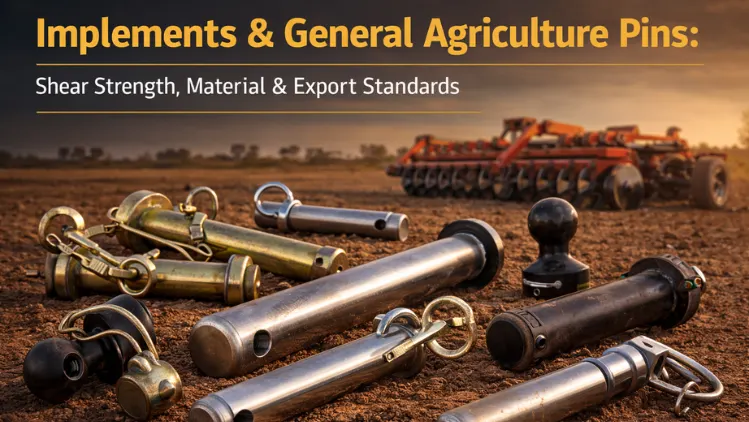
Agricultural machinery operates in demanding environments where reliability, safety, and durability are essential. One of the most critical components ensuring stable tractor-implement connections is the implement pin. These fastening components secure linkages between tractors and equipment such as plows, seeders, cultivators, and trailers.
Because these pins function as load-bearing connectors, they are constantly exposed to heavy shear forces, vibration, impact loads, and environmental conditions. The strength and performance of these pins depend on material grade, heat treatment, dimensional accuracy, and corrosion protection.
For global OEM buyers, distributors, and equipment manufacturers, sourcing high-quality pins from a reliable implement pins manufacturer ensures operational safety and compliance with international standards. This guide explains the types of agricultural implement pins, material grades, heat treatment processes, load capacity standards, and export considerations that define high-quality fastening components.
Key Takeaways
- Agricultural implement pins are load-bearing fasteners used in tractor-implement linkages.
- Proper material grade and heat treatment determine shear strength and durability.
- International standards such as ISO 730 and ASAE specifications guide agricultural pin compatibility.
- Precision machining and corrosion-resistant coatings ensure long service life and export readiness.
What are Agricultural Implement Pins?
Agricultural implement pins are high-strength steel fasteners used to connect tractors to agricultural implements such as plows, seeders, and trailers. These pins are engineered to withstand heavy shear loads, vibration, and outdoor exposure while maintaining secure mechanical connections within tractor linkage systems and hydraulic assemblies.
Types of Implements & General Pins
Different agricultural applications require different pin designs to accommodate varying loads, pivot movement, and mechanical connections.
| Pin Type | Primary Application | Load Characteristics | Common Material |
| PTO Pins | Lock PTO shaft assemblies | Rotational + vibration load | Alloy steel |
| Hitch Pins | Tractor three-point linkage | Heavy shear load | Carbon steel |
| Clevis Pins | Pivot joints and linkages | Shear with rotation | Alloy steel |
| Cylinder & Square Head Pins | Hydraulic cylinder mounting | High pressure load | Hardened steel |
| Hair / Split / Grip Pins | Secondary locking | Retention / safety | Spring steel |
For a complete product range, explore implements and general pins.
1. PTO Pins
PTO pins secure power take-off shaft assemblies and prevent detachment during rotation. Because PTO systems operate under continuous torque and vibration, these pins require high tensile strength and precise locking mechanisms.
2. Hitch Pins
Hitch pins connect agricultural implements such as plows, seeders, and trailers to tractors. These pins are designed to endure heavy shear forces while maintaining secure implement attachment.
3. Clevis Pins
Clevis pins are commonly used in pivot joints where movement between connected components is required. They allow rotational motion while distributing load across the joint.
4. Cylinder & Square Head Pins
Hydraulic cylinder pins support high-pressure mechanical operations in agricultural machinery. Their design ensures stable connections in hydraulic and load-bearing assemblies.
5. Hair, Split, and Grip Pins
These smaller locking pins act as secondary safety components, preventing larger pins from loosening or sliding out during machinery operation.
For a detailed product overview, explore implements and general pins used in agricultural machinery systems.
Material Grades Used in Agricultural Pins
The performance of agricultural pins depends heavily on steel composition and mechanical strength.
| Material Grade | Typical Tensile Strength | Hardness Range | Application |
| High Tensile Carbon Steel | 600–800 MPa | 20–28 HRC | Standard hitch pins |
| Alloy Steel (e.g., 4140) | 850–1000 MPa | 28–36 HRC | Heavy-duty equipment |
| Case-Hardened Steel | Hard surface + tough core | Surface 55–60 HRC | Wear-resistant applications |
Carbon steel is commonly used in general agricultural pins because of its balance between strength and cost.
Alloy steels offer higher fatigue resistance and improved shear performance, making them ideal for heavy equipment connections.
Case hardened pins combine surface hardness with internal toughness, improving wear resistance while preventing brittle fracture.
Heat Treatment & Surface Hardening
Heat treatment enhances mechanical strength, fatigue resistance, and wear performance.
- Through Hardening: Through hardening creates uniform hardness throughout the pin, improving structural strength for heavy-load applications.
- Case Hardening: Case hardening produces a hardened outer layer while maintaining a tough core. This structure improves wear resistance while preventing cracking.
- Induction Hardening: Induction hardening focuses heat treatment on areas exposed to friction or load contact, increasing durability in high-stress zones.
Maintaining a tough internal core with hardness typically between 28–36 HRC ensures the pin resists deformation without becoming brittle.
Shear Strength & Load Capacity Standards
Shear strength determines how much force a pin can withstand before failing.
The basic engineering formula for shear stress is:
Shear Stress = Applied Force ÷ Cross-Sectional Area
Single Shear vs Double Shear
- In single shear, the pin resists load across one cross-section.
- In double shear, the load is applied across two sections of the pin.
Double shear effectively doubles the load capacity compared to single shear, making it ideal for heavy machinery linkages.
Agricultural equipment manufacturers often follow guidelines from organizations such as ASAE (American Society of Agricultural Engineers) to ensure safe load capacities in tractor-implement connections.
Surface Finish & Corrosion Protection
Agricultural pins operate in environments exposed to moisture, soil, fertilizers, and chemicals, making corrosion protection essential.
- Zinc Plating: Zinc plating forms a protective barrier against rust and is commonly used in agricultural fasteners.
- Yellow Zinc Coating: Yellow zinc improves corrosion resistance and provides a distinctive finish often used for export components.
- Phosphate Coating: Phosphate coatings enhance wear resistance and improve lubricant adhesion.
- Powder Coating: Powder coating provides a thicker protective layer, making it ideal for export shipments exposed to varying climates.
Dimensional Accuracy & Machining Precision
Precision manufacturing ensures proper fitment in tractor linkages and mechanical assemblies.
- CNC Turning: CNC turning machines produce pins with tight tolerances and consistent diameter.
- Thread Tolerance: Accurate thread cutting ensures compatibility with nuts, washers, and locking mechanisms.
- Hole Alignment & Finishing: Properly aligned cross-holes allow easy installation of locking clips or split pins.
Working with an experienced agricultural implement parts manufacturer in India ensures high machining precision and consistent product quality.
How to Select the Right Implement Pin
Choosing the correct pin improves machinery safety and operational efficiency.
- Identify the load and application requirements of the implement
- Select the correct pin diameter and length
- Verify steel grade and heat treatment specifications
- Check corrosion protection for field conditions
- Ensure compatibility with tractor linkage systems
Bulk Procurement & Export Packaging
Large-scale agricultural equipment buyers require reliable supply chains and consistent quality.
- Minimum Order Quantities (MOQ): Manufacturers typically define MOQ to optimize production and logistics efficiency.
- Private Label Manufacturing: OEM and private-label options allow importers to brand components under their own product lines.
- Batch Traceability: Quality manufacturers maintain detailed production records to trace materials and manufacturing batches.
- Palletized Export Packaging: Pins are packaged in reinforced cartons and palletized shipments to protect components during international transport.
Why Choose a Certified Implement Pins Manufacturer
Working with a certified supplier ensures consistent product performance and compliance with global standards.
Reliable manufacturers provide:
- ISO-compliant quality systems
- Material and hardness testing
- Precision machining and inspection
- Corrosion-resistant finishing
- Export-ready packaging
Partnering with a trusted implement pins manufacturer ensures durable fastening components that meet agricultural machinery performance requirements.
Conclusion
Although small in size, implement pins play a vital role in agricultural machinery operation. They support heavy loads, maintain stable tractor-implement connections, and enable safe mechanical movement within equipment systems.
Selecting the right pins requires careful consideration of material strength, heat treatment, corrosion protection, and dimensional accuracy. By working with experienced manufacturers and adhering to international standards, agricultural equipment buyers can ensure reliable performance in demanding field environments.
High-quality implements and general pins ultimately contribute to safer machinery operation, longer equipment life, and improved agricultural productivity.
FAQs
Alloy steel and high-tensile carbon steel are the most common materials used for high-strength implement pins. These steels provide excellent shear strength, durability, and fatigue resistance, making them suitable for heavy agricultural equipment connections.
Shear strength is calculated by dividing the applied load by the pin’s cross-sectional area. Engineers also consider whether the application uses single shear or double shear configurations to determine safe load capacity.
Zinc plating, yellow zinc coating, phosphate coating, and powder coating are widely used to prevent corrosion. These finishes protect agricultural pins from rust and environmental exposure during field use and international shipping.
Importers can verify tolerance through inspection reports, dimensional testing, and quality certifications. Many manufacturers also provide sample testing and measurement documentation to ensure compliance with required specifications.
Export implement pins are typically packed in heavy-duty cartons and palletized shipments. Protective packaging prevents mechanical damage during transportation while labeling and batch identification ensure supply chain traceability.