
 (+91) 842-700-1426
  agriparts@jcblmail.com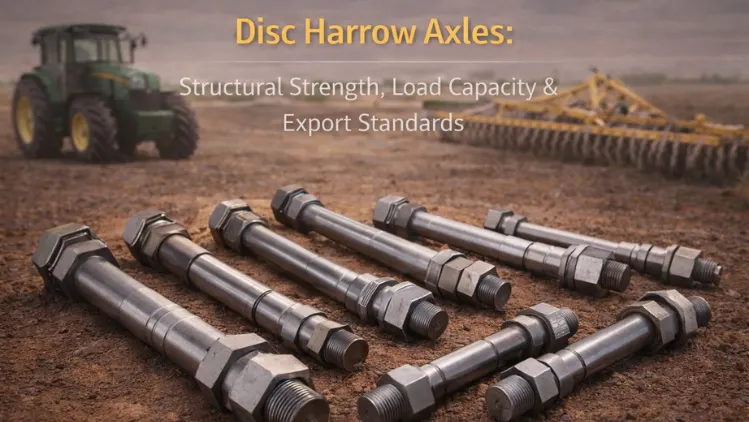
A disc harrow axle is a precision-engineered, load-bearing steel shaft that supports disc gangs, maintains alignment, and transmits torsional force in agricultural disc harrow assemblies. It operates under continuous bending stress, vibration, and torque loads, making material strength, heat treatment, and machining accuracy critical for long-term field performance.
A qualified disc harrow axles manufacturer designs axles according to tensile strength requirements, hardness standards, dimensional tolerances, and export compliance norms to ensure safe and durable agricultural operation.
This guide explains engineering standards, material grades, stress calculations, testing benchmarks, and procurement criteria used by OEMs and global importers.
Function of Disc Harrow Axles in Implement Assembly
The axle is the structural spine of the disc gang assembly. Its core functions include:
1. Structural Load Support
The axle carries the combined weight of:
- Concave discs
- Spacers
- Bearings
- Soil impact load
Failure in this component compromises the entire implementation.
2. Torque Transmission
During field penetration, rotational resistance from soil generates torsional forces. These forces are directly transferred to the axle shaft. High torsional strength prevents twisting or shear failure.
3. Bearing Interface Stability
The axle must match bearing inner diameter tolerances (typically H7/h6 fits depending on the design). Improper fitment causes the following:
- Bearing overheating
- Premature wear
- Vibration damage
4. Alignment & Runout Control
Straightness tolerance ensures discs cut soil uniformly. Excessive runout increases frame stress and uneven tillage depth.
For a broader understanding of system integration, refer to our guide on farm implements replacement parts, where axle compatibility with other structural components is explained.
Material Grades Used in Disc Harrow Axles
Disc harrow axles are typically manufactured using EN8, EN19 (AISI 4140 equivalent), or 42CrMo4 alloy steel. Alloy grades are preferred for heavy-duty applications due to higher tensile strength (850–1100 MPa) and improved fatigue resistance under torsional loading.
Commonly Used Grades
| Grade | Equivalent Standard | Tensile Strength | Application Type |
| EN8 | IS 1570 / ASTM A29 | 550–700 MPa | Standard-duty disc harrows |
| EN19 | AISI 4140 | 850–1000+ MPa (HT) | Heavy-duty & export applications |
| 42CrMo4 | DIN Alloy Steel | 900–1100 MPa (HT) | High-load commercial implements |
Why Alloy Steel Is Preferred for Export
Alloy steels such as EN19 and 42CrMo4 offer:
- Higher fatigue limit
- Improved impact resistance
- Better hardenability
- Superior torsional performance
Engineering Insight
Torsional shear stress (τ) in a solid shaft increases proportionally with torque and inversely with shaft diameter. Therefore, both material grade and shaft diameter must be engineered together for safe load capacity.
Heat Treatment & Hardness Standards
Heat treatment improves wear resistance, torsional strength, and fatigue life of disc harrow axles by enhancing both surface durability and internal core toughness.
- Induction Hardening: Induction hardening increases surface hardness typically between HRC 40–50 while retaining a tough core, making it ideal for bearing seating and high-wear contact zones.
- Through Hardening: Through hardening produces uniform hardness throughout the shaft, generally ranging from HRC 28–45, and is recommended for applications involving sustained high torque loads.
Why Controlled Hardness Is Critical
Excessive hardness can increase brittleness and crack susceptibility, while insufficient hardness may cause accelerated wear, plastic deformation, and reduced operational lifespan.
Reputable manufacturers follow:
- ASTM A29 mechanical property guidelines
- ISO 6508 Rockwell hardness testing standards
Uniform hardness across the shaft minimizes stress concentration points, significantly reducing the risk of fatigue cracking under repeated cyclic loading conditions in field operations.
Dimensional Accuracy & Machining Precision
Dimensional accuracy is critical to the structural integrity and service life of disc harrow axles. Even minor deviations in diameter, concentricity, or straightness can cause bearing misalignment, uneven disc rotation, vibration stress, and premature component failure. Precision machining ensures compatibility with bearings, spacers, and disc assemblies under dynamic agricultural loads.
1. CNC Turning & Concentricity
Modern CNC turning centers maintain tight dimensional tolerances and concentricity control across high-volume batch production. Proper concentricity minimizes rotational imbalance, reduces vibration, and improves torque transmission efficiency during field operation.
2. Thread Accuracy
Threaded ends must conform to ISO metric thread standards to ensure secure fastening under high-vibration conditions. Incorrect pitch, flank angle, or thread depth can result in loosening, stripping, or uneven load distribution during operation.
3. Straightness Tolerance
Straightness is typically controlled within defined limits based on shaft diameter and length specifications. Excessive runout increases bending stress, accelerates bearing wear, and compromises uniform soil penetration performance.
4. Surface Finish
Surface roughness values (Ra) are carefully controlled in bearing seating zones to improve fitment accuracy, reduce frictional heat generation, and prevent micro-movement that may lead to fretting corrosion.
Quality Verification & Documentation
Before bulk procurement, buyers should verify technical documentation from a trusted disc harrow axles supplier, including:
- Detailed dimensional inspection reports
- Thread gauge verification records
- Surface roughness measurement data
- Straightness and runout testing reports
Traceable inspection documentation ensures compliance with engineering tolerances and reduces rejection risk in international shipments.
Load Capacity & Stress Testing
Load capacity determines whether a disc harrow axle can withstand torsional, bending, and cyclic field stresses without permanent deformation or premature failure.
1. Torque Testing
Torque testing simulates rotational soil resistance under controlled laboratory conditions to verify torsional strength, shear limits, and resistance to twisting under operational load.
2. Static Load Testing
Static load testing applies calibrated bending force to measure yield threshold, elastic recovery behavior, and structural deflection limits under defined weight conditions.
3. Fatigue Testing
Fatigue testing replicates repeated cyclic stress to evaluate long-term durability and predict service life under continuous agricultural field operations.
4. Material Certification
Mill Test Certificates (MTC) verify chemical composition, tensile strength, yield strength, elongation properties, and conformity of heat treatment to specified mechanical standards.
Reputable manufacturers provide documentation aligned with ASTM, DIN, or equivalent international standards to ensure traceability and mechanical reliability.
Common Failure Modes to Monitor
Understanding failure patterns helps importers assess engineering quality before procurement.
- Torsional shear failure: Occurs when torque exceeds material shear strength, typically due to improper grade selection or undersized shaft diameter.
- Surface wear at bearing seat: Results from poor hardness control or improper surface finish, leading to premature bearing loosening.
- Thread stripping: Caused by incorrect thread machining, improper pitch tolerance, or insufficient material hardness.
- Fatigue cracking near stress concentration points: Develops under cyclic loading, particularly around shoulders, keyways, or abrupt diameter transitions.
Importers should always request documented load testing benchmarks and inspection reports before approving bulk shipments.
Bulk Procurement Considerations for OEMs & Importers
Bulk sourcing decisions should be based on engineering compliance, production capability, and documentation transparency rather than pricing alone.
1. Manufacturing Certification
Verify ISO 9001 quality management compliance and availability of third-party inspection reports to ensure standardized production control and process consistency.
2. Custom Engineering Capability
A qualified manufacturer should support square section axles, custom shaft lengths, modified threading profiles, and OEM stamping based on technical drawings.
3. Production Capacity & Lead Time
Standard export production cycles typically range between 3–6 weeks, depending on order volume, heat treatment scheduling, and machining requirements.
4. Traceability & Batch Control
Each production batch should be traceable to raw material lot numbers, heat treatment records, and inspection documentation to ensure accountability and quality consistency.
For export-ready sourcing, consult a verified agricultural implement parts manufacturer in India with established compliance systems and documented quality assurance protocols.
Export Packaging & Corrosion Protection Standards
Proper export packaging protects machined surfaces from oxidation, transit damage, and environmental exposure during international shipping.
- Anti-Corrosion Treatment: Rust preventive oil coating or phosphate treatment is applied to protect critical machined areas against moisture-induced corrosion.
- VCI Wrapping: Vapor Corrosion Inhibitor (VCI) film prevents oxidation by releasing corrosion-inhibiting molecules during extended sea transit.
- Palletization: ISPM-15 compliant fumigated wooden pallets provide structural stability and meet international phytosanitary export regulations.
- Labeling & Identification: Each shipment should include batch number, shaft dimensions, heat code, and customer reference marking to ensure traceability upon arrival.
Proper export packaging significantly reduces moisture damage, surface rust claims, and rejection risks in global supply chains
Key Takeaway
Disc harrow axles are high-stress structural components that must meet defined tensile strength, hardness, dimensional tolerance, and fatigue resistance standards. Proper material grade selection, controlled heat treatment, precision machining, and documented stress testing are essential for long-term field reliability and export compliance.
For OEM buyers and global importers, engineering documentation and manufacturing standards matter more than unit price.
Frequently Asked Questions
EN8 is used for standard-duty applications, while EN19 (AISI 4140 equivalent) and 42CrMo4 alloy steel are preferred for heavy-duty and export-grade disc harrow axles due to their higher tensile strength and fatigue resistance.
Load capacity is verified using torque simulation, static bending tests, and fatigue testing. Manufacturers also provide mill test certificates confirming mechanical properties and compliance with ASTM or equivalent standards.
Induction hardening is recommended for surface wear resistance, while through hardening provides uniform strength for high torque applications. Hardness is typically maintained between HRC 28–50 depending on duty requirements.
Importers should request CNC inspection reports, straightness testing documentation, thread gauge verification, and third-party inspection certificates to ensure consistent dimensional tolerances across shipments.
Export packaging includes rust-preventive oil coating, VCI wrapping, ISPM-15 compliant palletization, and batch labeling to protect against corrosion and transit damage during international shipping.