
 (+91) 842-700-1426
  agriparts@jcblmail.com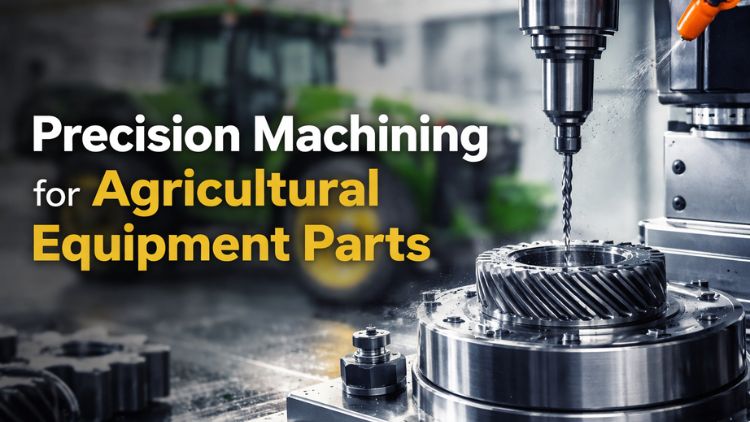
Modern agriculture depends heavily on machines that must perform reliably under tough conditions, dust, moisture, heavy loads, and long working hours. Whether it’s a tractor in the field or a harvester during peak season, even a small component failure can lead to costly downtime, delayed harvests, and revenue loss
This is where precision machining plays a critical role.
Precision machining ensures agricultural machinery parts are manufactured with extremely tight tolerances, improving performance, durability, and reliability, even in harsh operating environments.
In today’s competitive agricultural equipment market, precision is not just about accuracy, it directly impacts machine uptime, lifecycle cost, and operational efficiency.
What is Precision Machining?
Precision machining is a manufacturing process where components are produced with high dimensional accuracy (often within microns) using advanced equipment such as CNC (Computer Numerical Control) machines.
Unlike conventional machining, precision machining focuses on:
- Tight tolerances (often ±0.005 mm or better depending on application)
- Superior surface finish (critical for reducing friction and wear)
- Repeatability across batches (essential for OEM-scale production)
Why Tolerances Matter
In agricultural machinery, even minor dimensional deviations can lead to:
- Misalignment of moving parts
- Increased vibration and noise
- Accelerated wear and tear
Example: A transmission gear in a tractor must mesh perfectly with adjacent gears. A deviation of even a few microns can cause inefficient power transfer, overheating, or premature failure.
Why Precision Matters in Agricultural Machinery
Agricultural equipment operates in high-load, high-friction, and contamination-prone environments. Unlike controlled industrial settings, farm machinery faces unpredictable field conditions daily.
Key Stress Factors:
- Continuous exposure to dust and abrasive particles
- Moisture and chemical exposure (fertilizers, pesticides)
- Heavy torque and cyclic loading
- Long operational hours during peak seasons
Precision machining directly addresses these challenges by improving component integrity.
Key Roles of Precision Machining:
- Ensures accurate fit and alignment between components
- Reduces friction losses and heat generation
- Improves fuel efficiency and energy transfer
- Extends component and equipment lifespan
- Minimizes unscheduled downtime and maintenance costs
Precision-machined components can significantly reduce failure rates and improve overall equipment effectiveness (OEE) in agricultural machinery.
Key Agricultural Parts Manufactured Using Precision Machining
Precision machining is essential for producing high-performance, load-bearing, and motion-critical components.
Common Precision-Machined Parts:
| Component Type | Function | Precision Requirement |
| Gear shafts & gears | Power transmission | High dimensional accuracy & surface finish |
| Hydraulic valves & cylinders | Fluid control systems | Leak-proof tolerances |
| Crankshafts & pistons | Engine performance | High strength & balance |
| Bushings & bearings | Reduce friction | Tight clearance control |
| Couplings & fasteners | Mechanical stability | Consistent threading & fit |
These components must maintain dimensional stability under stress, making precision machining indispensable.
Benefits of Precision Machining for Agricultural Parts Manufacturing
For Manufacturers
Precision machining enables manufacturers to achieve operational efficiency and quality consistency at scale.
- Reduced scrap rates: Accurate machining lowers material wastage
- Process repeatability: Ensures uniformity across large production batches
- Faster turnaround times: CNC automation reduces manual intervention
- Capability for complex geometries: Supports advanced machinery design
- Improved quality control: Easier inspection and validation
For Buyers (OEMs, Exporters, Agri Equipment Companies)
For B2B buyers, precision machining directly influences product reliability and lifecycle cost.
- Higher equipment reliability: fewer breakdowns in the field
- Lower maintenance costs: reduced service intervals
- Improved machine efficiency: better fuel and power utilization
- Longer product lifecycle: enhanced brand reputation
- Supply chain consistency: standardized, interchangeable parts
Precision-machined components can reduce total cost of ownership (TCO) by lowering maintenance frequency and extending equipment life cycles.
Technologies Used in Precision Machining
Modern agricultural parts manufacturing relies on advanced technologies to achieve accuracy and efficiency. The key technologies include the following:
- CNC Machining: CNC machining uses computer-controlled systems to produce highly accurate components with micron-level precision, making it ideal for large-scale production where consistency, repeatability, and tight tolerances are critical.
- Multi-Axis Machining (3, 4, 5-axis): Multi-axis machining allows manufacturers to create complex component geometries in a single setup, reducing repositioning errors, improving accuracy, and enhancing overall production efficiency for intricate agricultural parts.
- CAD/CAM Integration: CAD/CAM integration enables precise digital design and automated machining instructions, allowing manufacturers to simulate production, detect errors early, and ensure high accuracy before actual machining begins.
- Automation & Robotics: Automation and robotics streamline machining operations by minimizing human intervention, reducing errors, and significantly improving production speed, consistency, and efficiency in high-volume agricultural parts manufacturing.
- In-Process Inspection Systems: In-process inspection systems use real-time measurement tools to monitor component dimensions during machining, ensuring quality control at every stage and reducing the risk of defects or post-production rejection.
These technologies allow manufacturers to produce parts that meet strict industry standards and performance requirements.
Materials Used in Agricultural Machinery Parts
Material selection is just as important as machining accuracy.
Common Materials:
- Steel Alloys: High strength and wear resistance
- Cast Iron: Excellent durability and vibration resistance
- Aluminum: Lightweight and corrosion-resistant
- Coated Materials: Enhanced protection against rust and chemicals
Each material is chosen based on:
- Load requirements
- Environmental exposure
- Cost considerations
Challenges in Precision Machining for Agriculture
Despite its advantages, precision machining in agriculture comes with specific challenges:
- Harsh operating conditions: Parts must resist corrosion, dust, and moisture
- Cost vs precision balance: Higher precision can increase manufacturing costs
- Complex geometries: Modern machinery requires intricate components
- High durability expectations: Parts must last through intense usage cycles
Manufacturers must balance cost, precision, and durability to remain competitive.
How to Choose the Right Precision Machining Partner
For B2B buyers, selecting the right manufacturing partner is critical.
Checklist for Evaluation:
- Experience in agricultural component manufacturing
- Availability of advanced CNC and multi-axis machines
- Quality certifications (ISO standards, etc.)
- Ability to handle custom designs and bulk orders
- Strong quality control processes
- Proven track record of on-time delivery
A reliable precision machining manufacturing partner ensures consistent quality, timely delivery, and long-term cost savings.
Future Trends in Precision Machining for Agriculture
The industry is evolving with new technologies and smarter processes.
Emerging Trends:
- Industry 4.0 integration (smart factories and data-driven production)
- IoT-enabled machinery components
- Sustainable machining practices (reduced waste, energy efficiency)
- Advanced coatings for longer part life
These trends are helping manufacturers produce more efficient, durable, and environmentally friendly components.
Conclusion
Precision machining is no longer optional in agricultural machinery parts manufacturing; it has become essential for ensuring performance, durability, and operational efficiency. By maintaining tight tolerances and consistent quality, it enables manufacturers to improve production efficiency, helps buyers reduce maintenance costs and downtime, and ensures farmers can rely on equipment during critical operations. As agricultural demands continue to grow, the importance of precision-engineered components will only become more significant.
FAQs
Precision machining is the process of producing agricultural components with high accuracy and tight tolerances to ensure reliable performance.
It improves durability, reduces wear, and ensures efficient operation of machinery under harsh conditions.
Steel alloys, cast iron, aluminum, and coated materials are commonly used for strength and corrosion resistance.
It minimizes defects, reduces maintenance needs, and extends the lifespan of machinery parts.