
 (+91) 842-700-1426
  agriparts@jcblmail.com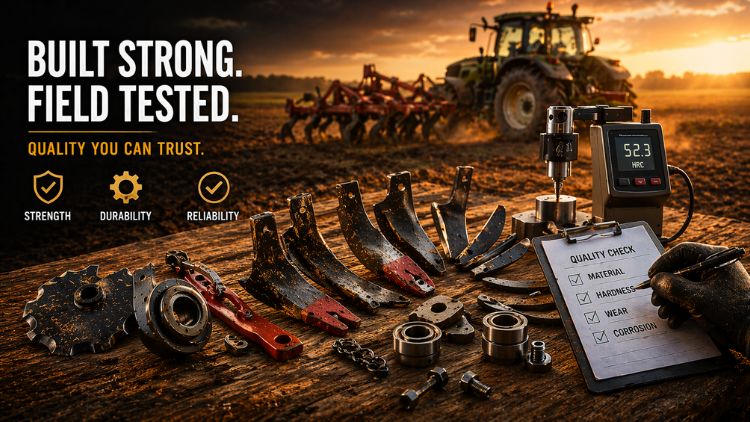
Agricultural machinery components operate under extreme conditions, including constant soil abrasion, heavy loads, vibration, moisture exposure, and long working hours. Unlike controlled industrial environments, farm conditions are unpredictable, making component reliability essential for consistent performance.
Even a single component failure, such as a worn-out rotavator blade, a cracked cultivator tine, or a corroded fastener, can disrupt operations, increase downtime, and lead to significant productivity and financial losses.
Quality testing standards for agricultural machinery components ensure that parts are tested for strength, durability, and performance, helping manufacturers deliver reliable components that perform consistently in real-world field conditions.
What Are Quality Testing Standards for Agricultural Machinery Components?
Quality testing standards are defined frameworks such as ISO, BIS, and ASTM that specify how agricultural machinery components should be tested for mechanical strength, material composition, environmental resistance, and performance reliability using standardized procedures and measurable parameters.
Why are quality testing standards important in agricultural machinery?
Quality testing standards are important because they ensure components can withstand mechanical stress, soil abrasion, and environmental exposure, reducing failure risk and improving reliability, safety, and long-term performance in field conditions. In agricultural applications, failure is often not gradual; it is sudden and operationally disruptive.
Quality testing helps manufacturers and buyers ensure the following:
- Predictable performance under cyclic and impact loads
- Resistance to soil abrasion and environmental degradation
- Consistency across large production batches
- Compliance with OEM specifications and export norms
- Reduction in lifecycle cost due to fewer failures
From a B2B perspective, testing is not just quality control; it is a risk management tool for both manufacturers and buyers.
Key Quality Testing Standards for Agricultural Machinery Components
Understanding how standards apply at a practical level is essential for building credibility.
ISO Standards (System & Safety Level)
- ISO 9001: Ensures process consistency, documentation, and traceability
- ISO 4254: Defines safety requirements for agricultural equipment
- ISO 3767: Standardizes control symbols for usability
ISO standards ensure that quality is built into the process, not just checked at the end.
BIS Standards (Indian Regulatory Framework)
- Defines IS codes for agricultural implements and components
- Specifies minimum safety, material, and performance requirements
Essential for domestic market access and institutional buyers.
ASTM Standards (Testing Methodology Level)
ASTM does not define what to achieve; it defines how to test it.
Examples:
- ASTM E8: Tensile testing of metals
- ASTM E18: Rockwell hardness testing
- ASTM G65: Abrasion resistance testing
These standards ensure repeatability and comparability of test results across manufacturers.
OECD & CE Certifications (Performance & Export Readiness)
- OECD tractor codes validate operational performance
- CE marking ensures compliance with European safety directives
Standards Mapping Table
| Standard | Level | What It Controls | Example Application |
| ISO | System | Quality processes | Manufacturing control |
| BIS | Regulatory | Minimum compliance | Indian market |
| ASTM | Testing | Test methods | Material validation |
| OECD/CE | Performance | Field validation | Export |
What are the main types of testing for agricultural machinery components?
The main types of testing include mechanical testing, abrasion testing, chemical testing, environmental testing, and performance testing, each designed to evaluate strength, wear resistance, material integrity, and real-world functionality.
1. Mechanical Testing (Core Structural Reliability)
Mechanical testing evaluates how a component behaves under physical stress, helping manufacturers ensure that parts can withstand load, pressure, and repeated operational forces without failure.
Key parameters typically evaluated include:
- Tensile strength (MPa)
- Yield strength
- Hardness (HRC/HRB scale)
- Fatigue life (number of cycles)
For example, a cultivator tine experiences continuous bending during field operations. Fatigue testing ensures it can endure thousands of stress cycles without cracking or deforming prematurely.
2. Abrasion & Wear Testing (Critical for Soil-Engaging Parts)
Abrasion and wear testing measure how quickly a material degrades when exposed to friction, which is especially critical for components that directly interact with soil and abrasive particles.
Key measurements include the following:
- Material loss under abrasive conditions
- Surface hardness retention over time
For instance, rotavator blades are tested using standardized abrasion methods to simulate soil contact, helping estimate their wear rate and operational lifespan in real farming environments.
3. Chemical & Metallurgical Testing
Chemical and metallurgical testing ensures that the material composition and internal structure meet required specifications, which directly affect strength, durability, and resistance to environmental damage.
Key parameters evaluated include the following:
- Carbon content and alloy composition
- Microstructure consistency
- Corrosion resistance
These tests are critical because even minor variations in material composition can lead to premature failure, reduced wear resistance, or inconsistent performance across batches.
4. Environmental Testing (Field Condition Simulation)
Environmental testing simulates real-world agricultural conditions to evaluate how components perform under exposure to moisture, temperature changes, dust, and other environmental factors over time.
Key parameters assessed include the following:
- Resistance to humidity and moisture
- Temperature tolerance
- Coating durability and corrosion resistance
This testing is especially important for externally exposed components, where environmental degradation can significantly reduce service life and reliability.
5. Performance Testing (Functional Validation)
Performance testing verifies whether a component performs as intended under actual working conditions, ensuring it delivers consistent results when subjected to operational loads and stress.
Key parameters evaluated include the following:
- Load-bearing capacity
- Operational efficiency
- Deformation under stress
This type of testing connects laboratory validation with real-world application, ensuring that components meet both design expectations and practical performance requirements.
Quality Testing Overview
| Test Type | Key Parameter | Why It Matters |
| Mechanical | Strength & fatigue | Prevents breakage |
| Abrasion | Wear resistance | Extends life of blades |
| Chemical | Material composition | Ensures consistency |
| Environmental | Corrosion resistance | Prevents degradation |
| Performance | Load handling | Ensures functionality |
Material-Based Testing Requirements for Key Components
Material-based testing ensures that each agricultural machinery component is evaluated according to its material properties and real-world application. Different materials, such as steel, rubber, and coated surfaces, require specific testing methods to ensure durability, strength, and resistance to field conditions.
Steel Components (Blades, Tines, Discs, Shafts)
Steel components are widely used in agricultural machinery because they handle heavy loads, repeated stress, and continuous soil contact. Their performance depends not only on material grade but also on proper heat treatment and processing.
To ensure reliability, testing focuses on achieving the right balance between hardness and toughness, as overly hard components may crack while softer ones wear out quickly.
Key parameters tested:
- Hardness (typically 40–55 HRC depending on application)
- Tensile and yield strength
- Heat treatment consistency
Incorrect heat treatment is a common failure point, leading to brittle fractures or excessive wear, especially in high-load or high-friction applications.
In many real-world cases, improper hardness levels in blades and tines lead to faster wear or sudden breakage. Components that are too hard may crack under impact, while softer ones wear out quickly in abrasive soil conditions.
Soil-Engaging Components (High Wear Zone)
Soil-engaging components operate in direct contact with soil, making them highly susceptible to abrasion, impact, and continuous friction. Their durability directly affects field efficiency and maintenance frequency.
These include rotavator blades, plough shares, and disc harrow discs, which require enhanced wear resistance to maintain performance over time.
Key parameters tested:
- Abrasion resistance under simulated soil conditions
- Impact strength for shock loads
- Edge retention for cutting efficiency
Since these components face constant wear, improved testing can significantly extend service life and reduce replacement costs.
Rubber & Polymer Components
Rubber and polymer components are used in seals, bushes, and flexible connections where elasticity and environmental resistance are essential for proper functioning.
These materials must maintain flexibility under varying temperatures and resist cracking or deformation over time.
Key parameters tested:
- Elastic recovery and compression set
- Crack resistance under repeated stress
- UV and temperature stability
Proper testing ensures long-term sealing performance and prevents failures caused by material hardening or degradation.
Coatings & Surface Treatments
Coatings and surface treatments protect components from corrosion and environmental damage, especially in agricultural conditions where exposure to moisture and chemicals is common.
Testing ensures that coatings provide consistent protection and remain intact throughout the component’s lifecycle.
Key parameters tested:
- Corrosion resistance (salt spray testing)
- Coating adhesion strength
- Coating thickness and uniformity
Poor coating quality can lead to early corrosion, reducing component strength and overall lifespan.
Material-Based Testing Overview
| Material Type | Primary Risk | Key Testing Focus |
| Steel | Wear & breakage | Hardness, strength, heat treatment |
| Soil-engaging parts | Abrasion | Wear resistance, impact strength |
| Rubber/Polymer | Cracking & deformation | Elasticity, UV resistance |
| Coatings | Corrosion | Adhesion, thickness, salt spray |
Step-by-Step Quality Testing & Certification Process
A structured quality testing and certification process ensures that agricultural machinery components consistently meet required standards, perform reliably in field conditions, and comply with OEM and export requirements. Learn more about selecting the right components in our agricultural machinery replacement parts guide.
1. Identify Applicable Standards
The first step is to determine which standards apply based on the product type and target market. This may include ISO for quality systems, BIS for domestic compliance, and ASTM for testing methods.
2. Define Measurable Testing Parameters
Once standards are identified, specific parameters such as strength, hardness, wear rate, and corrosion resistance are defined based on the component’s function and operating conditions.
3. Conduct In-Process Quality Checks
Quality control begins during manufacturing, not after. In-process checks help detect defects early, ensuring consistency in material properties, dimensions, and heat treatment before final testing.
4. Perform Laboratory Testing
Components are then tested using standardized methods (such as ASTM or ISO procedures) to evaluate mechanical strength, material composition, and performance under controlled conditions.
5. Validate Through Third-Party Testing
Independent testing by accredited laboratories adds credibility and ensures that results are unbiased, which is often a requirement for OEM approvals and export certifications.
6. Maintain Documentation & Traceability
All test results, material certifications, and process records are documented and linked to specific production batches to ensure full traceability and compliance during audits.
7. Conduct Periodic Audits & Re-Validation
Quality testing is an ongoing process. Regular audits and re-testing ensure that standards are consistently maintained across batches and over time.
Why this process matters: Strong documentation and traceability are critical in B2B markets, as many OEMs require detailed test records for every batch before approving suppliers.
Why Testing Often Fails in Practice
Many failures in agricultural components are not due to lack of testing but due to the following:
- Inconsistent raw material quality
- Improper heat treatment processes
- Lack of batch-level traceability
This is why leading manufacturers focus not only on testing but also on process control and supplier quality management.
Common Challenges in Agricultural Component Testing
- High cost of advanced testing equipment
- Limited access to certified labs in some regions
- Variability in soil conditions affecting real-world performance
- Differences in international compliance requirements
Best Practices for Ensuring Quality Compliance
- Implement process-driven quality systems (ISO 9001)
- Standardize testing procedures across batches
- Use calibrated and certified equipment
- Maintain supplier quality control
- Conduct real-field performance validation along with lab testing
B2B Buyer Checklist
Before approving a supplier, buyers typically verify:
Material grade and certification
Mechanical and wear testing reports
Compliance with ISO/BIS/ASTM standards
Consistency across production batches
How Quality Testing Impacts Real-World Farm Performance
Quality testing standards directly influence how agricultural machinery performs in the field. Components that are properly tested for wear resistance and strength tend to last longer, reducing the frequency of replacements during critical farming operations.
In real-world conditions, better-tested components lead to fewer breakdowns, improved operational efficiency, and lower maintenance costs. For farmers and operators, this translates into higher productivity and more predictable equipment performance over time.
Conclusion
Quality testing standards for agricultural machinery components are essential to ensure durability, safety, and consistent performance in real field conditions. They help verify that components can withstand stress, wear, and environmental exposure.
For manufacturers and suppliers, following standardized testing improves product reliability, reduces failures, and builds trust with OEMs and buyers. It also ensures compliance with global quality requirements and supports long-term business growth.
In today’s competitive agricultural market, quality-tested components are not optional, they are a basic requirement for reliability and market acceptance.
FAQs
They are structured guidelines that define how components are tested for strength, durability, and performance using standardized methods like ISO, BIS, and ASTM.
Abrasion and hardness testing are most critical as these components face continuous soil friction.
It ensures components can withstand repeated stress cycles without failure.
They check testing reports, certifications, material quality, and consistency across batches.
Yes, most global markets require compliance with ISO and other recognized standards.